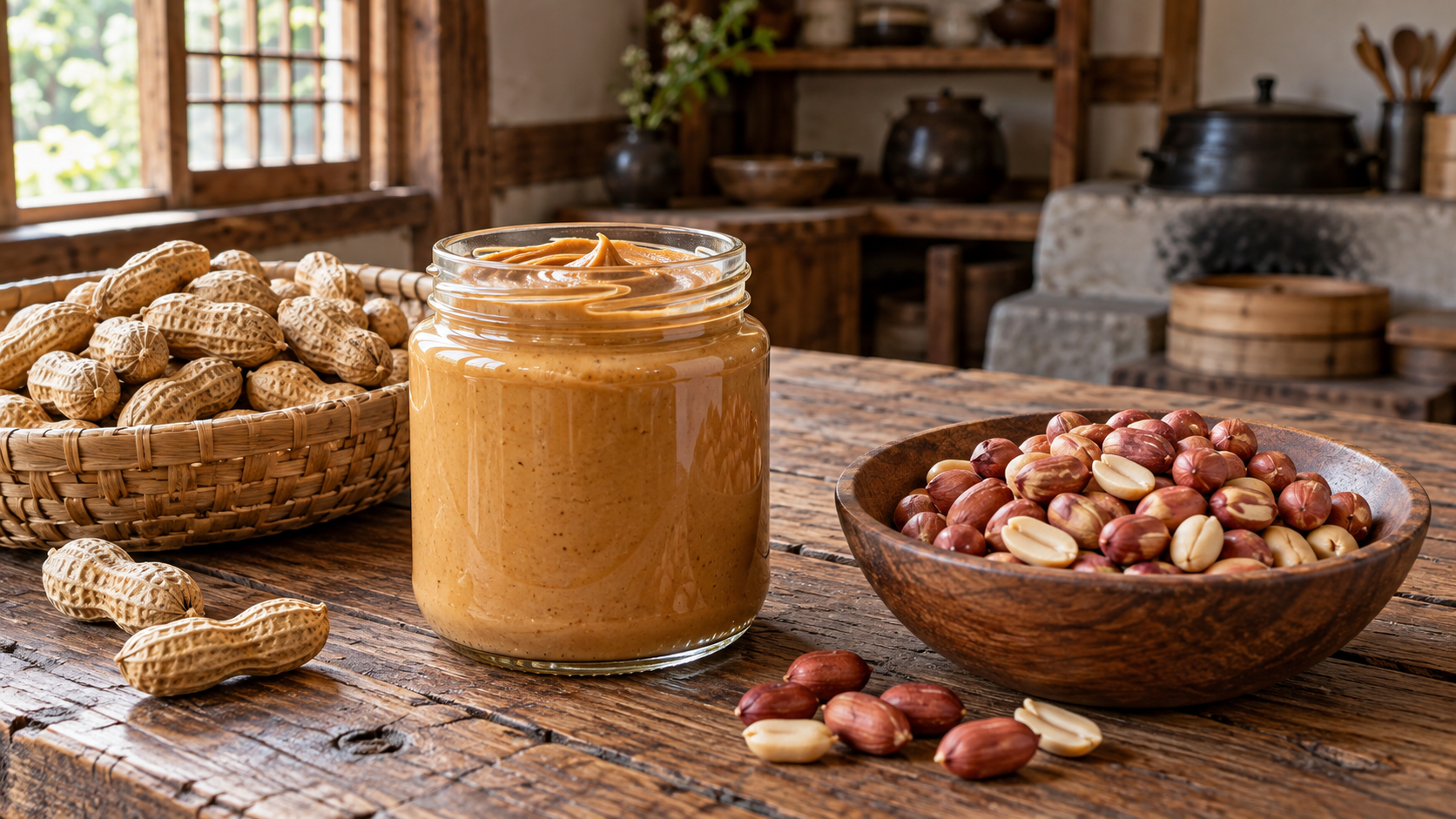
How much unsweetened peanut butter 1 kg of Korean peanuts makes and what it costs: KAMIS wholesale prices on October 20, 2026, retail prices and origin labels of domestic and imported 100% peanut butter on October 21, the roast-and-grind steps, an RDA storage trial, peanut storage rules and what growers should put on butter-grade packs.
Most “100% peanut butter” on Korean shelves is made from imported peanuts. The ingredient line says peanuts 100%, but the origin line often reads Argentina or simply “foreign”. Peanut butter made from Korean peanuts exists, but it costs two to three times as much by weight. So when the new crop arrives in October, people ask whether making it at home is cheaper. Here are the numbers.
Bottom line: 1 kg of shelled Korean peanuts, roasted and ground, makes roughly 900 g of unsweetened peanut butter. On October 20, 2026, domestic peanuts (top grade, 30 kg) averaged KRW 496,500 at wholesale in Seoul, Busan, Daegu and Daejeon, about KRW 16,550 per kilogram. At retail prices for shelled peanuts (KRW 16,000–23,000 per kg), 500 g of homemade butter costs about KRW 9,000–13,000. On October 21, Korean-peanut butters sold for KRW 30,000–50,000+ per 500 g, and imported 100% products for around KRW 15,000.
Earlier notes: new-crop prices and boiling in raw peanut price and boiling 2026, harvest-season prices in peanut price 2026, lifting and drying in peanut harvest timing 2026. Daily prices: peanut price.
Try the numbers: what you keep after selling in each city is in the produce market calculator.
1. What do Korean peanuts cost now?
KAMIS surveys domestic peanuts in 30 kg units at the wholesaler level. Prices on October 20, 2026 (Gwangju has had no survey since October 1 and is left out):
| City | 30 kg | Per kg |
|---|---|---|
| Seoul | KRW 486,000 | KRW 16,200 |
| Busan | KRW 510,000 | KRW 17,000 |
| Daegu | KRW 540,000 | KRW 18,000 |
| Daejeon | KRW 450,000 | KRW 15,000 |
| Average | KRW 496,500 | about KRW 16,550 |
Seoul is about 10% below the same day a year earlier (KRW 543,000 on October 20, 2025), and all four cities have held the same price since mid-September. Retail is higher once packing and delivery are added: shelled raw peanuts sold online for KRW 16,000–23,000 per kg on October 10.
2. How much butter does 1 kg make?
Unsweetened peanut butter is just ground roasted peanuts, so the roasted weight becomes the butter weight. Losses come from water driven off in roasting, the papery skins and what sticks to the blender.
We could not find raw and roasted peanuts side by side in the Korean food composition table, so we used USDA data: water is 6.5 g per 100 g raw and 1.81 g dry-roasted. If only water is lost, 1 kg raw becomes about 952 g roasted (935 g of solids ÷ 0.9819).
We found no official figure for the skins. Allowing a generous 5% for skins and blender losses gives about 900 g, a little under two 500 g jars. Grinding with skins on gives a higher yield and a darker colour.
3. Buy or make: price comparison
Products checked on October 21, 2026, limited to 100% peanut items whose origin could be confirmed. Prices are before coupons and change daily.
| Product | Origin label | Size | Price | Per 500 g |
|---|---|---|---|---|
| Kongkongdang (Coupang) | 2026 Korean peanuts 100% | 500 g | KRW 29,700 | KRW 29,700 |
| Okgok (Kurly) | Korean roasted peanuts | 200 g | KRW 15,400 | KRW 38,500 |
| Love and Peanut (Oasis) | Korean peanuts 100% | 110 g | KRW 12,900 | KRW 58,640 |
| Daywell crunchy (Oasis) | Foreign 100% | 230 g | KRW 6,900 | KRW 15,000 |
| Yasti crunchy (11st) | Argentina | 900 g | KRW 27,900 | KRW 15,500 |
Homemade cost for 500 g, assuming 900 g of butter per kg of peanuts:
| Peanut price basis | Per kg | 500 g of butter |
|---|---|---|
| KAMIS wholesale average | about KRW 16,550 | about KRW 9,190 |
| Online shelled raw peanuts (Oct 10) | KRW 16,700–22,720 | about KRW 9,280–12,620 |
Electricity is negligible: a 200 W blender running 10 minutes uses 0.033 kWh, around KRW 10. Homemade Korean peanut butter costs one third to one half of the shop-bought Korean product, but it is still dearer than imported 100% butter because Korean peanuts themselves are expensive.
4. Four steps
We found no RDA or Nongsaro recipe with set roasting temperatures or grinding times, so here are the steps and checks only.
- Pick out mouldy kernels first. The food safety ministry says not to eat anything with suspected mould; the toxins survive cooking.
- Roast evenly over low heat, stirring often, until a split kernel is light brown inside.
- Cool and rub off the skins in a dry cloth.
- Grind in small batches. It turns to powder, then a ball, then releases oil and goes smooth. Follow the blender’s continuous-use limit and let the motor rest.
Add salt or honey only at the end, to taste. No extra oil is needed.
5. Storage reduces oil separation and rancidity
In a trial published in March 2025, the Rural Development Administration kept butter from the Korean varieties Daan and Sinpalgwang at 4°C, 25°C and 40°C for 8 weeks. Refrigerated butter had 89% of the peroxide value of room-temperature butter (71% of the 40°C sample) and only 25% of the oil separation (17% at 40°C). RDA advises an airtight container in the fridge, taking out only what you need. After 12 weeks at 25°C, butter from the high-oleic varieties Haeol and K-ol 2 had 31% of the peroxide value of ordinary varieties. Seven high-oleic varieties have been released, from K-ol (2013) to Chamol (2023).
We found no official shelf life for homemade peanut butter, so make only what you will eat within about a month and discard it if the smell changes. Store leftover peanuts at 10–15°C and below 60% humidity, in the shell if possible.
6. For growers: selling butter-grade peanuts
Korea grew 8.2 thousand tonnes of peanuts on 3.4 thousand hectares in 2024, against consumption of 42.9 thousand tonnes; imports were 34.7 thousand tonnes and self-sufficiency 19.1%. That leaves room to sell shelled peanuts directly to people who want to make butter from Korean peanuts.
| Task | Standard | Source |
|---|---|---|
| Drying | Dry thoroughly to about 7–8% moisture | Nongsaro |
| Regional guide | 7 days on the vine, then pods to 10% or below | Jeju Agri. Tech. Center |
| Ambient storage | about 10% moisture, humidity 65% or below | Nongsaro Q&A (2018) |
| Cool storage | 10–15°C, 6.5–8.5% moisture, 56–69% humidity | Nongsaro Q&A (2018) |
Label origin and harvest year, offer 1 kg and 500 g shelled packs (1 kg makes about 900 g of butter), and name the variety if you grow a high-oleic one.
7. Checklist
- 1 kg shelled Korean peanuts → about 900 g of butter (calculated).
- KAMIS domestic peanuts on Oct 20: about KRW 16,550 per kg.
- Homemade 500 g: about KRW 9,000–13,000; Korean retail KRW 30,000–50,000+; imported 100% about KRW 15,000.
- Discard mouldy kernels; keep the butter airtight in the fridge.
8. Conclusion
Peanut butter from Korean peanuts is expensive to buy and roughly half the price to make. It will not beat imported butter on price; it is the cost of choosing Korean peanuts.
References
- aT KAMIS wholesaler prices: domestic peanuts, top grade, 30 kg, Seoul, Busan, Daegu, Daejeon, October 20, 2026 (data.go.kr API).
- RDA press release on peanut butter freshness by storage and variety, March 13, 2025: korea.kr
- Ministry of Food and Drug Safety webzine, July 2025: mfds.go.kr
- USDA FoodData Central: raw peanuts, dry-roasted peanuts
- Ministry of Agriculture, Food and Rural Affairs, Major Statistics 2025: mafra.go.kr
- Nongsaro peanut work schedule: nongsaro.go.kr
- Nongsaro Q&A on peanut storage (2018): nongsaro.go.kr
- Retail prices: Coupang, Kurly, Oasis and 11st product pages, checked October 21, 2026.