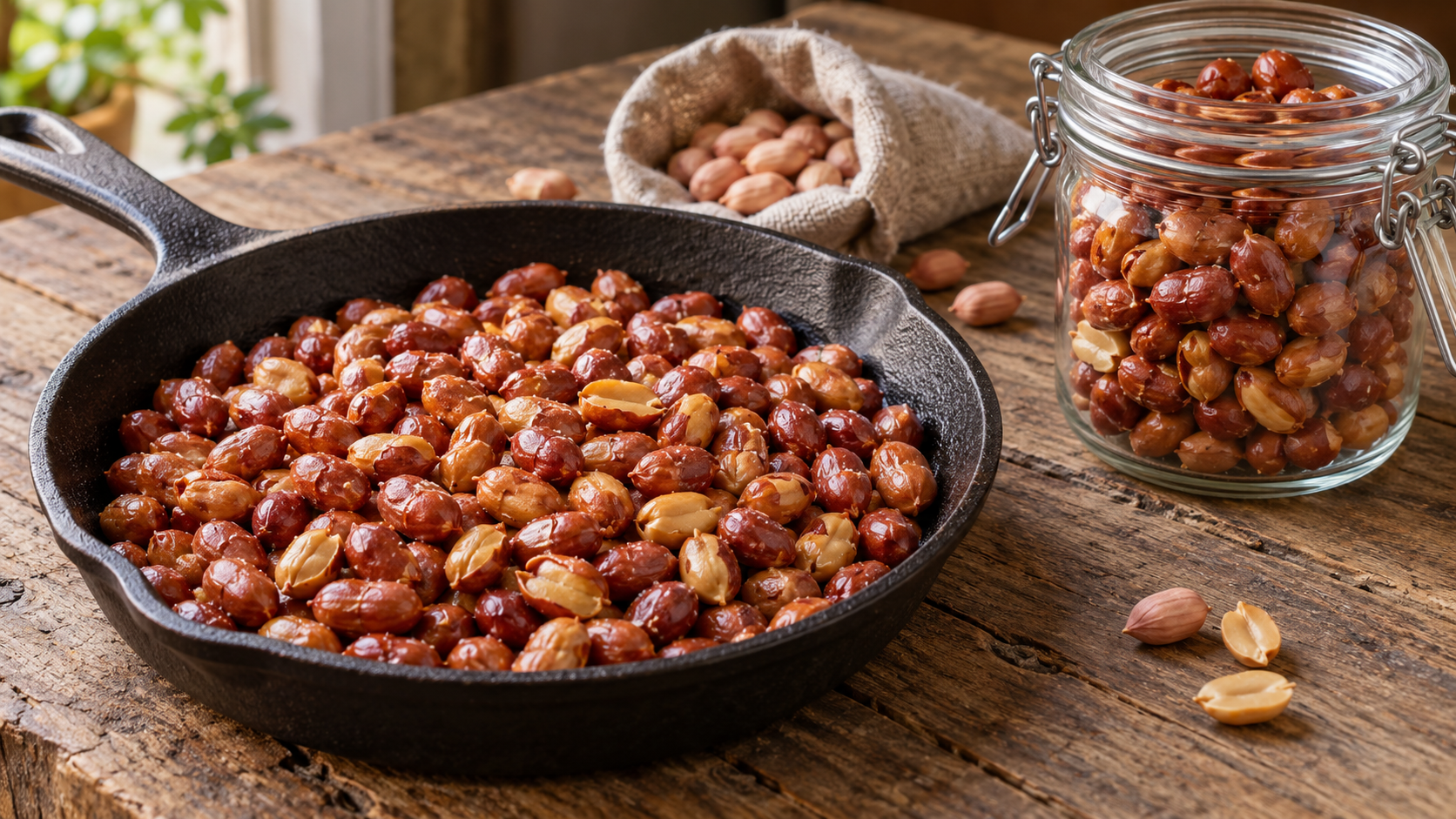
How to roast fresh Korean peanuts in a pan, oven or air fryer and tell when they are done, how much weight 1kg of raw kernels loses, MFDS storage rules to avoid aflatoxin, KAMIS domestic peanut wholesale prices on October 30, 2026 converted to per-kg values, and whether growers should sell raw or roasted.
After the first few days of boiling new-crop peanuts, most households want to roast the rest. Pan-roasting too hot burns the skins while the center stays raw, and roasted peanuts kept too long turn rancid.
Bottom line: Roast peanuts low and slow, stir often, and stop when a split kernel is light brown inside. Keep raw peanuts in the shell somewhere cool and dry (MFDS guidance: 10–15°C, humidity 60% or below). Keep roasted peanuts in small airtight jars in the fridge or freezer. On October 30, 2026, KAMIS put domestic top-grade peanuts at KRW 450,000–540,000 per 30kg, or KRW 15,000–18,000 per kg. The four-city average was about 11% lower than a year earlier.
Earlier records: peanut prices, harvest timing, boiling raw peanuts and homemade peanut butter.
1. How to roast
We found no official roasting temperature or time from the Rural Development Administration, so the times below are starting points only.
| Method | Steps | Starting point |
|---|---|---|
| Frying pan | Single layer, no oil, low heat, stir constantly | Kernels about 15–20 minutes |
| Oven | Single layer, stir once or twice | 160–170°C, 15–20 minutes |
| Air fryer | Don’t overfill, shake every 5 minutes | Around 160°C, 10–15 minutes |
| In-shell | Same methods | Longer than kernels |
Judge by sound (dry rattling, a few pops), smell (the raw bean smell disappears), and color (split one kernel; light brown inside means done). Peanuts keep cooking from residual heat, so stop slightly early, spread them on a tray and cool completely before storing.
2. Weight after roasting
USDA lists 6.5g of water per 100g for raw peanuts and 1.81g for dry-roasted. If only water is lost, 1kg of raw kernels becomes about 952g after roasting. Removing the skins takes a little more.
3. Prices, October 30, 2026 (30kg, top grade)
| City | 30kg | Per kg | A year earlier | Change |
|---|---|---|---|---|
| Daejeon | 450,000 | 15,000 | 600,000 | –25.0% |
| Seoul | 486,000 | 16,200 | 543,000 | –10.5% |
| Busan | 510,000 | 17,000 | 490,000 | +4.1% |
| Daegu | 540,000 | 18,000 | 600,000 | –10.0% |
The four-city average is KRW 496,500, about KRW 16,550 per kg, 11.1% below KRW 558,250 a year earlier. Daily prices: /prices/peanut/.
4. Storage and aflatoxin
Some molds on peanuts produce aflatoxin, a Group 1 carcinogen. MFDS notes that mycotoxins survive normal cooking, so roasting does not make moldy peanuts safe. Store raw peanuts in the shell, cool and dry; split shelled kernels into small sealed portions in the fridge; roast only what you will eat within a week or two. Discard moldy, blackened, broken or insect-damaged kernels.
5. For growers: raw or roasted
Roasted peanuts sell for more per gram but lose weight, need packaging and labeling, and go rancid faster. Selling roasted product may count as food processing, so check permit and labeling rules with the local county office first. Raw peanuts store well at about 10% moisture and humidity below 65% (Nongsaro Q&A, 2018).
References
- aT KAMIS mid-wholesale prices, domestic peanuts top grade 30kg, October 30, 2025 and October 30, 2026.
- MFDS webzine on storing grains and nuts to prevent mycotoxins, July 2025: mfds.go.kr
- USDA FoodData Central: raw, dry-roasted
- Nongsaro farming Q&A on peanut storage moisture and humidity (2018).
- Roasting times are starting points, not official standards.