A practical farmland solar sale guide covering grid capacity, utility poles, access roads, drainage, permitting, and contract conditions before selling or leasing land for solar.
When a solar farm appears at the entrance of a village, nearby landowners start asking the same question. If solar already works over there, can my farmland also sell for solar. The answer is sometimes yes, but never automatically.
A nearby solar farm is only a signal. It may mean the area has sunlight, road access, developer interest, and some permitting history. It does not prove that your parcel has grid room, a usable utility pole, a legal access road, or acceptable local permitting conditions. For solar land, sunlight matters, but the exit path for electricity matters just as much.
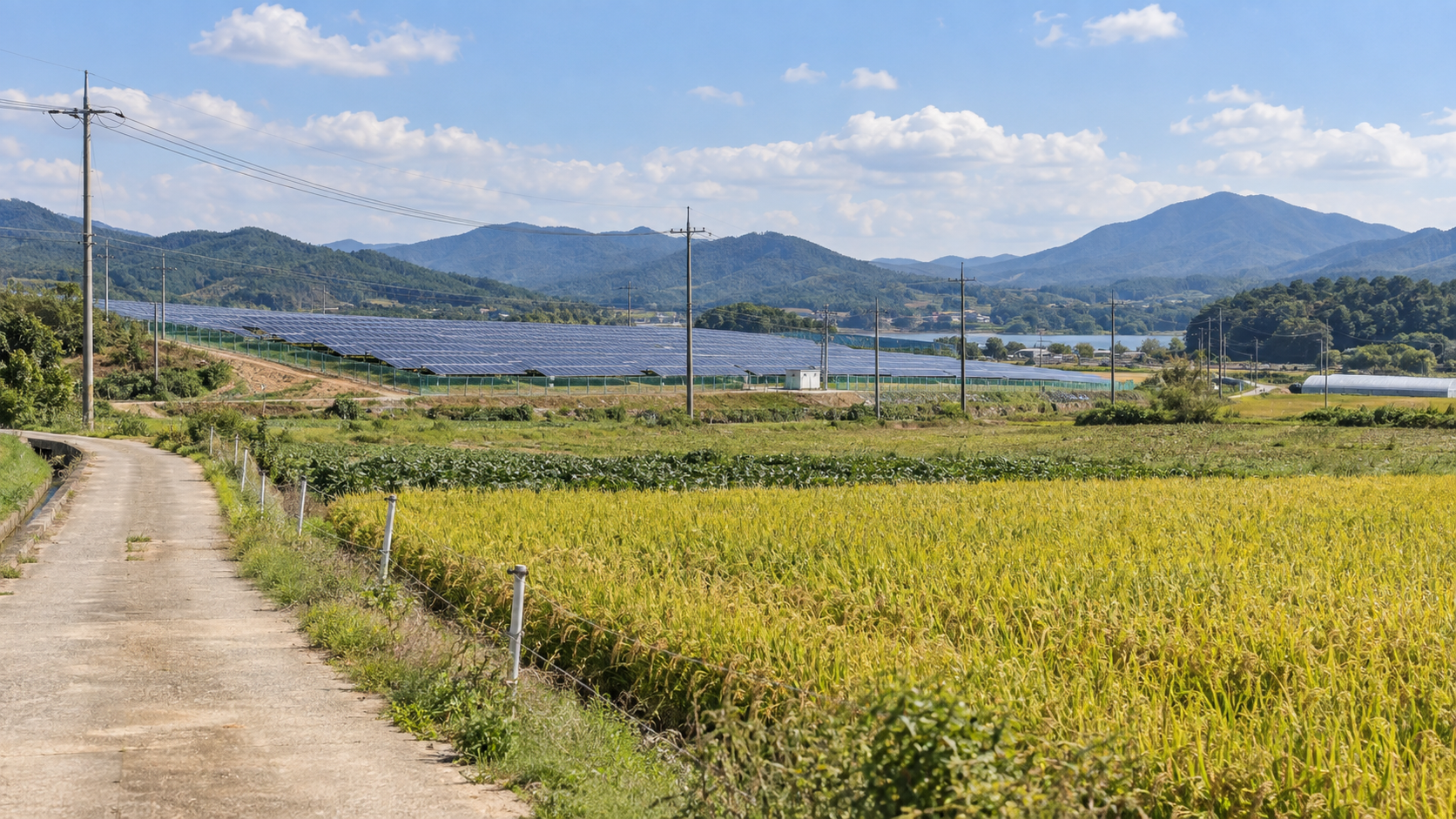
Short answer: check your parcel separately
Existing solar nearby can help market interest. It does not make every neighboring parcel developable. A solar developer looks at the exact lot, not only the village.
| Item | Why it matters |
|---|---|
| Distribution grid capacity | Determines whether the project can export power |
| Utility pole and transformer distance | Affects interconnection cost and schedule |
| Access road | Affects construction, maintenance, and permitting |
| Farmland regulation and setbacks | Affects local development approval and complaints |
Developers will look for poles, line direction, road width, drainage, nearby houses, and land shape. A parcel that looks good on a map can fail in the field.
Nearby solar is both a good and bad sign
The good side is simple. If solar already exists nearby, the area may have been reviewed before. Developers may already understand the local permitting attitude, sunlight conditions, and construction access. That can make your land easier to screen.
The bad side is grid saturation. The earlier solar projects may have used the available feeder capacity. If the distribution line is full, later projects may face waiting periods or reinforcement costs. Areas with many solar farms can also face stronger local resistance or stricter distance rules.
Nearby solar is useful evidence, not a guarantee. Your land still needs its own review.
Grid connection drives land value
One of the largest variables in a solar land sale or lease is grid connection. Solar panels can produce power, but the project fails if that power cannot be sent to the utility grid. That is why developers often check grid capacity before paying serious money for land.
KEPCO’s online distribution-grid capacity tools can help screen transformers, distribution feeders, reinforcement status, and distributed-generation applications. The key warning is that an online query is not a final approval. Actual connection still requires application, technical review, design, cost calculation, construction, and contract steps.
Be careful when:
- The area already has many solar farms.
- The feeder capacity is close to zero.
- The substation or main transformer also lacks room.
- A pole is nearby but the phase or capacity is unsuitable.
- Reinforcement work is required.
Grid shortage can take time. In some cases, transformer or feeder limits can push a project back by more than a year. Substation-level limits can be longer. That risk should be reflected in the land contract.
A nearby utility pole is not enough
A nearby pole is helpful. It is not the whole answer. A pole may be single-phase, undersized, connected in an unsuitable direction, or located across another owner’s land.
Check these points:
| Item | What to check |
|---|---|
| Pole distance | Distance from planned inverter and interconnection point |
| Power type | Whether the line can support the planned capacity |
| Transformer | Size and remaining capacity |
| Line route | Whether a practical route exists to your parcel |
| Third-party land | Whether consent is needed for line or construction access |
A pole is a starting clue, not a conclusion. The final answer comes from grid review and design.
Access road can make or break the deal
A solar site needs construction access. Piles, frames, modules, inverters, electrical equipment, and fencing must enter the site. After construction, maintenance vehicles still need access.
The problem is that the cadastral road and the actual road can differ. A road may exist on paper but be too narrow for trucks. A farm road may cross private land. A route may work in summer but fail during the rainy season.
Check:
- Whether the legal road and actual road match.
- Whether road width supports construction vehicles.
- Whether private-land consent is needed.
- Whether a waterway, ditch, or drainage channel must be crossed.
- Whether access remains usable in rain or winter.
Weak access gives buyers a reason to discount the land. For a lease, it becomes a cost-sharing issue.
Permitting and complaints still matter
Even with grid room, the project can fail on farmland regulation or local approval. Check whether the parcel is in an agricultural promotion area, whether conversion or temporary-use approval is needed, and whether local setback rules apply. Nearby houses, roads, streams, hills, drainage, and complaints can all matter.
General solar and agrivoltaics should also be separated. General solar usually raises farmland conversion and development-permit issues. Agrivoltaics keeps farming in the structure and depends on temporary-use rules, crop-maintenance duties, and follow-up management. A headline saying that a law has passed is not enough. Local details still decide the project.
Landowners should ask the local farmland and development-permit offices before signing a vague promise. One early phone call can prevent months of argument later.
Sale, lease, or conditional contract
Solar land deals often appear as a sale, a long-term lease, or a conditional agreement. Each has different risk.
| Structure | Advantage | Risk |
|---|---|---|
| Sale | Immediate cash | Price, closing conditions, failed approval |
| Long-term lease | Keeps ownership | Term, rent, restoration, security deposit |
| Conditional development deal | Waits for approval | Deposit, cancellation, time limits |
If grid and permitting are uncertain, conditional contracts are common. The contract should state what happens if approval fails, grid cost becomes excessive, road access is not secured, or reinforcement takes too long. Verbal promises are too weak for this type of land.
Contract checklist for landowners
Before selling or leasing farmland for solar, put the uncertain parts into writing.
- Who checks grid connection and who pays for the review.
- What happens if interconnection is not possible.
- Who pays for utility pole, transformer, feeder, or line reinforcement work.
- Who secures access road and third-party consent.
- Which permitting route is being used: farmland conversion, development permit, or temporary-use approval.
- When the deposit, interim payment, and final payment are made.
- For leases, who pays for removal and restoration at the end.
Solar land is not an ordinary farmland transaction. The land price depends on electricity, roads, and paperwork.
Conclusion
If solar already exists nearby, your farmland may attract interest. It may also face a saturated grid, tighter local review, or road and access limits. Do not assume the land will sell just because panels are visible from the road.
Ask one better question first: where will the electricity go. Then check poles, grid capacity, access, drainage, permitting, and contract conditions. In solar land deals, sunlight is only the beginning. The project needs a way out.
References
- KEPCO ON, distribution-grid capacity query: official screening flow for transformers, distribution feeders, reinforcement status, and distributed-generation applications.
- Korea Energy Agency Renewable Energy Cloud Platform, grid connection capacity check: guidance that solar projects should check three-phase poles and available capacity before development.
- KDI Economic Information and Education Center / MOTIE policy release on expanded solar grid connection criteria: background showing grid connection as a national solar bottleneck.
- IMUN.FARM, “How to Check KEPCO Grid Connection Capacity”: framing that online lookup is an early risk screen, not final connection approval.