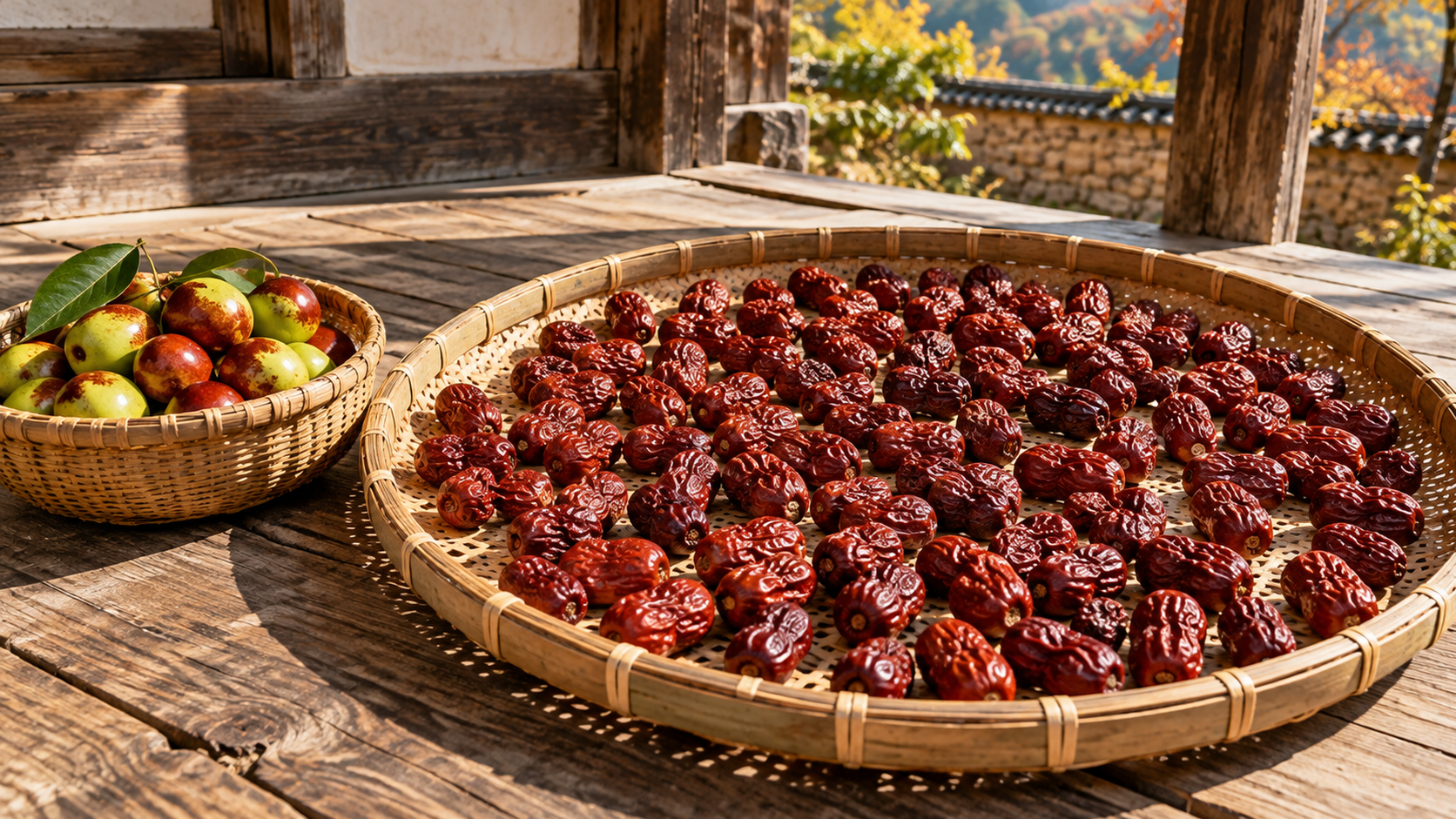
Korean dried jujube retail prices per kg by grade (August 2026, forestry co-op data), Boeun festival fresh jujube prices, how to store fresh jujubes, how to dry them at 50°C with a 35–40% yield, harvest timing, and whether growers should sell fresh or dried.
By mid-October, fresh jujubes arrive in Korean homes by the box. They are crisp and sweet for a few days, then they wrinkle and turn brown. That raises the usual question: dry them yourself, or just buy dried jujubes for samgyetang and jujube tea all year? What does a kilogram of dried jujubes cost, and how long do fresh ones really keep?
Bottom line: In August 2026, domestic dried jujubes retailed at KRW 17,313 per kg for the common teukcho (upper) grade, KRW 21,707 for byeolcho (top) and KRW 14,892 for sangcho (middle). That is 1–3% below a year earlier and close to a normal year. Fresh jujubes rarely last beyond a month even in ordinary cold storage, so dry whatever you cannot eat soon. In Korea Forest Service trials, 50°C gave the best dried quality, and 1 kg of fresh jujubes dried down to 350–400 g.
Earlier notes: this follows yesterday’s chestnut storage and price guide. For home drying equipment, see how to choose a food dehydrator or pepper dryer.
1. Dried jujube price 2026: what does 1 kg cost?
Jujubes are not in the KAMIS price tables. The National Forestry Cooperative Federation surveys retail prices instead, and the Korea Rural Economic Institute (KREI) summarizes them monthly in its jujube outlook. The September 4, 2026 issue reported these retail prices for domestic dried jujubes per kg:
| Grade (trade name) | Aug 2026 | Aug 2025 | Normal Aug | 2025 crop avg (Oct–Aug) |
|---|---|---|---|---|
| Top (byeolcho) | 21,707 | 22,343 | 21,403 | 22,255 |
| Upper (teukcho) | 17,313 | 17,649 | 17,186 | 18,100 |
| Middle (sangcho) | 14,892 | 15,129 | 14,200 | 15,244 |
Prices in KRW. The teukcho grade was 1.9% below a year earlier and 0.7% above a normal year. KREI expected September prices to stay flat or dip slightly because a lot of the 2025 crop remains in storage.
On October 18, a Coupang Partners product search showed Gyeongsan sangcho dried jujubes at KRW 17,100 per kg and imported “wang-byeolcho” jujubes at KRW 16,900 per kg. Large imported fruit and small domestic fruit can cost the same, so check the country of origin first. Imports have fallen, though: 146 tonnes of dried jujubes came in between October 2025 and August 2026, 51.4% less than a year earlier.
What do byeolcho, teukcho and sangcho mean?
They are size names. KREI’s price tables match byeolcho to the top grade, teukcho to upper and sangcho to middle. I found no official millimetre definition for the trade names themselves. The forestry co-op shipping standard does define size classes:
| Size class | Fruit per 100 g | Diameter |
|---|---|---|
| Extra-extra | fewer than 15 | 30 mm or more |
| Extra large | 15–25 | 28–29 mm |
| Large | 26–35 | 26–27 mm |
| Medium | 36–55 | 24–25 mm |
| Small | 56 or more | under 24 mm |
Every grade must be 20% moisture or less. For buyers, the useful number is how many fruit make 100 g. Small jujubes are fine for sliced uses like tea or yakbap. Large ones look better whole in samgyetang or as gifts.
2. Fresh jujube prices at the Boeun festival.
Fresh jujube prices are set by direct sales in producing areas. The 2026 Boeun Jujube Festival runs October 16–25 at Baetdeul Park and along the Bocheongcheon stream in Boeun. The county kept last year’s fresh prices:
| Diameter | 2026 Boeun fresh price |
|---|---|
| 36 mm | KRW 40,000 |
| 34 mm | KRW 35,000 |
| 32 mm | KRW 30,000 |
| 30 mm | KRW 25,000 |
| 28 mm | KRW 20,000 |
| 26 mm | KRW 15,000 |
| 24 mm | KRW 12,000 |
Gukje News (October 16) reported that Chungbuk NongHyup’s live-commerce sale offered 28 mm fruit at KRW 20,000 per kg and 30 mm at KRW 25,000 per kg, shipping included. The 32 mm and larger tiers are new this year. Boeun sells 60% of its crop fresh, and its order line takes calls through October 30.
By the co-op standard, one 28–29 mm fresh jujube weighs 15–17 g, so a kilogram of 28 mm fruit is roughly 60–65 jujubes.
3. Storing fresh jujubes: a month is hard.
Jujubes keep respiring after harvest and age quickly as they give off carbon dioxide. In storage trials by the Chungbuk Agricultural Research and Extension Services jujube institute, ordinary cold storage struggled to keep fruit fresh beyond a month. Controlled-atmosphere storage kept it fresh for more than 90 days, but that is not a home option.
The only official condition I could confirm is humidity: keep it at 90% or higher. Wrinkling is drying. At home:
- On the day they arrive, pick out bruised, soft or insect-damaged fruit. Eat or dry those first.
- Put the rest, unwashed, in a plastic bag or lidded container in the fridge so they do not dry out.
- Wash only what you are about to eat.
- Anything you cannot finish in two or three weeks, dry from the start.
I could not confirm an official fridge temperature or how long frozen jujubes keep, so this post does not give those numbers. Drying is the confirmed way to keep them long term.
4. How to dry jujubes: 50°C worked best.
The Korea Forest Service jujube cultivation guide includes drying trials from 1979–1980. They are old, but they are still the figures the agency publishes.
| Method | Days (1979 / 1980) |
|---|---|
| Hot air at 50°C | 2.6 / 3.0 |
| 3 days of sun, then 50°C | 4.8 / 5.7 |
| Inside a vinyl greenhouse | 14.7 / 22.4 |
| Sun only | 18.6 / 23.0 |
At 70°C drying took 1.5 days, but the fruit turned dark red and wrinkled poorly (quality score 40.2). At 50°C it took 2.6 days and scored best (75.4). At 30°C it took almost 30 days. Sun-only drying over 20 days also let many fruit rot.
The agency recommends about three days of sun followed by about two days at 50°C in good weather, or about three days at 50°C straight away if it rains. Steaming before drying did not help.
At home, set a food dehydrator to around 50°C, spread the fruit in one layer and swap the trays halfway. Press a fruit to check that no soft moisture remains inside. The shipping standard is 20% moisture or less, which is hard to measure at home. Sealing fruit that is not fully dry invites mould.
How much is left after drying?
| Method | Days | Dried yield | Rotten fruit |
|---|---|---|---|
| Pepper dryer | 2.6 | 35.2% | 0% |
| Ordinary drying room | 3.0 | 38.9% | 0% |
| Sun drying | 20.0 | 40.0% | 9.9% |
So 1 kg of fresh jujubes becomes 350–400 g dried. A kilogram of 28 mm fresh fruit (KRW 20,000) gives roughly 0.35–0.4 kg dried, which would cost about KRW 6,000–7,000 to buy at the teukcho retail price. On money alone, buying large fresh fruit to dry is a loss. Home drying makes sense for leftover fresh fruit, or for small and blemished fruit bought cheaply.
5. For growers: harvest timing and selling.
Jujube harvest time
Jujubes ripen about 110 days after fruit set. Flowering lasts 40–50 days, from mid-June to late July, so fruit on one tree ripens at different times. Harvest is split by use:
- For fresh sale: pick in several passes, taking only fruit with about 70% of the skin red (Korea Forest Service). Chungbuk’s extension service says 80% or more coloured, picked by hand from early October for about 20 days.
- For drying: harvest about 10 days earlier. The skin goes from green to milky white to red. Shake the whole tree onto mats when fruit with 20–30% red skin makes up about 30% of the crop, and finish drying within 4–5 days so bruising does less harm.
By variety, the Chungbuk jujube institute lists Bokjo, Mudeung, Geumseong and Wolchul for early October, and Cheonhwang, Hwangsil, Sangwang and Gukgwang for mid-October. Picking too early lowers sugar; too late and the fruit softens.
Sell fresh or dried?
| Factor | Sell fresh | Sell dried |
|---|---|---|
| Best fruit | 26 mm and up, unblemished | Small fruit, blemished fruit, leftover stock |
| Price (ref.) | Boeun direct sale, 28 mm, KRW 20,000 per kg | Farm-gate teukcho, Nov 2025, KRW 10,000 per kg |
| Weight | Unchanged | Only 35–40% remains |
| Risk | Must sell within a month, shipping damage | Drying cost and time, prices weak with high stock |
With a sales channel, selling large fruit fresh clearly earns more. Ten kilograms of fresh fruit dries to 3.5–4 kg, worth KRW 35,000–40,000 at the November 2025 farm-gate price (teukcho KRW 10,000 per kg, down 18.8% on the year). Note that direct-sale fresh prices include packing and delivery, so do not compare them with prices from a wholesale market or a collector.
The dried market looks soft this year. KREI expects more but smaller fruit in 2026 and higher output overall, with Boeun the exception. Boeun County, however, forecasts its own 2026 output at 2,104 tonnes, up 6.2%, so the two sources disagree. With 2025 stock still in storage, a big rise in dried prices looks unlikely. If you dry small fruit, sell it in batches rather than all at once next spring.
KREI’s survey regions are Gyeongsan and Cheongdo in North Gyeongsang, Miryang in South Gyeongsang, Gunwi in Daegu, and Boeun in North Chungcheong. Gyeongsan’s 2,057 farms produced about 2,330 tonnes in 2024, according to city figures reported in the press.
6. Checklist.
- Domestic dried jujubes, August 2026: teukcho KRW 17,313 per kg, byeolcho KRW 21,707, sangcho KRW 14,892.
- That is 1–3% below a year earlier and near a normal year, with plenty of 2025 stock.
- Compare origin and size together. Fruit per 100 g is the size standard.
- Boeun fresh jujubes: 28 mm KRW 20,000 per kg, 30 mm KRW 25,000 (2026 festival).
- Fresh jujubes rarely last a month. Keep them from drying out in the fridge and dry what you cannot eat soon.
- Dry at around 50°C. At 70°C the fruit darkens.
- 1 kg fresh becomes 350–400 g dried.
- Growers pick fresh-market fruit at 70–80% colour and drying fruit about 10 days earlier.
7. Conclusion.
Dried jujube prices are at normal-year levels in 2026. Teukcho is about KRW 17,000 per kg, and with high stocks there is little reason for a sharp rise before year-end, so there is no need to stock up in a hurry. Treat fresh jujubes as a seasonal fruit, and dry anything you cannot eat in two or three weeks at 50°C the week it arrives. Growers do best selling large fruit fresh first, then drying small and blemished fruit and selling it in batches.
References
- Korea Forest Service, jujube cultivation guide (harvest timing, drying days by method, quality by temperature, dried yield; 1979–1980 trials). Download
- Korea Rural Economic Institute, Forestry Outlook: Jujube, September 2026 issue (Sept 4; dried jujube retail prices by grade, imports, 2026 outlook) and December 2025 issue (Dec 4; 2025 output and farm-gate price).
- National Forestry Cooperative Federation forest product distribution information, shipping standards for dried and fresh jujubes.
- Chungcheongbuk-do Agricultural Research and Extension Services, jujube harvest and shipping guidance; jujube institute variety information.
- Hankook Ilbo, report on CA storage trials for fresh jujubes, October 25, 2018.
- Yonhap News, Boeun Jujube Festival 2026 and fresh prices, October 1, 2026. Gukje News, Chungbuk NongHyup Boeun jujube live commerce, October 16, 2026. Gukje News and Kyongbuk Ilbo, Gyeongsan jujube production.
- Ministry of Culture, Sports and Tourism regional festival listing, Boeun Jujube Festival.
- Coupang Partners product search prices, October 18, 2026. Discounts and coupons change daily.