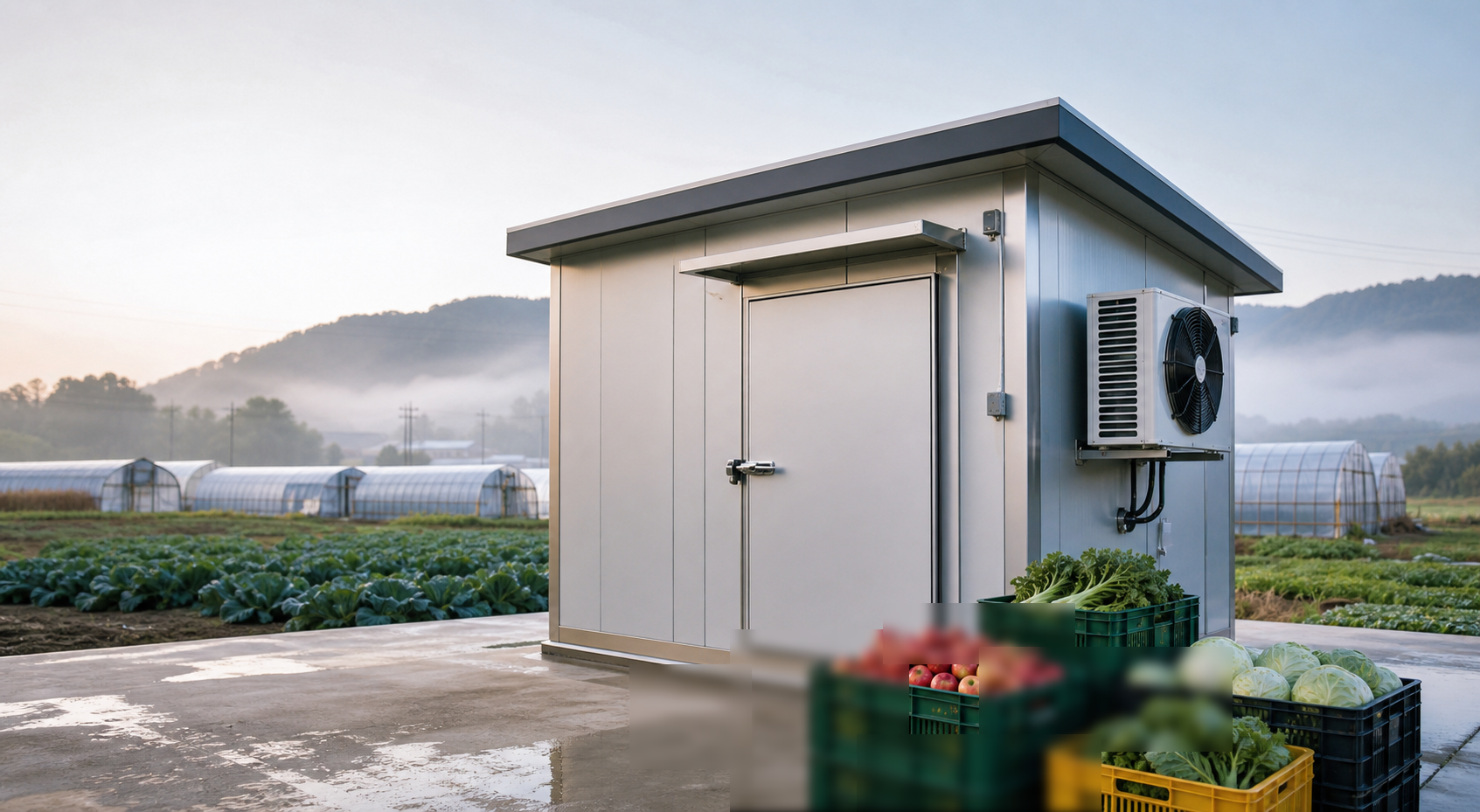
A practical 2026 farm cold storage cost guide covering installation cost, subsidy assumptions, electricity cost, and extra site work for 3, 5, and 10 pyeong units.
Farm Cold Storage Price Table 2026: Installation and Electricity Costs for 3, 5, and 10 Pyeong
Farmers usually ask two questions first when considering a cold storage unit.
“How much does a 3-pyeong unit cost?” “How much is the monthly electricity bill?”
The answer is not as simple as one fixed price. The same 3-pyeong unit can vary by panel thickness, refrigeration capacity, floor work, electrical connection, door direction, and subsidy eligibility. Electricity cost is not decided by floor area alone either. It depends on refrigeration input power, how often the door is opened, sunlight exposure, insulation, and the crop being stored.
Still, farmers need a practical benchmark before comparing quotes. This article summarizes 2026 installation and electricity cost ranges for 3, 5, and 10 pyeong farm cold storage units.
Bottom line: For a first estimate, 3 pyeong can be viewed around 6.5–9.0 million KRW, 5 pyeong around 11–17 million KRW, and 10 pyeong around 25–38 million KRW or more. A simple monthly electricity subtotal can be roughly 20,000–40,000 KRW for 3 pyeong, 30,000–60,000 KRW for 5 pyeong, and 50,000–100,000 KRW for 10 pyeong depending on duty cycle.
1. 2026 cold storage price table
The table below is a starting benchmark for farmers comparing quotes. Actual costs vary by region, subsidy program, unit specification, concrete base, electrical work, transport distance, refrigeration brand, and installation site conditions.
| Size | Typical user | Rough installation range | Farmer share with 50% subsidy | Simple monthly electricity subtotal | Key point |
|---|---|---|---|---|---|
| 3 pyeong | Small direct sales, local-food stores, small fruit/vegetable farms | 6.5–9.0M KRW | 3.25–4.5M KRW | About 20,000–40,000 KRW | Easiest entry size |
| 5 pyeong | Small/mid fruit farms, leafy vegetables, delivery and supply channels | 11–17M KRW | 5.5–8.5M KRW | About 30,000–60,000 KRW | Broad practical use |
| 10 pyeong | Fruit/vegetable farms with shipment volume or supply contracts | 25–38M KRW+ | 12.5–19M KRW+ | About 50,000–100,000 KRW | Check site work and contract power |
This table does not mean every farm can install at exactly these prices. It is a benchmark for quote comparison.
Official subsidy examples help frame the range. A 2023 Jangheung County small farm cold storage notice listed 91 units of 3 pyeong each with a total project cost of 577.2 million KRW. That is about 6.34 million KRW per unit by simple division, with a 50% subsidy and 50% self-payment structure.
Larger fruit cold storage projects are much more expensive. A 2026 Andong/Dosan-myeon subsidy notice listed new fruit cold storage installation at 3.3 million KRW per 3.3㎡. A simple calculation gives about 33 million KRW for 10 pyeong, 66 million KRW for 20 pyeong, and 132 million KRW for 40 pyeong.
So a 3-pyeong small unit and a 10-pyeong fruit cold storage facility are very different even though both are called “cold storage.”
2. 3 pyeong: the common starting size
A 3-pyeong cold storage unit is the first size many small farms consider. It works for holding harvests before local-food store delivery, direct sales, or parcel shipping.
For 2026 planning, a rough 3-pyeong range is about 6.5–9.0 million KRW. Some basic units may appear near the lower end, but the final price can rise when concrete work, electrical work, panel specification, and refrigeration performance are included.
A 3-pyeong unit fits farms that need:
- one or two days of holding before local-food store delivery
- small-volume leafy vegetable storage
- temporary fruit storage after sorting
- time to pack direct-to-consumer parcels
But 3 pyeong fills quickly. Farmers should not only look at box capacity. They also need walking space, shelves, airflow, and work space in front of the door.
3. 5 pyeong: a practical size for individual farms
Five pyeong is a realistic middle ground for many individual farms. It has more usable space than 3 pyeong but is far less burdensome than 10 pyeong.
A rough 2026 installation range is about 11–17 million KRW. The price can be lower for a simple unit and higher when refrigeration capacity, inverter equipment, controls, drainage, concrete base, and electrical connection are added.
A 5-pyeong unit works well for:
- farms that often outgrow 3 pyeong
- farms combining direct sales and wholesale/supply channels
- farms shipping two or three times per week
- farms handling both fruit and vegetables with careful crop separation
Mixed crop storage needs caution. RDA has noted that many fruits such as apples, pears, and grapes are stored around 0°C with 90–95% relative humidity. Leafy vegetables such as lettuce, spinach, and cabbage also need low temperature and high humidity. But cucumbers and eggplants are cold-sensitive and require warmer conditions around 10–12°C.
A single 5-pyeong cold room cannot perfectly solve every crop’s needs. Cold storage is a small climate, not just a cold box.
4. 10 pyeong: site conditions matter as much as the unit
Ten pyeong is a full farm operation asset. It is considered by fruit farms, vegetable production areas, farms with supply contracts, and farms that need to hold meaningful volume.
A rough installation range is 25–38 million KRW or more. If the official example of 3.3 million KRW per 3.3㎡ is applied, 10 pyeong comes to about 33 million KRW. On-site electrical work, concrete base, drainage, vehicle access, forklift movement, shading, and outdoor-unit space can raise the total.
At 10 pyeong, the surrounding site matters greatly:
- Is the KEPCO contract power sufficient?
- Does the outdoor unit have good airflow?
- Can trucks or forklifts reach the door?
- Is drainage and cleaning easy?
- Is the unit protected from direct summer sunlight?
- Are subsidy post-management rules understood?
A 10-pyeong unit is not just convenient storage. It is operational equipment. It must reduce waste, improve shipment timing, or stabilize delivery schedules to pay back.
5. Electricity cost depends on kW and duty cycle
Electricity cost can be estimated with this formula.
Monthly use (kWh) = refrigeration input power (kW) × average duty cycle × 24 hours × 30 days
Energy charge = monthly use × electricity rate
Basic charge = contract power or equipment capacity × basic charge rate
Rough monthly electricity cost = energy charge + basic charge + additional charges
Under the Han전ON tariff table, Agricultural Power Eul includes electricity used for agricultural cold storage facilities. The April 1, 2025 low-voltage Agricultural Power Eul table lists a basic charge of 1,150 KRW/kW and an energy rate of 65.9 KRW/kWh.
The table below uses those rates as a simple example. Actual bills include VAT, power industry fund, climate/environment charges, fuel adjustment, contract details, and site conditions. So this is not a bill forecast. It is a benchmark for comparing quotes.
| Size | Refrigeration input assumption | Low use 25% | Normal use 35% | Heavy use 50% |
|---|---|---|---|---|
| 3 pyeong | 1.5kW | about 270kWh, 19,500 KRW | about 378kWh, 26,600 KRW | about 540kWh, 37,300 KRW |
| 5 pyeong | 2.2kW | about 396kWh, 28,600 KRW | about 554kWh, 39,100 KRW | about 792kWh, 54,700 KRW |
| 10 pyeong | 4.0kW | about 720kWh, 52,000 KRW | about 1,008kWh, 71,000 KRW | about 1,440kWh, 99,500 KRW |
The key to reducing electricity cost is not just choosing a smaller room. It is using the room properly. Leaving the door open loses cold air. Putting hot produce directly inside keeps the compressor running longer. Loose door gaskets, panel gaps, and poor outdoor-unit ventilation quietly raise the bill.
6. Subsidies are conditional discounts, not free money
Many farm cold storage units are installed through local subsidy programs. A 50% subsidy structure is common, but the actual rate varies by city/county, year, crop, farm size, and budget.
Subsidies reduce the initial farmer payment. But they are not free money. Assets purchased with subsidies can be subject to post-management rules, restrictions on non-agricultural use, and disposal limits. Farmers should check not only the subsidy amount but also how long and under what conditions the equipment must be maintained.
Before applying, check:
- farm business registration
- eligible crops and required cultivation area
- installation site ownership or lease status
- written landowner approval and restoration terms for leased land
- settlement documents and tax invoice requirements
- post-management period and use restrictions
- whether existing cold storage affects eligibility
A subsidy lowers installation cost. But if the operating model does not fit, even the self-payment portion can be hard to recover.
7. Which size should a farm choose?
Size selection should start from shipping style, not from which unit looks cheap.
| Farm type | Suggested size | Why |
|---|---|---|
| Small local-food or direct-sale farm | 3 pyeong | Enough for one or two days of holding and parcel prep |
| Farm shipping several times per week | 5 pyeong | Good balance of usable space and cost |
| Fruit/vegetable farm with steady volume | 10 pyeong | Can support sorting, holding, and shipment timing |
| Producer group or joint sorting operation | 10 pyeong+ | Vehicle movement, loading, and contract power need separate design |
| Cold-sensitive crops such as cucumbers or eggplants | Separate temperature planning | Too-low temperature can damage quality |
Crop storage conditions must be checked before installation. Apples, pears, grapes, and leafy vegetables often need low temperature and high humidity. Cucumbers and eggplants can suffer cold injury at too-low temperatures. Whether the room needs partitions or separate temperature zones should be discussed during quoting.
8. Installation checklist
When requesting quotes, confirm these items:
- Whether VAT is included in the unit price
- Panel thickness and floor insulation method
- Refrigeration input power, inverter option, and A/S terms
- Electrical work and KEPCO contract power changes
- Concrete base, drainage, shading, transport cost
- Door direction, loading path, and forklift access
- Whether the specification fits subsidy settlement rules
- Post-management period and non-agricultural use restrictions
- Temperature, humidity, and ethylene sensitivity of stored crops
- The assumptions used for monthly electricity cost
A quote should not simply say “cold storage one set.” Panels, refrigeration, electrical work, floor, drainage, transport, and installation conditions should be separated so farmers can compare properly.
9. Bottom line: payback matters more than the price tag
If you are considering farm cold storage in 2026, it makes sense to begin with 3, 5, and 10 pyeong price tables. But the final decision should be based on payback, not only installation price.
Three pyeong is accessible. Five pyeong is broadly useful. Ten pyeong is closer to operating equipment. Electricity cost may look modest in simple calculations, but it changes with door use, insulation, outdoor-unit airflow, and crop type. Subsidies help, but they come with conditions.
Cold storage must do at least one of three things to make money. It must reduce waste, buy time for better shipment timing, or stabilize direct sales and supply schedules. If it does not do any of these, it becomes an expensive storage shed rather than a profit tool.
References
- Han전ON electricity tariff table: Agricultural Power Eul low-voltage basic charge 1,150 KRW/kW and energy rate 65.9 KRW/kWh, applied from April 1, 2025.
- Rural Development Administration, “Keep fruits and vegetables fresh under proper storage conditions,” September 30, 2014.
- Jangheung County 2023 small farm cold storage installation notice: 91 units of 3 pyeong, total project cost 577.2 million KRW.
- Andong/Dosan-myeon 2026 vegetable/special crop and fruit cold storage subsidy notice: new installation benchmark of 3.3 million KRW per 3.3㎡.
- Actual installation cost and electricity bills vary by region, subsidy program, specification, contract power, electrical/civil work, and usage habits.