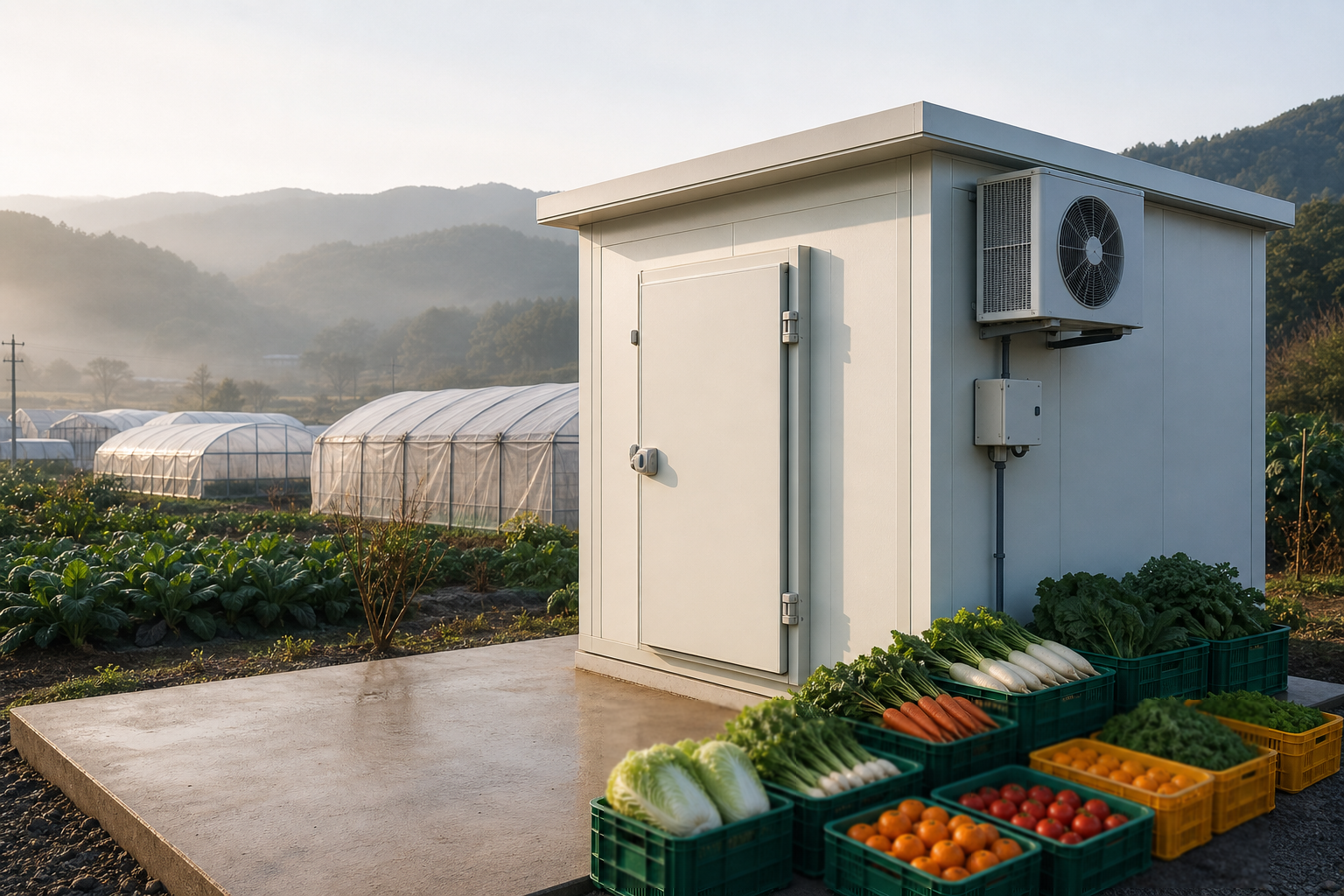
A practical way to estimate monthly electricity costs for 3, 5, and 10 pyeong farm cold storage rooms using compressor capacity, duty cycle, and agricultural power rates.
Farm Cold Storage Electricity Cost: 3, 5, and 10 Pyeong
The first question many growers ask before installing a cold storage room is simple. How much will the monthly electricity bill be. Installation cost matters. Subsidies matter too. But if the monthly running cost is unclear, it is hard to know whether the room is a profit tool or just a convenient refrigerator.
Cold storage electricity cost cannot be judged by floor area alone. A 5-pyeong room can use very different amounts of power depending on how often the door opens, what crop is stored, whether the unit is exposed to direct summer sun, and what temperature is set. Still, the calculation itself is not difficult. The key is compressor capacity and actual duty cycle.
This article shows a practical estimate for 3, 5, and 10 pyeong farm cold storage rooms. The numbers below are examples for decision-making, not actual bills. VAT, climate and fuel adjustment charges, power industry fund, KEPCO contract details, and electrical construction costs must be checked separately.
1. The basic formula
A simple monthly estimate starts like this.
Monthly kWh = compressor power (kW) × average duty cycle × 24 hours × 30 days
Energy charge = monthly kWh × energy rate
Basic charge = contracted capacity or equipment capacity × basic rate
Rough monthly cost = energy charge + basic charge + additional charges
The duty cycle is the part many farms miss. A 2kW refrigeration unit does not necessarily draw 2kW for 24 hours straight. It runs, stops after reaching the target temperature, then starts again when the room warms up. That is why the calculation must include how much of the time the unit actually runs.
For example, a 2kW unit running at an average 35% duty cycle uses:
2kW × 0.35 × 24 hours × 30 days = 504kWh
If the agricultural low-voltage energy rate is assumed at 65.9 KRW/kWh, the energy charge is about 33,000 KRW. If the basic charge is assumed at 1,150 KRW/kW and 2kW is applied, about 2,300 KRW is added. The simple subtotal is around 35,000 KRW before additional billing items.
2. 3 pyeong cold storage example
A 3-pyeong room is often considered by small local-food suppliers, direct-sale farms, small orchards, and leafy vegetable growers. It works well when the goal is to keep harvested produce stable for a day or two. But even a small room can run hard if it is packed tightly and opened often.
The example below assumes a 1.5kW refrigeration unit. The energy rate is calculated at 65.9 KRW/kWh, and the basic charge at 1,150 KRW/kW.
| Use case | Average duty cycle | Monthly use | Energy charge | Basic charge | Simple subtotal |
|---|---|---|---|---|---|
| Light use | 25% | about 270kWh | about 17,800 KRW | about 1,700 KRW | about 19,500 KRW |
| Normal use | 35% | about 378kWh | about 24,900 KRW | about 1,700 KRW | about 26,600 KRW |
| Hot season / frequent opening | 50% | about 540kWh | about 35,600 KRW | about 1,700 KRW | about 37,300 KRW |
For a 3-pyeong room, a rough starting range is about 20,000 to 40,000 KRW per month before extra billing items. Summer heat, old insulation panels, direct sunlight, and frequent loading can push it higher. Shade, good insulation, and short door-opening time can bring it down.
For this size, the bigger question is not the electricity bill. It is waste reduction. If the room prevents 100,000 KRW of produce from losing quality, a 30,000 KRW electricity cost is not the real problem.
3. 5 pyeong cold storage example
Five pyeong is a common middle point. Three pyeong feels too small, while 10 pyeong feels too expensive or too large. Farms that combine local-food store deliveries with direct sales often find this size practical.
The example below assumes a 2.2kW refrigeration unit.
| Use case | Average duty cycle | Monthly use | Energy charge | Basic charge | Simple subtotal |
|---|---|---|---|---|---|
| Light use | 25% | about 396kWh | about 26,100 KRW | about 2,500 KRW | about 28,600 KRW |
| Normal use | 35% | about 554kWh | about 36,500 KRW | about 2,500 KRW | about 39,100 KRW |
| Hot season / frequent opening | 50% | about 792kWh | about 52,200 KRW | about 2,500 KRW | about 54,700 KRW |
For a 5-pyeong room, about 40,000 KRW per month is a reasonable midpoint in this simple model. During hot months, 50,000 KRW or more should not be surprising. Actual bills vary with contract capacity and added charges.
From this size upward, workflow matters. If workers keep the door open while looking for boxes, cold air pours out. A simple storage layout by crop and shipping date can reduce electricity use without buying any new equipment.
4. 10 pyeong cold storage example
A 10-pyeong room is closer to an operating asset than a convenience item. It suits orchards, farms with shipment volume, group sorting operations, or farms with harvest peaks. The monthly electricity cost rises, but turnover becomes more important than the bill itself. An empty 10-pyeong room is like running a large refrigerator for no reason.
The example below assumes a 4.0kW refrigeration unit.
| Use case | Average duty cycle | Monthly use | Energy charge | Basic charge | Simple subtotal |
|---|---|---|---|---|---|
| Light use | 25% | about 720kWh | about 47,400 KRW | about 4,600 KRW | about 52,000 KRW |
| Normal use | 35% | about 1,008kWh | about 66,400 KRW | about 4,600 KRW | about 71,000 KRW |
| Hot season / frequent opening | 50% | about 1,440kWh | about 94,900 KRW | about 4,600 KRW | about 99,500 KRW |
For a 10-pyeong room, around 70,000 KRW per month is the normal-use starting point in this model. In hot months, around 100,000 KRW should be kept in mind. The number may feel lower than expected, but electricity is only one part of the decision. Floor work, drainage, electrical connection, shade, loading space, and subsidy management can all matter more than the monthly bill.
5. Why actual costs can differ
The biggest variable is the door. Every long door opening lets cold air escape and warm humid air enter. The refrigeration unit then runs again to remove that heat. A slow loading routine can raise both electricity cost and quality loss.
The second variable is location. A room under direct sun, a blocked outdoor unit, or poor drainage will perform worse. Cold storage does not just make cold air. It also has to throw heat outside. If the outdoor unit cannot release heat well, the system uses more electricity.
The third variable is crop type. Rural Development Administration guidance notes that many fruits such as apples, pears, grapes, persimmons, and kiwifruit are stored near 0°C with high relative humidity. Strawberries are often held around 0–4°C, Korean melon around 5–7°C, and cold-sensitive crops such as cucumber and eggplant around 10–12°C. Leafy vegetables also need low temperature and high humidity. One room cannot treat every crop the same way.
The fourth variable is maintenance. Loose door gaskets, panel gaps, frost buildup, dirty outdoor coils, or a poorly placed temperature sensor can all increase electricity use. If the bill suddenly rises, do not look only at the tariff. Check the door seal, frost, outdoor unit airflow, and sensor location first.
6. Agricultural electricity still needs contract checks
Korean agricultural electricity can apply to agricultural production-related uses, including crop cold storage facilities in eligible cases. The low-voltage agricultural rate may look inexpensive compared with general electricity. That can make a cold room feel cheaper to operate than expected.
Still, eligibility must be checked in the field. The use, contract type, equipment, and whether the room is mixed with non-agricultural commercial use can matter. If new electrical connection or increased contract capacity is needed, the initial electrical work may feel larger than the monthly electricity bill.
Do not calculate with energy charge alone. Basic charge, VAT, power industry fund, climate/environment charge, and fuel adjustment can be added. The tables in this article are simple comparisons, not official bill forecasts.
7. A five-minute calculation for growers
When a quote arrives, use this sequence.
- Find the compressor power or rated input in kW.
- Test three duty cycles: 25%, 35%, and 50%.
- Calculate
kW × duty cycle × 24 × 30. - Multiply monthly kWh by the energy rate.
- Add the basic charge.
- Leave room for VAT and additional billing items.
- Use a higher case for summer months.
For example, a 5-pyeong room with a 2.2kW unit at a 35% duty cycle uses about 554kWh per month. At 65.9 KRW/kWh, the energy charge is about 36,500 KRW. Adding a basic charge of about 2,500 KRW gives a simple subtotal of about 39,100 KRW before additional charges.
This method changes the conversation with vendors. Instead of accepting “the bill is not high,” the grower can ask about duty cycle, insulation, door opening, and outdoor unit placement. Those questions lead to a better decision.
8. Electricity-saving checklist
Electricity savings usually start with installation and habits, not expensive add-ons.
- Place the room away from direct sunlight where possible.
- Keep airflow clear around the outdoor unit.
- Reduce door-opening time and frequency.
- Decide box locations before loading.
- Avoid putting field-hot produce directly into storage when possible.
- Check door gaskets regularly.
- Investigate heavy frost buildup.
- Clean the outdoor unit coil periodically.
- Do not set the temperature lower than the crop requires.
- Check crop-specific temperature and humidity needs.
- Avoid long storage of ethylene-sensitive crops together with high ethylene producers.
- Do not block internal air circulation by overpacking.
The simplest saving is closing the door quickly. It sounds too plain, but it works. During harvest season, the cold room door often opens like a shop refrigerator. Better workflow can reduce both power use and quality loss.
9. Choose size by volume, not by electricity cost alone
The electricity cost of a 10-pyeong room may look manageable in the table. But a cold room costs money even when it is half empty. On the other hand, a room that is too small fails during harvest peaks. Size should be chosen by storage volume and turnover, not just monthly electricity.
Three pyeong often fits small direct sales, weekend markets, local-food stores, and small parcel shipping. Five pyeong fits farms with several crops and a mix of local-food delivery and direct sales. Ten pyeong fits orchards, larger shipment plans, processing material storage, or farms with clear volume.
A subsidy does not automatically mean a larger room is better. A subsidy is a conditional discount, not free money. Post-management rules, settlement documents, and restrictions on non-purpose use may apply. A large cold room that stays empty can feel colder than the electricity bill itself.
10. Bottom line
Farm cold storage electricity cost is calculable. Use compressor kW, duty cycle, 24 hours, 30 days, and the applicable electricity rate. In this simple model, 3 pyeong starts around 20,000–40,000 KRW per month, 5 pyeong around 30,000–60,000 KRW, and 10 pyeong around 50,000–100,000 KRW before added billing items. Actual bills depend on contracts and site conditions.
The more important question is operational. Does the room reduce waste. Can it delay shipment until a better price. Can it stabilize local-food deliveries. Can it make parcel shipping and direct sales easier.
A cold storage room is not just a cold box. It buys the farm a few extra days. If those days turn into sales, the electricity bill is an operating cost. If there is no plan for those days, even a low bill will not create profit.
References
- KEPCO / Han전ON electricity tariff information for agricultural power, including agricultural low-voltage tariff examples and agricultural cold storage use cases.
- Rural Development Administration press material on recommended storage conditions for fruits and vegetables, including crop-specific temperature and humidity guidance.
- Local government farm cold storage subsidy notices were used as examples for the caution that subsidy details vary by year, budget, eligibility, specifications, and post-management requirements.
- The electricity tables in this article use 65.9 KRW/kWh and 1,150 KRW/kW as simple assumptions. They are not official bill estimates.