A practical 10-pyeong agricultural cold storage price guide comparing 3, 5, and 10 pyeong units by installation cost, refrigeration capacity, insulation, floor work, electrical work, subsidy, and electricity use.
A 3-pyeong cold room feels like an add-on. A 5-pyeong unit starts to support direct sales and small delivery schedules. A 10-pyeong cold room is different. It becomes equipment that can change how a farm ships produce.
That is why the 10-pyeong price cannot be estimated by simply multiplying a 3-pyeong quote. Refrigeration capacity, floor base, electrical work, door size, insulation thickness, drainage, and loading flow all become more important. A good unit buys shipping time. A bad unit becomes an expensive shed.
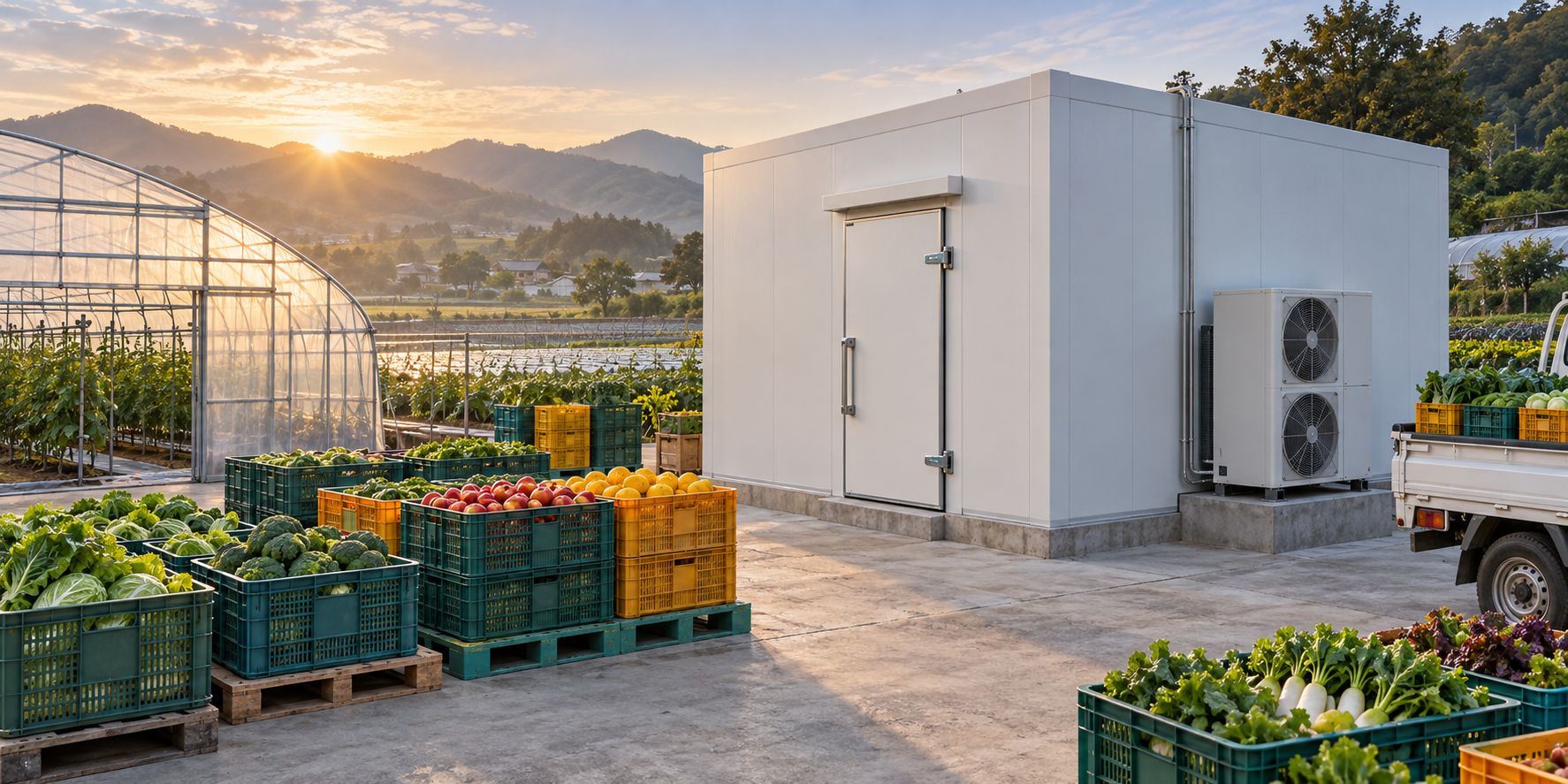
Short answer: plan around 25 million to 38 million KRW or more
For 2026 planning, a 10-pyeong agricultural cold storage unit often starts around 25 million to 38 million KRW or more. A simple refrigeration-only unit with good site conditions may sit toward the lower end. A freezer-capable unit, thicker panels, floor work, electrical work, drainage, and loading improvements can push the price higher.
| Size | Typical user | Installation range | Simple monthly electricity example |
|---|---|---|---|
| 3 pyeong | Small direct sales, small fruit and vegetables | 6.5 million to 9 million KRW | About 20,000 to 40,000 KRW |
| 5 pyeong | Mid-size fruit farms, delivery plus wholesale | 11 million to 17 million KRW | About 30,000 to 60,000 KRW |
| 10 pyeong | Fruit and vegetable farms with shipment scheduling | 25 million to 38 million KRW or more | About 50,000 to 100,000 KRW |
These are planning ranges, not guaranteed quotes. Actual prices change with local subsidy rules, panel thickness, refrigeration spec, floor condition, electrical ingress, transport distance, and site access.
1. Refrigeration capacity changes first
Small 3- and 5-pyeong units are often approached as compact farm cold rooms. A 10-pyeong unit needs more careful refrigeration design. The question is not only how cold the room can become, but how quickly it can remove heat after produce is loaded.
Check:
| Item | What to check in a 10-pyeong unit |
|---|---|
| Refrigeration capacity | Whether it matches produce volume and incoming temperature |
| Cooling-only or freezer-capable | Freezer-capable systems cost more and use more power |
| Outdoor-unit location | Airflow, sunlight, dust, and rain protection |
| Defrost method | Frost control and maintenance convenience |
| Temperature variation | Difference between the back of the room and the door area |
A 10-pyeong unit loses more cold air whenever the door opens. For farms with frequent loading, door location and work flow matter as much as machine size.
2. Insulated panels drive the price gap
A cold room is not only a machine that makes cold air. It is also a box that holds that cold air. Weak insulation forces the refrigeration unit to work longer, increasing electricity use and shortening equipment life.
Panel thickness and floor insulation matter more at 10 pyeong. A small unit may survive with compromise. A larger unit exposes every weak point through energy loss.
Check:
- Wall and ceiling panel thickness.
- Floor insulation inclusion.
- Door gasket and hinge quality.
- Interior finish and cleaning convenience.
- Direct sunlight exposure.
- Airflow space around the outdoor unit.
Low quotes often remove cost from panels or floor work. Ask for these line items in writing.
3. Floor, drainage, and loading space affect the real cost
A 10-pyeong cold room needs a proper site. Boxes, pallets, hand carts, and sometimes small forklifts may move through the area. A weak floor can settle near the door. Poor drainage can create hygiene and maintenance problems.
Typical site-cost items include:
| Item | Why it matters |
|---|---|
| Concrete base | Load support and level installation |
| Drainage slope | Rainwater, washing water, and pooling control |
| Loading area | Pallets, carts, sorting, and truck access |
| Canopy or rain cover | Reduces rain entry and heat gain near the door |
| Access road | Installation and farm-logistics access |
Separate the cold-room body price from the site-work price. A cheap body quote can become expensive once concrete, drainage, and electricity are added.
4. Electrical work must be checked separately
A 10-pyeong unit should not be treated casually on the electrical side. The refrigeration unit is larger, and breaker, wiring, grounding, and contract power must match. The possibility of agricultural electricity also needs confirmation.
KEPCO agricultural electricity categories can include agricultural cold storage for crops, but actual application depends on contract and use conditions. Use any estimate as a comparison tool, not as a bill forecast.
A simple formula is:
Monthly use = refrigeration input × average duty cycle × 24 hours × 30 days
Energy charge = monthly use × energy rate
Rough power cost = energy charge + basic charge + other surcharges
Using a simple 10-pyeong example with a 4.0kW refrigeration input, 65.9 KRW/kWh energy rate, and 1,150 KRW/kW basic charge gives this planning table.
| Average duty cycle | Monthly use | Simple subtotal |
|---|---|---|
| 25% | About 720kWh | About 52,000 KRW |
| 35% | About 1,008kWh | About 71,000 KRW |
| 50% | About 1,440kWh | About 99,500 KRW |
This excludes VAT, climate and environmental charges, fuel adjustment, power-industry fund, actual contract power, and site electrical work. Real bills can differ.
5. Which farms need 10 pyeong?
A 10-pyeong unit may be too large for very small direct-sales farms. Unused space still costs money to cool. For larger fruit and vegetable farms, the unit can change shipment timing and reduce losses.
It fits farms that:
- Grow apples, pears, grapes, persimmons, or kiwifruit and need timing control.
- Store onions, garlic, potatoes, or similar crops where storage strategy affects price.
- Combine local food stores, school meals, direct delivery, and wholesale.
- Need temporary storage before sorting or joint shipment.
- Harvest enough volume that sorting and shipping cannot happen immediately.
Crop temperature matters. Rural Development Administration storage guidance shows that many fruits prefer around 0°C and high humidity, while sweet potatoes need warmer conditions and crops like cucumbers and eggplants are sensitive to low temperature. One cold room should not be treated as a universal box for every crop.
6. Subsidies reduce price, but add conditions
Cold storage often appears in local subsidy programs. Some notices use 3-pyeong units, 50% subsidy structures, registered farm-business requirements, and crop-area requirements. The details change by year and local government.
A 2023 Jangheung County small cold-storage procurement notice listed 91 three-pyeong units with a total project cost of 577.2 million KRW, roughly 6.34 million KRW per unit by simple division. A 2026 Andong/Dosan notice for fruit cold storage used a new-installation reference of 3.3 million KRW per 3.3㎡. Applied simply to 10 pyeong, that is about 33 million KRW.
Subsidies are not free money. They are conditional discounts. Settlement documents, post-management rules, purpose restrictions, and disposal limits can follow.
7. Quote checklist
For a 10-pyeong quote, compare the structure, not only the total number.
- Cold-room body price.
- Panel thickness and floor insulation.
- Refrigeration capacity, maker, and warranty.
- Electrical work and KEPCO connection scope.
- Concrete base and drainage work.
- Transport, crane, and installation cost.
- Door size, door direction, and interior lighting.
- Temperature recorder, remote alarm, and inverter control.
- Cooling-only versus freezer-capable specification.
A one-word difference can change the budget. Cooling-only and freezer-capable systems are not the same purchase.
Conclusion
A 10-pyeong agricultural cold room is not just a bigger 3-pyeong unit. Plan around 25 million to 38 million KRW or more, then separate refrigeration, panels, floor, electricity, drainage, and loading flow.
The equipment buys time. That time must reduce waste, improve shipment timing, or stabilize direct sales and delivery. If it does not, the cold room is only a cold shed.
References
- KEPCO ON agricultural electricity tariff information: agricultural cold storage eligibility framing and example basic and energy rates.
- Rural Development Administration, fruit and vegetable storage-condition guidance: crop temperature and humidity differences.
- Jangheung County 2023 small farm cold-storage procurement notice: 3-pyeong unit project-cost example.
- Andong City Dosan-myeon 2026 fruit cold-storage subsidy notice: 3.3㎡ new-installation reference cost example.
- IMUN.FARM, “Agricultural Cold Storage Price Table 2026” and “Agricultural Cold Storage Electricity Cost”: comparison ranges and electricity calculation formula.