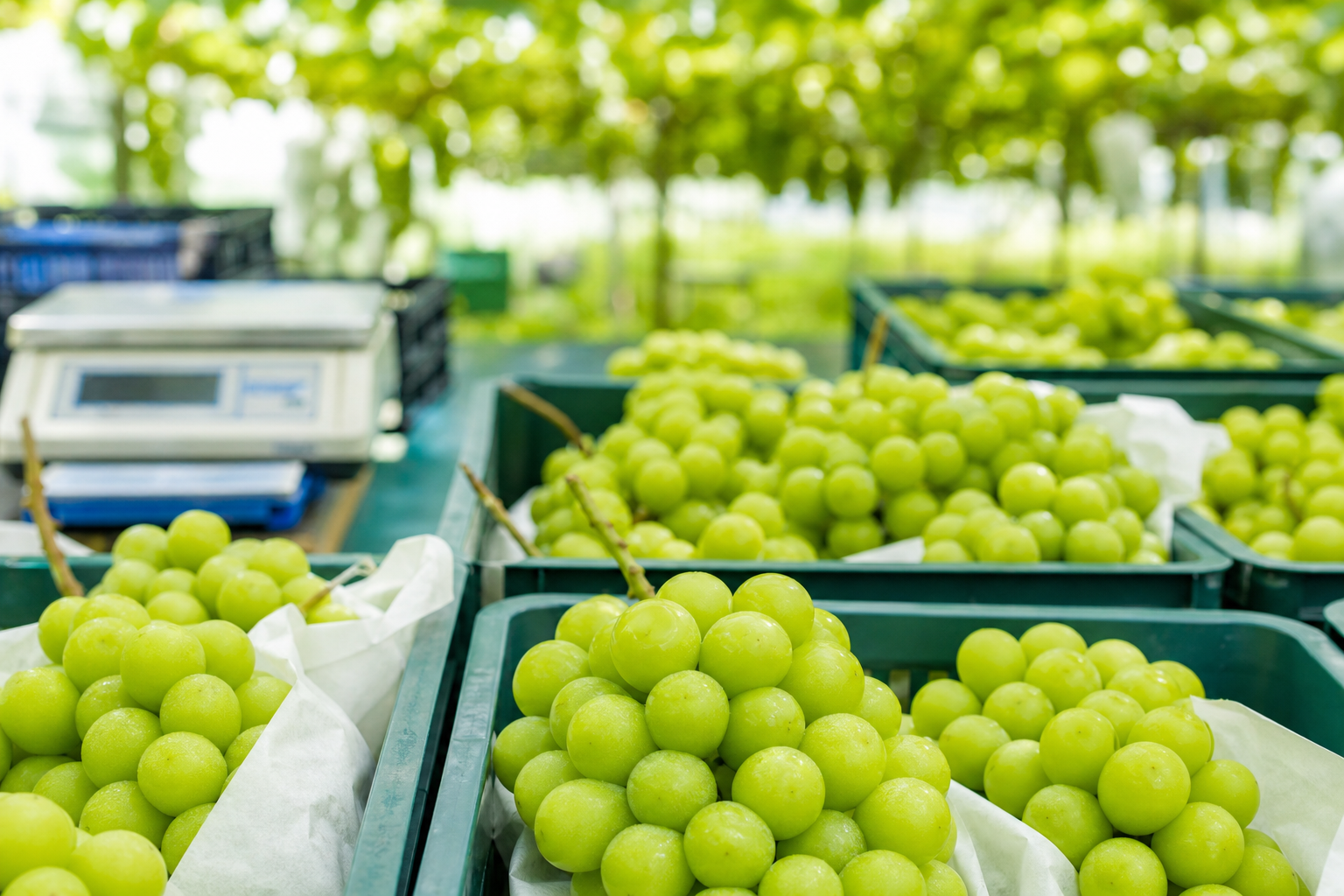
A farmer-focused July 2026 update on Korean Shine Muscat grape prices, KAMIS wholesale data, KREI fruit outlook, shipments, and near-term market risks.
Shine Muscat Prices and Outlook in July 2026
For Shine Muscat growers, July prices are not just market numbers. They decide when to pick, how hard to grade, and which buyer should receive the best boxes. In July 2026, the signal is fairly clear. Prices are softer than last year, and much lower than the normal-year level.
As of the July 21, 2026 KAMIS wholesale middleman price screen, Shine Muscat L-size grapes averaged 21,660 won per 2kg box. M-size grapes averaged 18,120 won per 2kg box. KREI’s July 2026 fruit outlook projected the July Shine Muscat wholesale price at around 20,000 won per 2kg, below the previous year’s 21,700 won.
That does not mean every grower will receive the same price. Shine Muscat is now a mature consumer product in Korea. Buyers look at berry size, sugar level, skin texture, bunch shape, packaging, and reliability. In a weak average market, grading discipline matters more, not less.
1. The current July price level
KAMIS provides wholesale middleman selling prices from major Korean markets. For July 21, 2026, the Shine Muscat data showed the following level.
| Grade | Unit | Average | Five days earlier | One year earlier | Normal year | Vs. normal year |
|---|---|---|---|---|---|---|
| L-size | 2kg | 21,660 won | 22,320 won | 23,455 won | 32,594 won | -33.5% |
| M-size | 2kg | 18,120 won | 19,000 won | 18,955 won | 27,862 won | -35.0% |
The short-term direction is also weak. L-size was down 3.0% from five days earlier and 7.7% from one year earlier. M-size was down 4.6% from five days earlier and 4.4% from one year earlier. Both grades were more than 30% below the normal-year price.
Regional differences were visible as well. For L-size fruit, the July 20 price was 23,000 won in Gwangju, 22,400 won in Seoul, 21,600 won in Busan, 21,000 won in Daejeon, and 20,300 won in Daegu. For M-size fruit, the range was 16,600 to 19,800 won. Even within the same variety, location and buyer flow can create a 2,000 to 3,000 won gap per 2kg box.
2. KREI’s July outlook points to lower prices
KREI’s July 2026 fruit outlook expects July greenhouse grape shipments to increase 6.1% year on year. For Shine Muscat, the projected increase is 6.5%. The report also says overall quality is expected to improve because crop conditions are better than last year.
That combination can be uncomfortable for farmers. Better crop conditions do not always mean better prices. When more good fruit enters the market at the same time, the average price can still fall. KREI projected July Shine Muscat wholesale prices at around 20,000 won per 2kg, below the previous year’s 21,700 won.
The same direction appears in other greenhouse grape varieties. Campbell Early and Kyoho were also projected to trade below last year’s July levels. This is not only a Shine Muscat story. It is a broader greenhouse grape supply story.
3. Total grape production is not shrinking much
KREI projects 2026 Korean grape production at about 213 thousand tons. That is 1.0% lower than the previous year, but 6.5% higher than the normal-year level. The planted area is down 2.4% year on year at 13,829 hectares, while yield is expected to rise 1.5% to 1,539kg per 10a.
The production mix matters. Greenhouse grape production is projected to increase 6.2% year on year. Rain-shelter and open-field production is projected to decrease 3.3%. Since July prices are driven mainly by greenhouse shipments, the increase in greenhouse volume is the key short-term pressure.
This is why a small decline in total annual grape production does not automatically create a bullish July market. The timing of supply matters as much as the annual total.
4. Grade spread matters more than the average
The July 2026 market can be summarized in one sentence. The average is weak, but premium fruit still has room to defend itself.
Consumers are no longer buying Shine Muscat only because of the name. They have tried it before. They know when berries are small, when bunches are loose, when sweetness is weak, and when the skin texture is disappointing. Wholesale buyers know this even faster.
In a weak market, lower-grade fruit pulls the average down quickly. High-grade fruit can still hold a premium if grading is strict and buyer trust is strong. For growers, this means one practical thing. Do not let weak bunches enter premium boxes.
5. Three scenarios for the rest of July
The base case is continued softness. KREI expects greenhouse grape shipments to rise, and the KAMIS price screen already shows weaker movement from mid-July. Unless demand improves sharply, the average price may remain under pressure.
The second scenario is a quality split. Rain, heat, cracking, lower sugar, and storage problems can widen the gap between premium and ordinary fruit. In that case, the average market can look weak while top-grade lots still trade better.
The third scenario is a slower structural adjustment. The Korea Grape Association is supporting some Shine Muscat growers who switch varieties, and reported applications covering about 147 hectares. That could reduce domestic Shine Muscat production by roughly 3,000 tons, or about 3 to 4% of annual output. This matters for the medium term, but it is unlikely to reverse the July 2026 market by itself.
6. What growers should track now
The first indicator is the spread between L-size and M-size prices. If the gap widens, buyers are separating quality more aggressively. That is a warning to tighten grading.
The second indicator is shipment volume versus average price. If market arrivals rise while average prices fall, the short-term market is still heavy. If top-grade prices hold despite larger arrivals, premium demand is still alive.
The third indicator is weather. Rain and high temperatures around harvest can quickly change sugar, cracking, firmness, and shelf life. When the average market is already weak, small quality problems can become large price discounts.
7. A practical shipment strategy
Waiting for a rebound is tempting when prices are low. But Shine Muscat does not always reward waiting. If more volume continues to arrive, delayed harvest can create over-ripeness, berry drop, uneven sugar, and shorter shelf life.
A segmented strategy is safer. Send strictly graded premium fruit to the buyers who pay for reliability. Move mid-grade fruit with realistic price expectations. Handle lower-grade fruit through separate channels instead of mixing it into premium packs.
Direct-to-consumer farms need the same discipline. If wholesale prices are soft but retail prices stay too high, repeat purchases may weaken. If prices are cut too sharply, the farm brand can lose its premium position. Clear separation between gift-grade and home-use boxes is usually better than one vague price.
8. The one-line outlook
As of July 2026, the Shine Muscat market is a weak average-price market driven by higher greenhouse shipments and better crop conditions. KAMIS shows L-size fruit around 21,660 won per 2kg and M-size around 18,120 won per 2kg. KREI’s July outlook points to about 20,000 won per 2kg for Shine Muscat, below last year.
The practical conclusion is simple. Growers should not rely on the variety name alone. This year’s price defense will come from grading, consistency, buyer trust, and keeping weak bunches out of premium boxes.
Field checklist
- Track the daily gap between L-size and M-size prices.
- Compare market arrival volume with the KAMIS average price direction.
- Recheck berry size, sugar level, bunch shape, and firmness before packing.
- Separate gift-grade, standard, and home-use channels.
- Watch rain and heat after mid-July because they can widen quality gaps.
- Do not mix lower-grade bunches into premium boxes.
- Adjust direct-sales pricing without damaging the farm brand.
References
- aT KAMIS, wholesale middleman price data for fruit/grape/Shine Muscat, accessed July 21, 2026.
- KREI Agricultural Outlook Center, Fruit Outlook, July 2026 issue, published July 2, 2026.
- Seoul Agro-Fisheries & Food Corporation Garak Market price and arrival data as cited in KREI’s July 2026 fruit outlook.
- Korean agriculture press coverage on Korea Grape Association support for Shine Muscat variety-switching growers, checked through July 2026 search results.