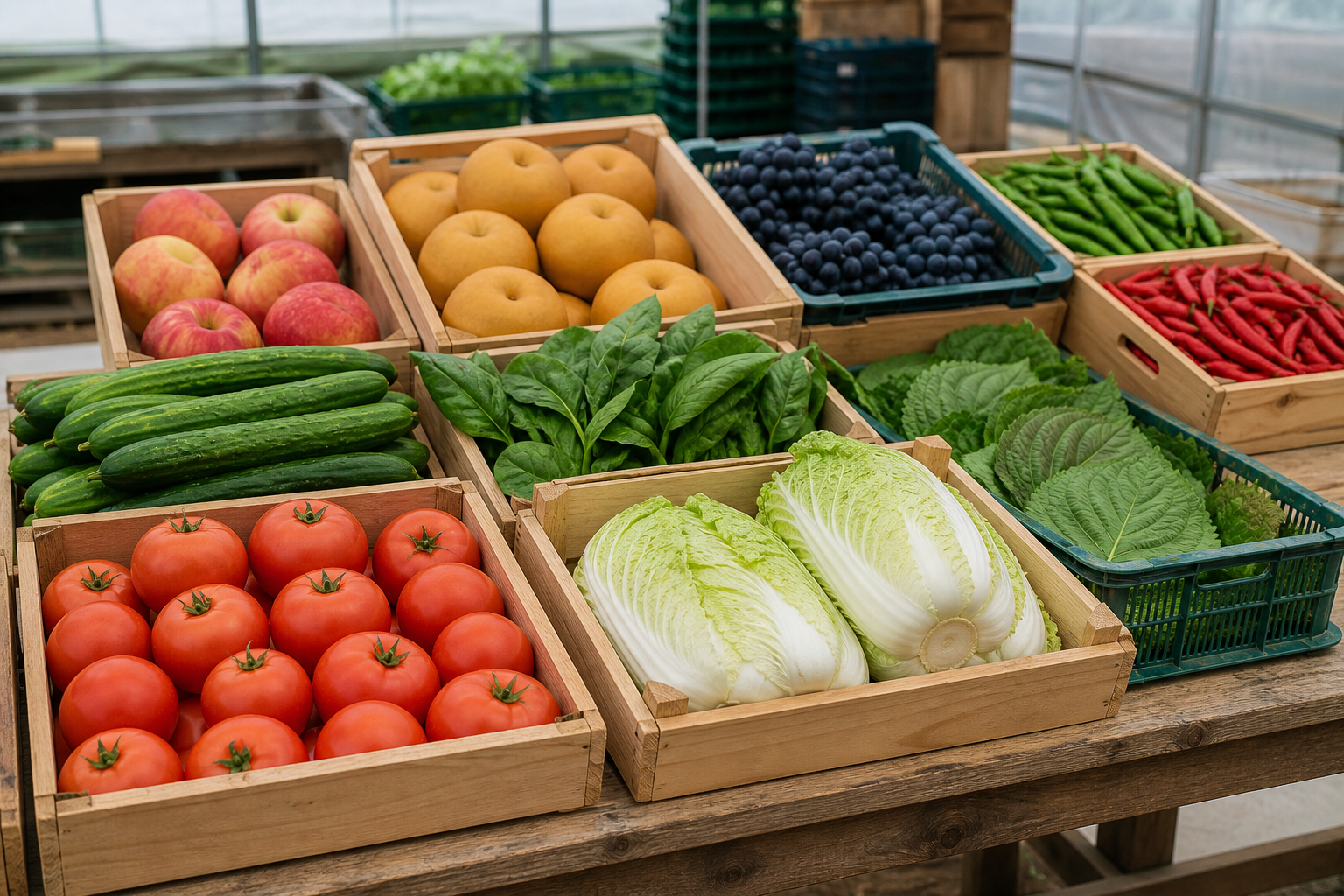
A farmer-facing September produce price table based on KAMIS wholesale prices as of August 27, 2026, covering tomatoes, napa cabbage, spinach, grapes, cabbage, and other crops.
Rising and Falling Crops: September Produce Prices in One Table
September produce prices are moving in very different directions by crop. Some crops, such as tomatoes, small napa cabbage, spinach, young radish greens, and zucchini, are sharply higher than a month ago. Others, including Campbell Early grapes, Shine Muscat, Geobong grapes, cherry tomatoes, and cabbage, are lower.
For farmers, the key question is not simply whether a crop went up or down from last month. The more important question is where today’s price stands versus last year and the normal-year level. A crop can rise from last month and still be weak versus normal. Another crop can fall from last month and still remain above normal.
Bottom line: Strong September candidates are tomatoes, small napa cabbage, young radish greens, zucchini, and spinach. Weaker candidates are grapes, cherry tomatoes, and cabbage. But cabbage and grapes must be read by type and grade.
1. How to read this table
This article uses aT KAMIS wholesale prices as of August 27, 2026. The selected crops include commonly watched fruits, leafy vegetables, fruit vegetables, seasoning vegetables, and some staple crops.
The table should be read through three comparisons.
- Month-on-month: whether the price has recovered from a month ago
- Year-on-year: whether it is stronger than the same period last year
- Normal-year comparison: whether it is high or low versus the recent normal level
Month-on-month movement alone can be misleading. For example, highland napa cabbage rose 33.0% from a month earlier, but it is still 34.5% below last year and 30.1% below the normal-year level. Hongro apples, meanwhile, have no one-month comparison in this KAMIS row, but they are close to last year and 19.4% above normal.
2. September produce price table
The table below uses wholesale prices. Units differ by crop, so focus on percentage movement rather than the absolute price alone.
| Direction | Crop | Unit | Aug. 27 price | MoM | YoY | Normal-year | September reading |
|---|---|---|---|---|---|---|---|
| Rising | Tomato | 5kg premium | 31,800 KRW | +147.0% | +36.7% | +51.6% | Clear strength |
| Rising | Small napa cabbage | 8kg premium | 38,600 KRW | +123.1% | +4.0% | +2.0% | Sharp recovery, currently firm |
| Rising | Young radish greens | 4kg premium | 20,000 KRW | +84.0% | +59.8% | +68.3% | Short-term strength |
| Rising | Zucchini | 20-count premium | 35,500 KRW | +83.7% | +27.3% | +31.9% | Strong zone |
| Rising | Spinach | 4kg premium | 75,000 KRW | +80.2% | +14.5% | +2.5% | Strong post-heat recovery |
| Rising | Young cabbage greens | 4kg premium | 14,300 KRW | +59.6% | +14.7% | +18.9% | Leafy-vegetable strength |
| Rising | Highland radish | 20kg premium | 18,600 KRW | +48.4% | +31.4% | -9.8% | Strong versus last month and last year |
| Rising | Perilla leaves | 2kg premium | 34,500 KRW | +48.0% | +17.1% | -0.1% | Back near normal |
| Rising caution | Highland napa cabbage | 10kg, 3 heads premium | 13,000 KRW | +33.0% | -34.5% | -30.1% | Recovered from last month, still weak |
| Flat/firmer | Green lettuce | 4kg premium | 42,300 KRW | +20.0% | -3.5% | -3.2% | Higher than last month, near normal |
| Flat/firmer | Cucumber | 50-count premium | 42,800 KRW | +22.8% | +4.5% | +1.9% | Stable upward move |
| Flat/firmer | Green onion | 1kg premium | 2,320 KRW | +10.5% | +11.3% | +5.7% | Mild strength |
| Falling | Campbell Early grape | 3kg L | 22,800 KRW | -26.6% | +0.6% | +0.6% | Weaker than last month, normal level holds |
| Falling | Red pepper | 10kg premium | 45,000 KRW | -25.2% | -15.4% | -14.0% | Weak |
| Falling | Shine Muscat | 2kg L | 16,000 KRW | -18.7% | -5.4% | -24.4% | Weak versus normal |
| Falling | Geobong grape | 2kg L | 16,400 KRW | -14.9% | +0.6% | -11.3% | Weak versus normal |
| Falling | Cherry tomato | 3kg premium | 12,000 KRW | -14.8% | -37.0% | -37.0% | Clearly weak |
| Falling | Cabbage | 8kg premium | 6,000 KRW | -12.2% | -30.1% | -32.8% | Weakness continues |
| Falling | Rice | 20kg premium | 59,000 KRW | -3.2% | +5.2% | +14.2% | Slightly down from last month but above normal |
Two points stand out. First, leafy vegetables and some fruit vegetables are firm. Second, grapes, cabbage, and cherry tomatoes are weak.
3. Rising crops: tomatoes, small napa cabbage, and spinach stand out
Tomatoes are the clearest outlier. Premium tomatoes were 31,800 KRW/5kg, up 147.0% from a month earlier. They were also 36.7% above last year and 51.6% above normal. This is not just a small rebound; it is a strong-price zone.
Small napa cabbage is also firm. Premium 8kg small napa cabbage was 38,600 KRW, up 123.1% from a month earlier and slightly above last year and normal. This should be separated from regular highland napa cabbage, which is still below last year and normal.
Spinach, young radish greens, young cabbage greens, and perilla leaves are also on the stronger side. After hot weather, leafy vegetables can move sharply because growth, harvest timing, and quality all change quickly. Spinach rose 80.2% from a month ago. Young radish greens rose 84.0%.
Farmers should not treat these as crops to hold indefinitely. Leafy vegetables can weaken quickly if shipments rush in after a price rise. Good lots should move while prices are strong, while medium-grade lots should be separated before the market turns.
4. Falling crops: grapes and cherry tomatoes are cautious
Grapes are weaker in the early-September price table. Campbell Early L fell 26.6% from a month earlier. Geobong L fell 14.9%. Shine Muscat L fell 18.7%.
Campbell Early is still close to last year and normal, so it is not a collapse. But Shine Muscat is 24.4% below normal. That means the variety name alone no longer protects the price. Sweetness, cluster shape, berry size, and buyer trust matter more.
Cherry tomatoes also need caution. Premium jujube cherry tomatoes were 12,000 KRW/3kg, down 14.8% from a month earlier and 37.0% below both last year and normal. Regular tomatoes are strong, but cherry tomatoes are weak. They should not be read as the same market.
Cabbage is also weak. Premium cabbage was 6,000 KRW/8kg, down 12.2% from a month earlier and more than 30% below last year and normal. For cabbage farmers, shipment timing and channel-specific pricing matter more than waiting for a broad rebound.
5. Confusing crops: highland napa cabbage and rice
Highland napa cabbage looks like a rising crop because it is up 33.0% from a month earlier. But it is still 34.5% below last year and 30.1% below normal. So this is a recovery from a low base, not a strong market.
Rice is the opposite. It is down 3.2% from a month earlier. But premium 20kg rice is still 5.2% above last year and 14.2% above normal. This is a short-term adjustment within a still-high price position.
For these crops, one comparison is not enough. A farmer price sheet should list month-on-month, year-on-year, and normal-year comparisons together.
6. How farmers can set September price sheets
September prices are affected by Chuseok demand, hot-weather quality gaps, and shipment volume. Average market prices often differ from actual farm-gate selling prices.
A practical approach:
- Move rising crops while quality is good: tomatoes, spinach, young radish greens, and small napa cabbage should not be held too long.
- Separate grades for weak crops: grapes, cherry tomatoes, and cabbage need premium, medium, home-use, and discounted channels.
- Do not trust only month-on-month gains: highland napa cabbage is up from last month but still weak versus last year and normal.
- Do not discount crops still above normal too aggressively: rice, Hongro apples, and Wonhwang pears remain firm versus normal.
- Make separate gift-box pricing: apples, pears, and grapes should have separate Chuseok gift and home-use price sheets.
7. Bottom line
The September 2026 produce market is clear when seen in one table. Tomatoes, small napa cabbage, young radish greens, zucchini, spinach, and young cabbage greens are rising. Grapes, cherry tomatoes, and cabbage are falling.
But price judgment should not stop there. Highland napa cabbage is higher than last month but still weak versus last year and normal. Rice is lower than last month but still above normal. Shine Muscat may benefit from holiday demand, but its normal-year comparison remains weak.
For September farm price sheets, do not rely on one average price. Use month-on-month, year-on-year, and normal-year comparisons together. Move strong crops quickly while quality is good, and defend weak crops through grade separation and channel strategy.
References
- aT KAMIS Agricultural Price Information, wholesale prices as of August 27, 2026.
- KAMIS prices are reference market averages. Actual transaction prices may vary by origin, market, brand, grade, quality, and packaging condition.