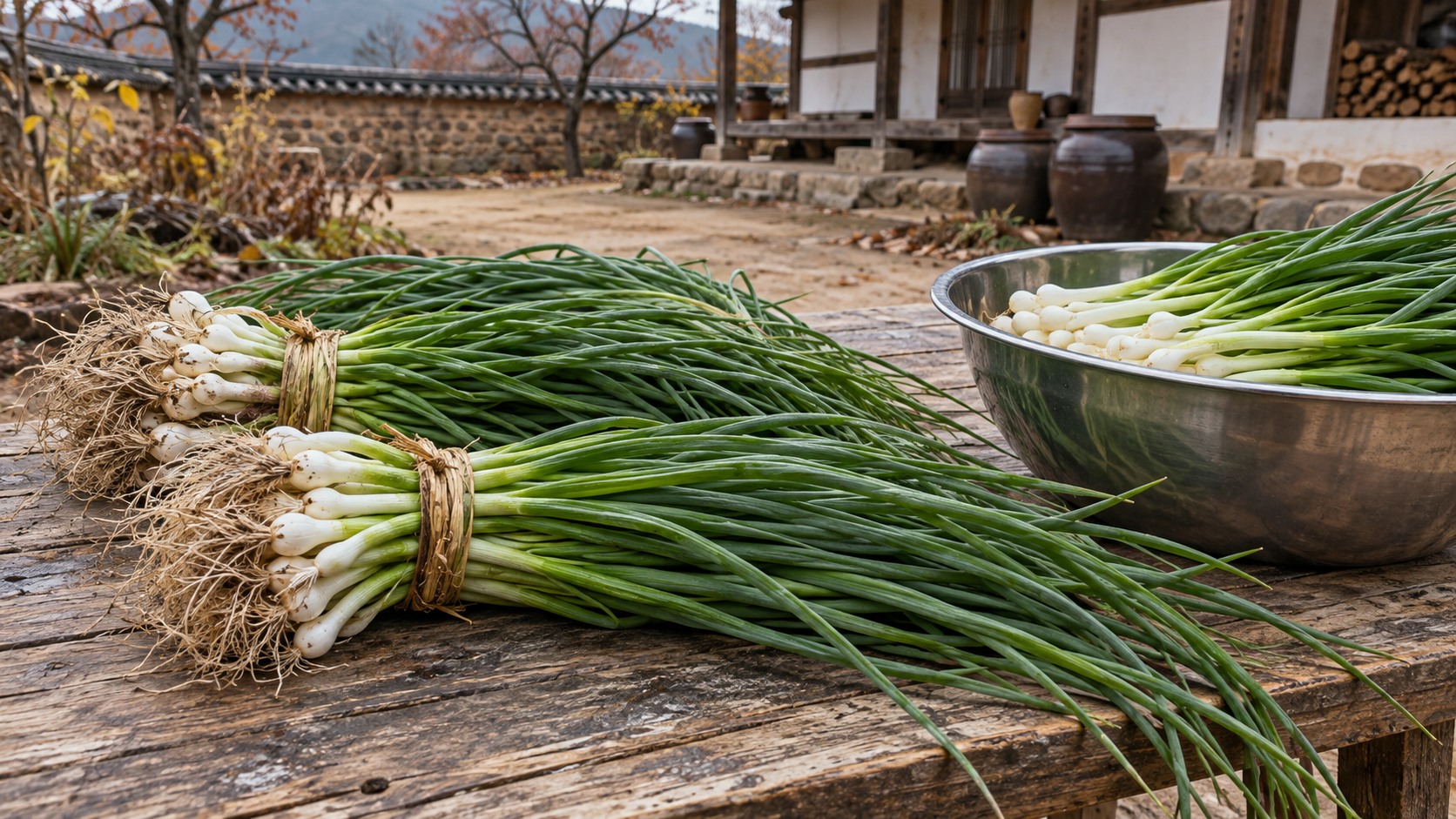
KAMIS data as of October 27, 2026: jjokpa wholesale prices in five Korean cities compared with a year earlier, how October prices moved into November over 11 years, how much to buy for pa-kimchi, and when growers harvest and ship.
Jjokpa, the thin Korean scallion with a small white bulb, is the last thing a household buys before kimjang, the late-autumn kimchi making. Chili powder and fermented fish sauce are bought early, but scallions wilt fast, so they are bought a few days before. That is why families check the price again at the end of October. This year the price that sat near KRW 10,000 per kilogram in September fell sharply within ten days.
Bottom line: In the KAMIS survey on October 27, 2026, top-grade jjokpa sold at wholesale in Seoul for KRW 6,000 per kilogram. It was KRW 9,500 until October 16, then dropped to 6,750 on the 19th and 6,000 on the 23rd, a 37% fall in ten days. It is 26% lower than a year earlier (KRW 8,120). Over the past 11 years, Seoul prices rose six times and fell five times from October to November, with wide swings, so waiting for November is not a safe bet.
Earlier records: when to plant jjokpa (early October) and the 2026 kimjang cost checklist.
1. Wholesale price at the end of October
| City | Per kg, KRW (Oct 27) | Oct 1 | A year earlier | Change |
|---|---|---|---|---|
| Daegu | 6,660 | 9,330 | 8,160 | −18.4% |
| Seoul | 6,000 | 9,500 | 8,120 | −26.1% |
| Busan | 5,000 | 8,000 | 7,000 | −28.6% |
| Gwangju | 3,830 | 7,660 | 11,000 | −65.2% |
| Daejeon | 3,160 | 3,500 | 5,550 | −43.1% |
All five cities are below their October 1 price and below last year. Gwangju spiked to KRW 11,000 at this time last year, which exaggerates its year-on-year drop. Daejeon has moved on its own in the KRW 3,000 range since late September and swings day to day, so it is safer to read Seoul, Busan, and Daegu together. Medium grade in Seoul was KRW 4,000 per kilogram the same day. Daily prices are on the jjokpa price page.
2. Will November be cheaper?
Korea’s Rural Development Administration (RDA) schedules the field harvest of kimjang scallions for October and November, and the price break lines up with that window. KAMIS records prices only, so it does not by itself show that volume caused the drop.
| Year | October avg | November avg | Change |
|---|---|---|---|
| 2015 | 2,324 | 2,476 | +6.5% |
| 2016 | 3,795 | 5,600 | +47.6% |
| 2017 | 2,394 | 2,155 | −10.0% |
| 2018 | 2,971 | 2,659 | −10.5% |
| 2019 | 3,995 | 3,343 | −16.3% |
| 2020 | 4,671 | 6,167 | +32.0% |
| 2021 | 6,684 | 7,011 | +4.9% |
| 2022 | 5,553 | 4,636 | −16.5% |
| 2023 | 7,737 | 5,364 | −30.7% |
| 2024 | 7,990 | 8,769 | +9.7% |
| 2025 | 7,648 | 8,123 | +6.2% |
The average change was +2.1%, but the range runs from +47.6% to −30.7%. Scallions are a leafy vegetable, and weather and shipments move them quickly. Seoul’s October 2026 daily average so far is about KRW 8,240, so today’s KRW 6,000 is already on the cheap side of this month.
3. How much to buy for pa-kimchi
A survey of a four-person household’s kimjang (20 napa cabbages) by Korea Price Research Center counted two bunches of jjokpa. A pa-kimchi recipe published by the National Health Insurance Service also starts from two bunches, with one cup of anchovy fish sauce, two cups of chili powder, half a cup of glutinous rice paste, and four tablespoons of salted shrimp. A “bunch” has no fixed weight, so ask for the weight in kilograms. At KRW 6,000 per kilogram, 2 kg costs KRW 12,000 at wholesale. Retail adds distribution costs.
The recipe salts the white ends with half of the fish sauce first and soaks the chili powder in the remaining sauce rather than water. Too much water makes the scallions go limp.
4. Picking, trimming, and storing
Choose deep green leaves without dry tips and firm, plump white bases. Trim roots and peel the outer layer before washing, then drain well. Unwashed scallions wrapped in paper keep for a few days upright in the fridge. Chopped scallions can be frozen for soups, but thawed ones are too soft for pa-kimchi.
5. When growers harvest and ship
Field jjokpa for kimjang is planted from late August to early September and harvested about 40 days later. With November prices rising and falling in almost equal numbers of years, waiting a month offers little edge, while leaving plants in the field risks dry tips and frost that push them from top grade to medium, a KRW 2,000 per kilogram gap in Seoul this week. Direct sellers do better timing harvest to the week their customers make kimchi. City gaps matter too: Daegu KRW 6,660, Seoul 6,000, Busan 5,000.
6. Checklist
- Seoul top grade KRW 6,000 per kg, medium KRW 4,000 (Oct 27); 26% below last year.
- Down 37% in ten days from KRW 9,500.
- October to November: six rises, five falls in 11 years, with wide swings.
- Two bunches for 20 cabbages; two bunches for one batch of pa-kimchi. Confirm the weight in kg.
- Growers: protect the grade before chasing the price.
References
- Korea Agro-Fisheries & Food Trade Corporation (aT) KAMIS, intermediate wholesaler prices (Public Data Portal): jjokpa top and medium grade per kg, Seoul, Busan, Daegu, Gwangju, Daejeon, October 27, 2025 and September–October 27, 2026.
- aT KAMIS monthly wholesale and retail prices: Seoul jjokpa top grade, October 2015 to November 2025.
- RDA National Institute of Horticultural and Herbal Science, “Characteristics and cultivation of jjokpa” (December 2018); RDA webzine, September 2020.
- National Health Insurance Service, Geongang iN magazine, January 2019 (pa-kimchi recipe).
- Joongdo Ilbo, November 16, 2025 (Korea Price Research Center kimjang survey quantities).
- Wholesale prices are intermediate wholesaler selling prices, not farm-gate or retail prices.