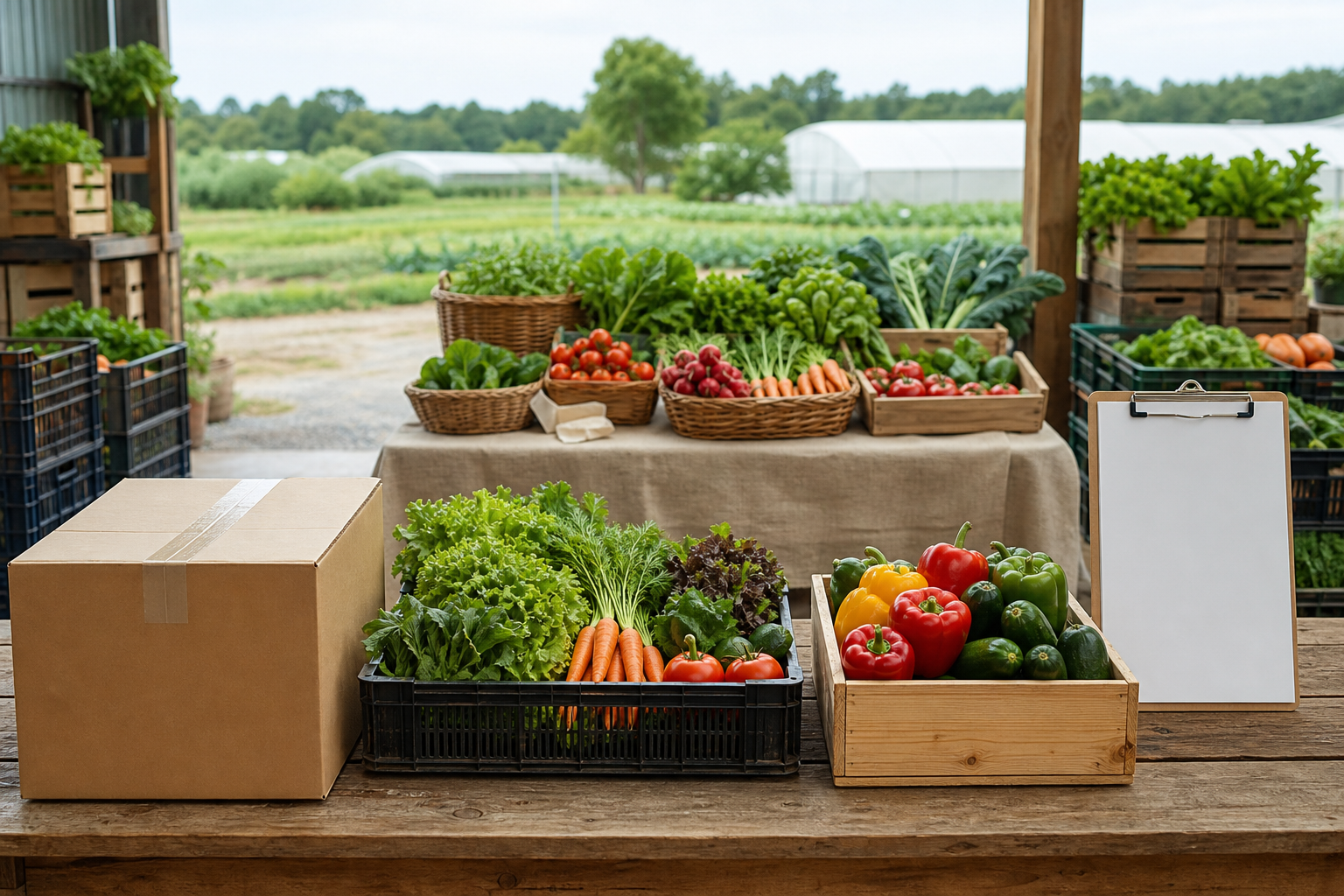
A practical margin comparison for beginner farmers choosing between contract growing, local food direct stores, and online produce sales.
Contract Growing vs Local Food Stores vs Online Sales for Farm Margins
Farming does not end in the field. Another kind of farming begins when the produce is packed, priced, and sent somewhere. Beginner farmers often struggle most at this point. Good crops do not help much if they cannot be sold. Average crops can still create cash flow if the sales channel is right.
Is contract growing more stable. Is a local food direct store better. Is online direct sales the highest-margin path. All three can work. But their margin structures are very different. The real question is not the price printed on the product. The real question is how much reaches the farmer’s bank account.
This article compares three common sales channels for beginner farmers: contract growing, local food direct stores, and online sales. There is no single best answer. The right channel depends on crop type, volume, labor, packing ability, and customer service capacity.
1. Compare net margin, not the selling price
The biggest mistake in produce sales is treating a high selling price as high profit. If a box sells online for 30,000 KRW, that does not mean the farmer receives 30,000 KRW. Delivery, packaging, platform fees, payment fees, returns, customer support, product photography, page design, and advertising all eat into the number.
Local food direct stores also have costs. The farmer can often set the price and stay close to consumers. But store commission, sorting, packaging, labels, transport, display work, and unsold product collection all matter. Contract growing may show a lower unit price, but it can stabilize volume and cash flow. If the contract terms are weak, quality standards and delivery obligations can become painful.
So each sales channel should be calculated this way.
- Start with the selling price.
- Subtract direct product cost.
- Subtract commission and transport.
- Subtract packaging, sorting, returns, and waste.
- Convert your own labor time into money.
- What remains is the real margin.
The ledger is cold. Customer likes do not pay for boxes.
2. Contract growing is mainly about stability
Contract growing means the farmer and buyer agree in advance on price, quantity, quality, and delivery timing. KREI materials describe it as a transaction in which a producer and a contracting buyer make an agreement for future produce, the producer grows the crop, delivers it, and receives payment. In plain words, the sale is promised before harvest.
The biggest strength is stability. When the buyer is known, the farmer can focus on production. If the market price collapses, the contract can act as a cushion. This is especially useful for crops linked to processors, food service, distribution centers, cooperatives, or food companies.
The margin usually does not jump very high. The buyer also carries risk, so the price is often conservative. The farmer may miss the market peak. But the farmer may also avoid the market bottom. Contract growing is less about hitting the jackpot and more about reducing disaster.
The cost focus is different. Instead of parcel delivery and online customer service, the farmer must look at quality standards, off-grade treatment, delivery timing, shortage liability, and cancellation clauses. Weather damage is especially important. Agriculture is not factory production. Rain, disease, and pests arrive without asking. If the contract ignores that reality, the paper can become a knife.
3. A simple contract growing example
Imagine a farmer grows onions or potatoes under contract. The market price might rise to 1,200 KRW per kg, while the contract price is 850 KRW. At first, that looks disappointing. But if the market price falls to 600 KRW, the contract becomes a shield.
A simple structure may look like this.
- Contract price: 850 KRW per kg.
- Production volume: 10,000 kg.
- Sales revenue: 8.5 million KRW.
- Sorting, loading, and transport burden: 0.5 to 1.5 million KRW depending on the contract.
- Practical receipts: roughly 7 to 8 million KRW before production cost.
The exact number depends on crop and contract terms. The structure is what matters. Contract growing is not primarily a channel for maximizing price. It is a channel for reducing uncertainty. For a beginner farmer, that stability can be valuable. Price gambling in the first year can crack the mind like dry soil.
Contract growing suits farms that can produce volume, keep quality consistent, and meet delivery schedules. It may be less exciting for small multi-crop farms, experience farms, or premium direct-sales farms.
4. Local food direct stores give farmers pricing power
A local food direct store lets nearby farmers bring produce directly to a regional store where consumers buy it. Many stores follow a structure where farmers transport, package, price, label, and display products, while the store handles sales. Local food FAQ pages and local government materials often discuss shipment rules, commissions, and processed food requirements.
The attractive part is pricing power. The farmer is less exposed to auction price swings. Consumer reaction is visible immediately. If tomatoes sell out in the morning, the display tells the farmer. If they remain until evening, the display also tells the farmer. That feedback is a useful classroom for beginners.
The margin structure sits in the middle. The selling price can be higher than contract growing. Packaging, delivery, and customer service are usually lighter than online sales. But store commission exists, and the farmer must manage delivery, display, and unsold products. Quality problems are visible immediately. Consumers are quiet but strict. They pass by wilted leaves without a speech.
The real strength is that small volumes can be sold. Local food direct stores can help small, elderly, or new farmers who do not fit large distribution channels. Korean National Assembly Research Service materials also describe local food direct stores as an important sales route for small and elderly farmers and a tool for income improvement.
5. A simple local food margin example
Suppose a lettuce pack sells at a local food store for 2,000 KRW. If the store commission is assumed at 10 to 15%, and packaging and label cost around 150 to 250 KRW, the structure becomes clear.
- Consumer price: 2,000 KRW.
- Store commission at 12%: 240 KRW.
- Packaging and label: 200 KRW.
- Amount before labor and waste: 1,560 KRW.
- Harvest, sorting, transport, display, and unsold product management still remain.
The product sells for 2,000 KRW, but the real margin starts from 1,560 KRW minus labor and waste risk. Even so, this can be better than wholesale for many crops. Freshness and local identity can be rewarded.
The labor should not be ignored. Morning harvest, sorting, packing, transport, display, stock check, and collection can take half a day. Small amounts repeated every day can become tiring. Local food is not an effortless channel. It is a nearby channel. Nearby still takes hands.
6. Online sales can have high prices and high hidden costs
Online sales look the most attractive at first. The farmer can reduce middlemen and sell to consumers nationwide. Smart Store, marketplace platforms, own websites, social media, and live commerce all offer routes. If it works, the farm builds a brand and customer list.
But the cost structure is complicated. Platform fees, payment fees, parcel delivery, boxes, cushioning materials, labels, invoice handling, product pages, photography, advertising, customer questions, exchanges, refunds, and damage compensation all follow. Fresh produce carries more return risk than manufactured goods. One hot delivery day can turn a box into a tiny sauna.
Korean agricultural project guideline materials for direct sales mention business registration, mail-order business reporting, parcel contracts, and bank account preparation for online sales. Fresh produce and processed food are not treated the same. If the farmer sells processed products, food business reporting, labeling, origin marking, hygiene rules, and shelf-life management must be checked. Online sales may start from a phone, but logistics and administration stand behind it.
The advantage is pricing power and brand building. The disadvantage is that the farmer carries everything. The farmer becomes producer, packer, customer service staff, photographer, marketer, and shipping manager. After fieldwork, another field opens on the computer.
7. A simple online margin example
Suppose a 2 kg box of cherry tomatoes sells online for 30,000 KRW. The selling price looks strong. The margin changes once costs are subtracted.
- Consumer price: 30,000 KRW.
- Platform and payment fee at 5%: 1,500 KRW.
- Parcel delivery: 3,500 to 4,500 KRW.
- Box, cushioning, labels, invoice, and packing materials: 1,500 to 2,500 KRW.
- Advertising, coupons, live commerce, damage, and reshipping can add more.
With delivery at 4,000 KRW, packaging at 2,000 KRW, and platform fees at 1,500 KRW, only 22,500 KRW remains before production cost and labor. Online sales can earn a higher price, but the cost line follows closely. Where the needle goes, the thread follows.
Online sales suit farms with consistent quality, reliable packing, good photos and explanations, and time for customer support. If production volume fluctuates, packing space is weak, or delivery complaints feel overwhelming, scaling online sales too early can be risky.
8. Comparing all three with the same 1 million KRW sales assumption
To compare the structures, imagine 1 million KRW in sales or contract value. This is not exact accounting. It is a structural example.
Contract growing may have little commission but a lower unit price. If sorting, loading, and transport cost 100,000 KRW, about 900,000 KRW remains before production cost. The key benefit is lower sales risk and lower price-collapse risk.
Local food direct stores may allow a higher retail price but subtract commission and packaging. If commission is 120,000 KRW, packaging and labels 80,000 KRW, and transport or collection 50,000 KRW, about 750,000 KRW remains before production cost and labor. Waste and unsold products can reduce it further.
Online sales may subtract platform fees of 50,000 KRW, parcel delivery of 150,000 to 250,000 KRW, packaging of 80,000 to 150,000 KRW, plus advertising, coupons, and complaints. The remaining amount may look like 550,000 to 700,000 KRW before production cost and labor. But the farm also gains brand and customer data.
This does not mean online sales are bad. It means a high retail price can hide high logistics cost. Local food is a middle balance. Contract growing is the stability option. Each channel has a different margin shape.
9. Beginners should not bet everything on one channel
Putting everything into one sales channel is risky. Only using contract growing can miss high market prices. Only using local food can tie the farmer to daily display work and unsold products. Only using online sales can exhaust the farmer with packing and customer service.
A three-layer mix is often more realistic. First, stabilize base volume through contract growing or fixed buyers. Second, send high-quality small batches and multi-crop items to local food stores. Third, test premium, giftable, or story-driven products online.
For example, a tomato farm can send bulk or B-grade product to a contracted buyer, sell fresh small packs through local food, and sell selected high-sugar boxes online. That spreads the strengths and weaknesses. The old rule about not putting all eggs in one basket works in produce sales too.
10. Different crops fit different channels
Leafy greens need freshness and have low unit price. Local food stores and restaurant supply often fit better. Parcel delivery can be difficult for beginners because freshness and packing are demanding.
Fruit vegetables have more options. Tomatoes, cucumbers, peppers, eggplants, and similar crops can mix local food, online sales, and contract growing. But sorting and damage control matter. Once a box is crushed, customer service begins.
Fruit crops can work well online and as gift products. But sweetness, size, blemishes, packaging, delivery temperature, and complaint standards must be clear. Contract growing may fit processing or specific distributors. Local food can test regional consumer response.
Processed farm products can work in both online and local channels. But food hygiene, labeling, shelf life, origin marking, and business reporting must be checked. A jar of jam may look cute. The paperwork is not cute.
11. A checklist before choosing a sales channel
Before choosing a channel, answer these questions. Skipping them can lead to regrets while taping boxes late at night.
- How much can the farm supply per day or per week.
- How will standard and off-grade products be separated.
- Can the farm explain its sorting standards with photos.
- What is the unit cost of packaging.
- What is the parcel delivery rate.
- What are the rules for returns, damage, and reshipment.
- What are the local food commission rate and settlement cycle.
- What are the contract quality standards and shortage obligations.
- Are business registration, mail-order reporting, origin labeling, and food-related reporting checked.
- What hourly value will be assigned to the farmer’s own labor.
The last question matters most. If the farmer’s labor is counted as zero, every channel looks profitable. But the farmer’s body is not a free machine.
12. A realistic starting order for beginner farmers
The safest start is to sell small and learn fast. Local food direct stores are useful for learning consumer reaction. A beginner can test small volumes, change packaging, and see which items move.
Then add fixed buyers or contract growing to stabilize volume. A slightly lower price can be worth the calm. Not having to search for buyers during harvest season is already a real benefit.
Online sales should usually scale last. Photos, product pages, reviews, packing, delivery, and customer service need to be ready. Instead of spending heavily on online ads in the first year, it may be better to test online gift boxes with products that already sold well offline. Start small, learn fast, and scale slowly.
One-line summary
Contract growing offers stability, local food direct stores offer pricing power and consumer feedback, and online sales offer higher retail prices and brand building; beginner farmers should compare net margin after commission, packaging, delivery, returns, and labor time.
References
- Korea Rural Economic Institute,
How to Activate Vegetable Contract Growing?, Agricultural Outlook material. - Ministry of Agriculture, Food and Rural Affairs public data,
Contract Growing Status for Open-field Vegetables. - Baroinfo,
Local Food Direct Store FAQ, https://www.baroinfo.com/front/M000000732/baroFAQ/list.do - Jeonbuk Institute,
Local Food Direct Store Operation Manual. - National Assembly Research Service,
Locations of Local Food Direct Markets and Vitalization Plan. - Ministry of Agriculture, Food and Rural Affairs, project guideline materials for agricultural direct sales support.
- Nongmin Newspaper,
Special Feature on Online Agricultural Product Distribution. - Korea Farmers and Fishermen Newspaper,
The Standard for Agri-food Distribution Innovation in the Digital Era, 2022-05-20.