A practical home-scale plan for earning about 300,000 KRW per month from tropical fish and aquatic plants: tank count, lighting, species selection, electricity, and sales.
A spare corner at home can trigger a very specific idea. What if you put a few tanks on a rack, breed tropical fish, grow aquatic plants, and make around 300,000 KRW per month? It is not a huge income target. If feed, electricity, and packing costs are covered and some money remains, it feels like a realistic side business.
It can work. The trick is not adding as many tanks as possible. For a 300,000 KRW monthly net-profit target, the system has to stay small, repeatable, and focused on items that actually sell.
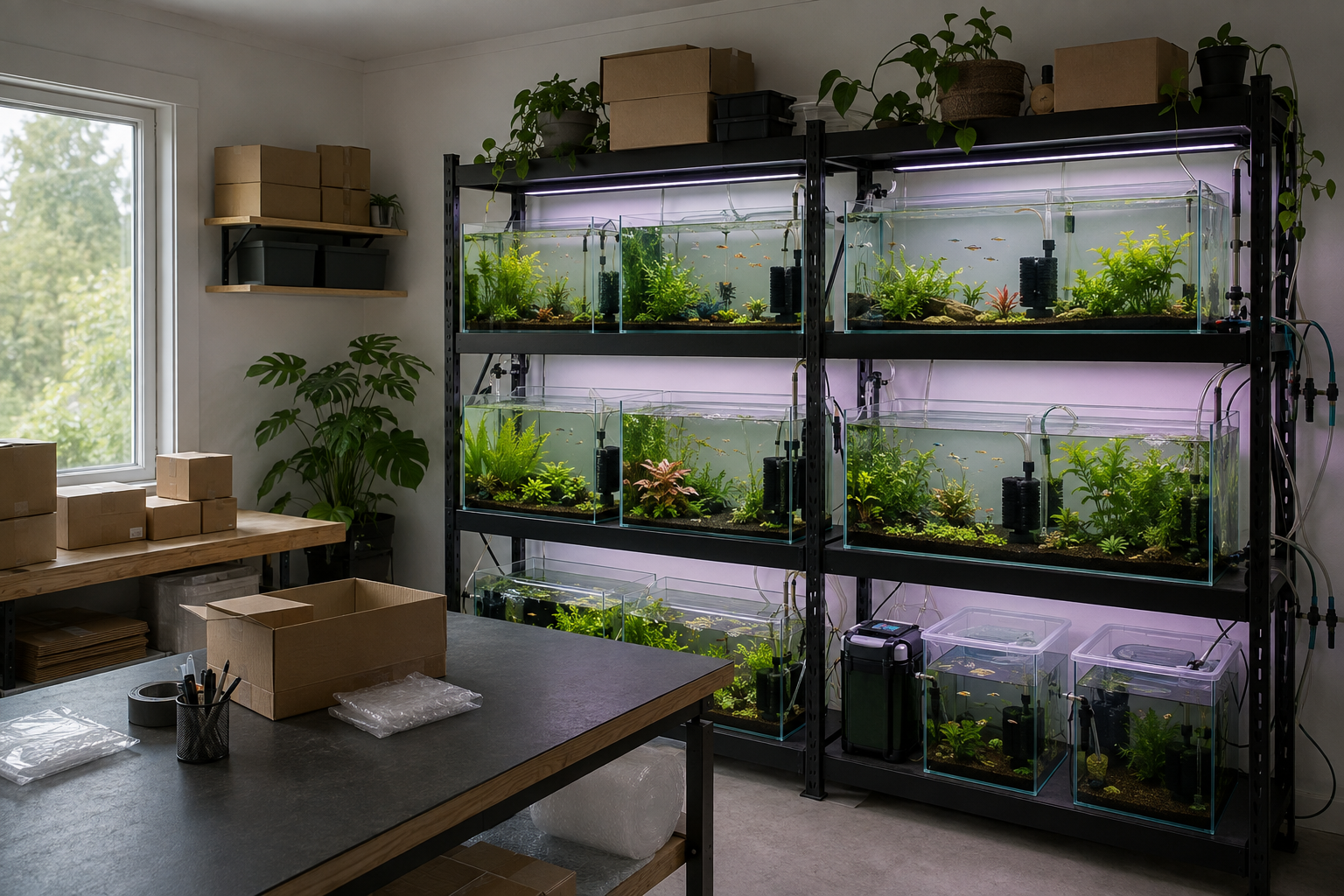
The short answer: start with about 12 tanks
Starting with 30 tanks is a bad idea for most beginners. Wiring becomes messy, water changes become tiring, and disease can move fast. Three or four tanks are safer, but they rarely create enough sales volume.
A realistic home setup for a 300,000 KRW monthly net-profit target looks like this.
| Item | Recommended setup |
|---|---|
| Tank count | 10 to 12 small tanks, around 30cm cube or under 2 feet |
| Operating model | 6 fish-breeding tanks, 4 plant-growing tanks, 2 quarantine or fry tanks |
| Revenue target | 600,000 to 700,000 KRW per month |
| Net-profit target | About 300,000 KRW after electricity, feed, packing, and losses |
| Daily management time | 20 to 40 minutes on weekdays, 1 to 2 hours on weekends |
The number to remember is 12 tanks. It is close to the upper limit that a beginner can manage at home, and also close to the lower limit for generating enough monthly inventory.
Use a 60% fish, 40% plant mix
Fish-only systems have higher mortality and timing risk. Plant-only systems can work, but unit price and presentation become harder. For this income target, mixing tropical fish and aquatic plants is safer.
A good ratio is about 60% fish and 40% aquatic plants.
| Category | Tank count | Role |
|---|---|---|
| Selected guppy line | 3 | Main sales item |
| Shrimp or small fish | 2 | Pairs well with plant packages |
| Fry grow-out tank | 1 | Grows fish to sellable size |
| Aquatic plant grow-out tanks | 4 | Builds steady small cash flow |
| Quarantine tanks | 2 | Separates new or sick stock |
If you start with 10 tanks, reduce the plant tanks to three and the quarantine tanks to one. Do not remove quarantine completely. One disease outbreak can erase months of work.
The best tropical fish is not a rare fish. It is a selected guppy line
For a 300,000 KRW target, the most realistic fish is the guppy. More precisely, it is one or two selected guppy lines with clear color and body traits.
Guppies make sense because they breed fast, tolerate beginner mistakes better than many species, photograph well, and can be sold as pairs, trios, or groups of young fish. They also do not require huge tanks.
Do not build the business around very cheap mixed guppies. Price competition is too strong. Choose one line with a clear visual difference: blue, red, metallic, or another stable line that photographs well. One stable line is enough at the beginning.
Good beginner candidates are below.
| Candidate | Strength | Caution |
|---|---|---|
| Selected guppy | Fast breeding and good product photos | Line maintenance and inbreeding control matter |
| Cherry shrimp or blue velvet shrimp | Easy to bundle with plants | Sensitive to water changes |
| Some corydoras types | Strong hobbyist demand | Breeding takes more patience |
| Betta | Good unit price | Individual management takes time |
Start with selected guppies. Use shrimp as a supporting item for planted-tank packages. Add corydoras or bettas only after you have experience.
The best aquatic plants grow fast and ship easily
A plant side business should not start with expensive rare plants. Premium plants can melt, adapt slowly, or create disputes when photos look better than the delivered product. For a 300,000 KRW target, easy plants with repeat sales are better.
A practical plant mix is below.
| Plant | Use | Sales format |
|---|---|---|
| Anubias nana types | Hardy beginner plant | Attached to wood or stones |
| Common Bucephalandra types | Small, attractive, higher unit price | Small premium bundles |
| Java moss and Christmas moss | Fits shrimp tanks | Mesh, stone, or wood attachments |
| Rotala and Ludwigia | Fast growth and easy trimming | Stem bundles |
| Some floating plants | Fast propagation | Low-price bundle or service item |
The best product is not a single plant name. It is a beginner package. A “30cm tank low-light plant set” is easier to buy than a random list of Latin names.
Good package ideas are below.
- Low-light plant set for a 30cm tank.
- Moss and Anubias set for shrimp tanks.
- Guppy fry hiding plant set.
- Ready-made attached plant on wood or stone.
Customers often buy the promise that their tank will look better. Package design matters.
Lighting: avoid going too bright
In a home side business, strong lighting often creates algae before profit. Plants grow faster, but glass cleaning, water changes, and algae control take more time. If the work becomes too heavy, the side business collapses.
Use low to medium light.
| Tank | Light | Photoperiod |
|---|---|---|
| Guppy breeding tank | 8W to 12W LED for a 30cm tank | 7 to 8 hours per day |
| Plant grow-out tank | 12W to 18W LED for a 30cm tank | About 8 hours per day |
| Moss and Anubias tank | 8W to 12W LED for a 30cm tank | 6 to 7 hours per day |
| Photo tank | Separate brighter light | Only for shooting photos |
Use timers. Manual on-off control always fails eventually. Start with 6 hours per day for the first two weeks. Increase by 30 minutes only if plant condition is good and algae stays under control.
CO₂ is not essential at the beginning. Low-light plants, mosses, Anubias, and easy stem plants are enough for a 300,000 KRW target. CO₂ can increase growth, but it also increases cost and management complexity.
Electricity: expect about 60,000 to 80,000 KRW for the tank system
The actual bill depends on the home electricity contract, season, progressive billing, heating, and humidity control. This estimate looks only at the aquarium equipment.
For 12 small tanks, the power model looks like this.
| Item | Assumption | Monthly use |
|---|---|---|
| Heaters | 12 units of 50W heaters, 40% average duty | About 173kWh |
| Lights | 12W LED lights, 12 tanks, under 10 hours per day | About 43kWh |
| Air and circulation | 24-hour operation | About 17kWh |
| Total | Seasonal variation applies | About 233kWh |
At 250 KRW per kWh, that is about 58,000 KRW. At 350 KRW per kWh, it is about 82,000 KRW. Heating and dehumidifying the room can add more.
This is why insulation matters. Window sealing, tank lids, insulation mats, and stable room temperature can reduce heater runtime. Electricity cost is decided by the room as much as by the equipment.
A 300,000 KRW monthly net-profit model
To keep about 300,000 KRW after costs, monthly revenue usually needs to be around 600,000 to 700,000 KRW.
A middle-case model looks like this.
| Item | Monthly target |
|---|---|
| 20 pairs of selected guppies | 240,000 KRW |
| Young guppy group sales | 120,000 KRW |
| 18 aquatic plant packages | 270,000 KRW |
| 4 ready-made attached plant pieces | 80,000 KRW |
| Total monthly revenue | 710,000 KRW |
| Feed, water conditioner, supplies | 80,000 KRW |
| Packing, heat packs, boxes | 80,000 KRW |
| Electricity and water | 70,000 KRW |
| Mortality, refunds, discounts, inventory loss | 180,000 KRW |
| Estimated net profit | 300,000 KRW |
This means around 40 to 50 sales per month. That is one or two orders per day. The number looks easy on paper, but photos, messages, packing, and shipping dates take real time. Keep the product list short.
Sell about five products, not twenty
A beginner does not need a large catalog. Five products are enough.
| Product | Price range | Monthly sales target |
|---|---|---|
| Selected guppy pair | 10,000 to 15,000 KRW | 20 sets |
| 10 young guppies | 20,000 to 30,000 KRW | 4 sets |
| 30cm planted-tank package | Around 15,000 KRW | 12 sets |
| Shrimp-tank moss and attachment set | 15,000 to 20,000 KRW | 6 sets |
| Ready-made attached plant on wood or stone | 20,000 to 30,000 KRW | 4 sets |
Prices are not fixed. Check local stores, online communities, resale platforms, and smart-store prices. If the average order value falls below 15,000 KRW, the work can become too tiring for the margin.
Month 1 should be a survival test
Do not buy everything in the first month.
In week 1, install only six tanks. Run filters, stabilize water, and watch temperature swings. Keep lighting at six hours per day.
In week 2, add one guppy line and easy plants. Do not move new fish directly into the main tank. Observe them in quarantine.
In week 3, plug in a power meter. Track real electricity use, nighttime temperature drops, and heater runtime.
In week 4, test product photos and packing. Before real sales, test plant packing with wet paper towels, plastic bags, and cushioning.
In month 2, expand to 10 or 12 tanks. Start posting sales listings and track which products get inquiries. In month 3, begin aiming for the 300,000 KRW monthly net-profit model.
Home setups have hidden problems
A home setup saves rent, but the living space and business space overlap.
Humidity comes first. More tanks mean higher room humidity. Ventilation and dehumidification matter if you want to avoid mold and wall damage. In winter, condensation and electricity bills arrive together.
Noise comes next. Air pumps can be more annoying than expected. If the fish room is near a bedroom, use vibration pads and think carefully about pump placement.
Shipping is the final stress point. Live fish and aquatic plants are not ordinary goods. Weather, heat packs, oxygen, sealing, arrival condition, and refund rules must be set in advance. Avoid risky shipping during the hottest and coldest periods.
Business-level ornamental fish production may require reporting
There is a difference between hobby keeping and ornamental fish aquaculture as a business. Korean law defines ornamental fish aquaculture as raising ornamental fish or producing aquatic seed. A person who runs such a business must meet facility standards and report the facility to the local government.
The law also includes grounds for startup support, facility modernization support, and support for equipment, facilities, and sales-channel expansion. Actual programs and eligibility vary by time and region.
If sales become regular and the setup grows, check with the local city or county office. Alien species release, wastewater, odor, noise, and electrical safety should be reviewed before the system gets large.
What not to do
The “do not” list matters.
- Do not start with expensive rare fish.
- Do not start with 30 tanks.
- Do not breed first and look for buyers later.
- Do not start with high-light CO₂ plant systems.
- Do not skip quarantine.
- Do not ignore summer and winter shipping risk.
- Do not sell only products under 10,000 KRW.
A 300,000 KRW side business is not a jackpot. It is a small repeatable system. Reliable species, stable lighting, quarantine, insulation, and a clear product list matter more than fancy equipment.
Final recommended setup
The safest starting point is below.
| Item | Recommendation |
|---|---|
| Tanks | 12 small tanks, 30cm cube or under 2 feet |
| Layout | One 3-tier rack or two 2-tier racks |
| Fish | One selected guppy line, with shrimp or easy small fish as support |
| Plants | Anubias, mosses, easy stem plants, common Bucephalandra |
| Lighting | Low to medium LED with timers |
| Photoperiod | Start at 6 hours, then move to 7 to 8 hours |
| Sales | Guppy pairs, young guppy groups, plant packages, attached plant pieces |
| Target | 600,000 to 700,000 KRW monthly revenue and 300,000 KRW net profit from month 3 |
This plan is not flashy. That is the point. A home side business should survive first. The person who keeps the system boring and repeatable usually wins.
References
- Korean Law Information Center, Act on the Promotion and Support of the Ornamental Fish Industry.
- Same Act, Article 2 definitions of ornamental fish, ornamental fish industry, and ornamental fish aquaculture.
- Same Act, Articles 10 to 12 on startup support, facility modernization support, and aquaculture reporting.
- Same Act, Article 19 on support for equipment, facilities, and sales-channel expansion.
- IMUN.FARM internal article, “Raising Ornamental Fish in a Smart Aquafarm: Equipment, Power, Sales.”
- Electricity and profit examples in this post are planning estimates based on 12 small tanks, 50W heaters at 40% average duty, 12W LED lighting, and roughly 40 to 50 monthly sales.