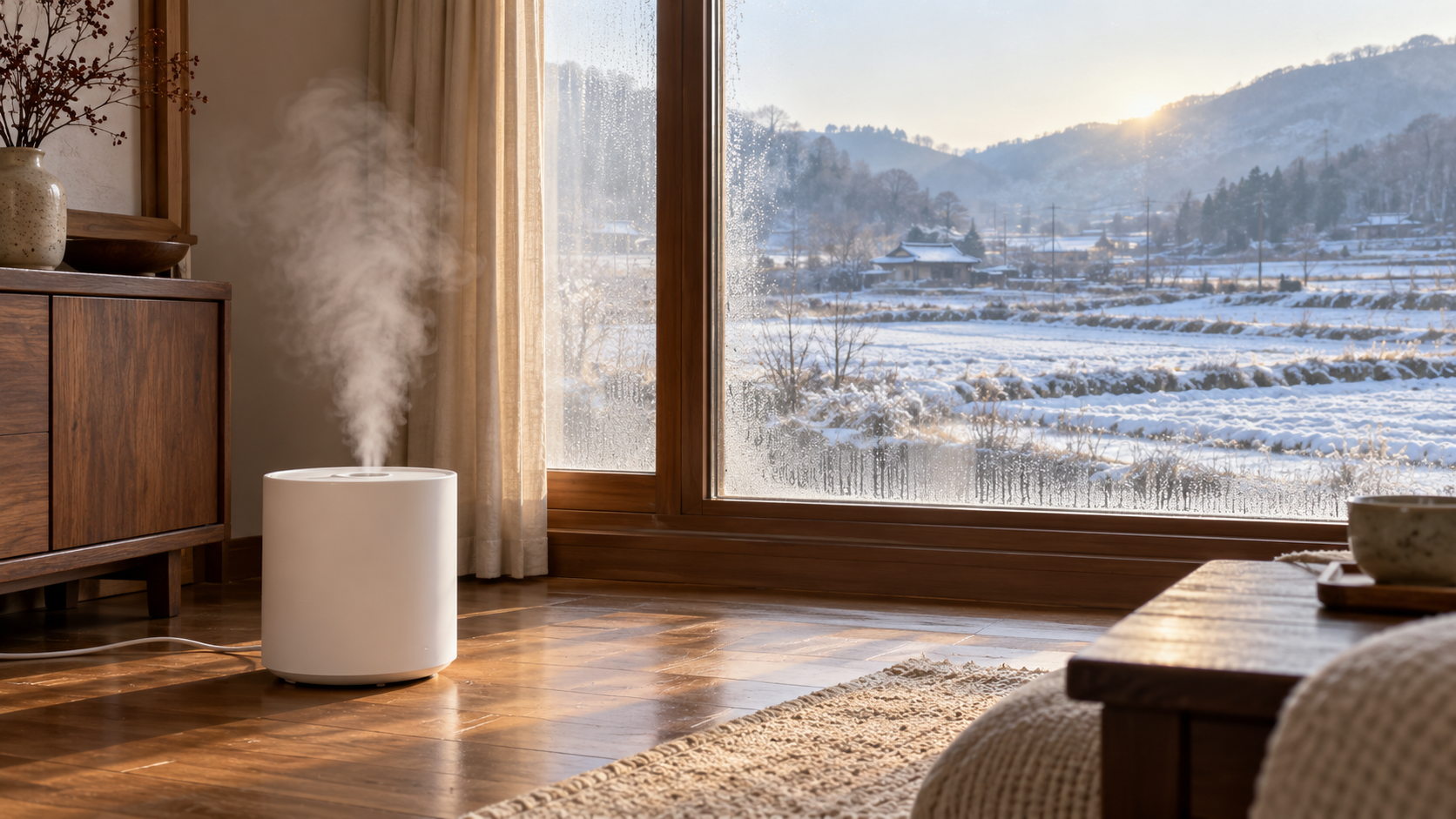
Steam (heated) humidifiers compared with ultrasonic, evaporative and hybrid types using the Korea Consumer Agency 2025 test of 13 models: output, noise, running cost, how to work out daily electricity from wattage, cleaning intervals, the ban on additives, burn risks and keeping window condensation down in a rural house.
Once the boiler and stove are running, the house dries out. By late October people dig out a humidifier or buy one, and face four types with very different prices and power use. In an old rural house or farm hut there is a second problem: raise the humidity and the windows stream with water. Here are the differences, based on official test figures.
Bottom line: A steam humidifier boils water, so hygiene is easier, but it uses the most electricity and gets hot. In a Korea Consumer Agency (KCA) test of 13 models published in October 2025, running cost for six months at 8 hours a day was KRW 72,750–91,070 for steam models and KRW 4,640–6,420 for ultrasonic. That is roughly KRW 400–500 a day versus about KRW 30. Whatever the type, change the water daily, put nothing but water in it, and aim for 40–50% indoor humidity.
Earlier notes: your tariff tier and cost per kWh in electricity bill calculation 2026, and electric heating costs in carbon mat and electric mat costs 2026.
1. Four types
| Type | How it works | Pros | Cons |
|---|---|---|---|
| Steam | Boils water into vapour | Less hygiene worry | High power use, hot outlet |
| Ultrasonic | Vibrates water into fine mist | Cheap to buy and run | Tank must be kept very clean |
| Evaporative | Fan blows through a wet filter | Low power, hard to overdo | Filter cleaning and replacement |
| Hybrid | Warms water, then ultrasonic mist | Between steam and ultrasonic | Power use varies widely by model |
In the KCA test, output ranged from 182 to 606 ml/h. The best per type: ultrasonic 267, steam 499, evaporative 433 and hybrid 606 ml/h. Maximum noise was 37–62 dB; steam models reached 52–55 dB while boiling.
2. Daily running cost
| Type | Six-month cost (KCA) | Per day |
|---|---|---|
| Ultrasonic | KRW 4,640–6,420 | about KRW 26–36 |
| Evaporative | KRW 5,330–108,330 | about KRW 30–600 |
| Steam | KRW 72,750–91,070 | about KRW 404–506 |
| Hybrid | KRW 15,780–189,290 | about KRW 88–1,052 |
To work out your own, read the rated wattage. As an illustration only, a 300 W steam unit for 8 hours a day uses 2.4 kWh, or 72 kWh a month. At the second residential tier (about KRW 258 per kWh with all charges) that adds about KRW 18,580 a month. Moving into a higher tier adds more.
3. Burns
In the 2025 test, three steam models reached up to 99°C at the outlet with water above 100°C in the tank. According to a February 2024 report on a KCA survey, steam models accounted for 92 of 164 humidifier burn cases from January 2020 to October 2023 (56.1%), 77.2% of them children aged six or under, and all 21 steam models tested released hot water when tipped over. Keep them out of children’s reach, on a flat surface, and let them cool before emptying.
4. Cleaning
Korea’s 2011 health ministry guidance remains the baseline: change the water every day and discard leftover water; wipe the tank and transducer every two days; wash weekly with neutral detergent and rinse at least three times; never use bleach, soap, acidic or alkaline cleaners, or disinfectants. The environment ministry said in May 2024 that no oil, antibacterial filter or additive has ever been approved for use in humidifiers.
5. Condensation in a rural house
The national health insurance service recommends 40–50% indoor humidity, and the land ministry’s condensation design standard for apartments uses 25°C and 50% as its indoor condition. We found no official humidity level at which windows start to sweat, but dew point gives a guide. At 20°C indoors (Magnus formula): 40% → about 6.0°C, 50% → about 9.3°C, 60% → about 12.0°C. If the inside of the glass is colder than that, water forms. Single-glazed windows on a freezing night easily drop below 10°C, so aim nearer 40%, keep the humidifier away from windows, switch it off on a timer at night, and ventilate three times a day for 10–30 minutes.
6. Checklist
- Steam: KRW 72,750–91,070 per six months (KCA 2025); ultrasonic KRW 4,640–6,420.
- Your cost: watts × hours → kWh × your tier price.
- Water daily, wipe every two days, wash weekly.
- Nothing but water in the tank.
- 40–50% humidity; nearer 40% with single glazing.
References
- Korea Consumer Agency, comparison test of 13 humidifiers (October 30, 2025): kca.go.kr, korea.kr
- Kyunghyang Shinmun on the KCA steam humidifier safety survey (February 6, 2024): khan.co.kr
- Ministry of Health and Welfare humidifier guidance (November 4, 2011): korea.kr
- Ministry of Environment card news (May 28, 2024): korea.kr
- National Health Insurance Service, indoor humidity and ventilation: nhis.or.kr
- Ministry of Land, Infrastructure and Transport, condensation design standard: molit.go.kr
- KEPCO residential tariff: cyber.kepco.co.kr