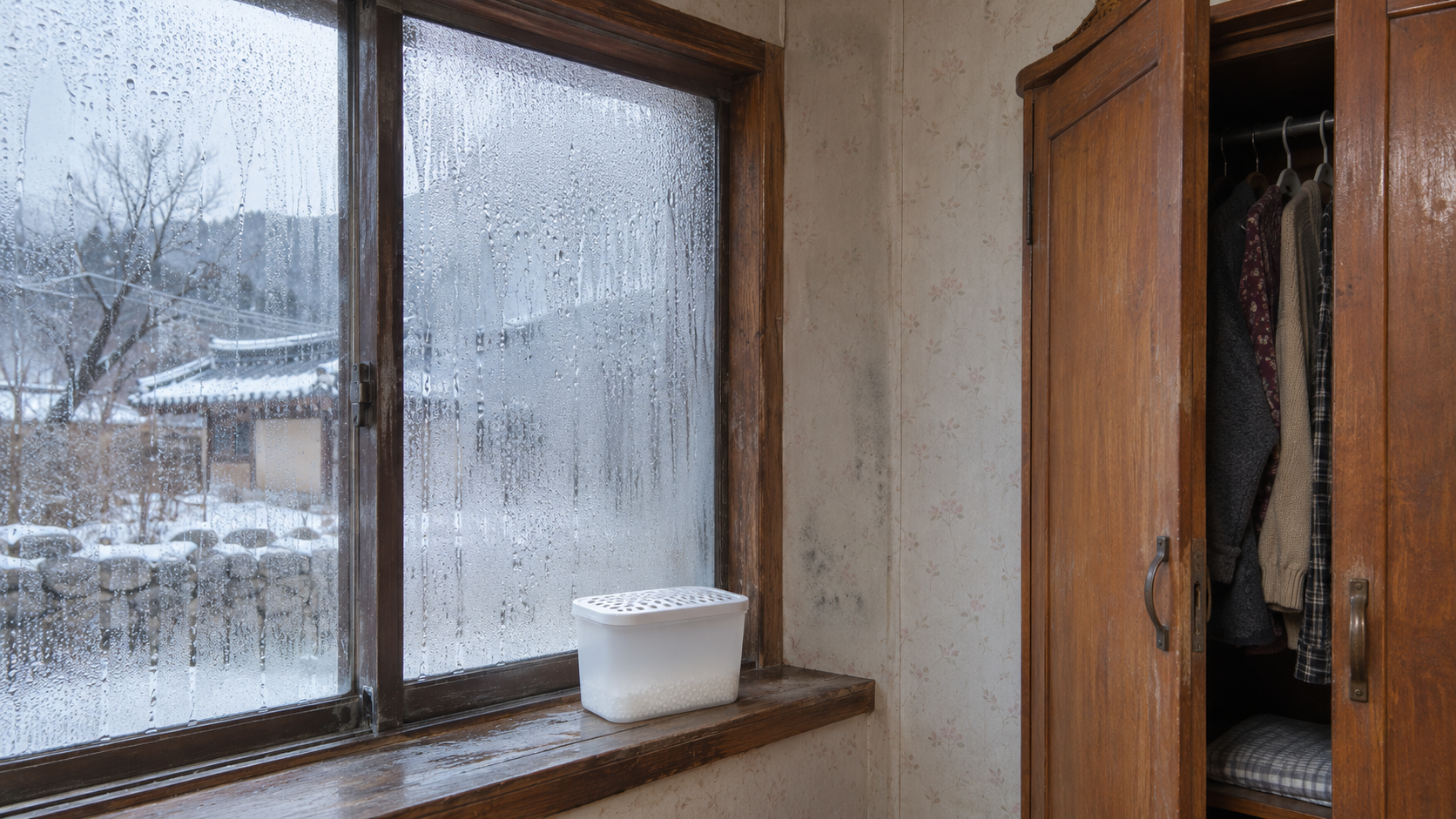
Why condensation forms indoors in winter (LH Housing Research Institute), recommended indoor humidity from the Korea Disease Control and Prevention Agency and the National Institute of Environmental Research, how to use closet moisture absorbers safely (Korea Consumer Agency tests), whether to make a calcium chloride absorber yourself, and how to remove wallpaper mould without mixing bleach and acid cleaners.
Winter air is dry, yet in an old country house the north-facing window sill is wet every morning, black spots spread behind the wardrobe, and coats smell musty. Here is how winter moisture works and what official sources say about controlling it.
Bottom line: condensation is water vapour in indoor air turning to water on surfaces colder than its dew point (LH Housing Research Institute). The KDCA recommends 18–20°C and 40–50% humidity indoors in winter. In a 2011 National Institute of Environmental Research survey, homes above 60% humidity had 2.7 times more airborne mould. Keep closet absorbers upright, as the collected calcium chloride liquid corrodes metal and hardens leather (Korea Consumer Agency). For wallpaper mould, ventilate, wear gloves and a mask, and use no more than 1 cup of bleach per 4L of water (Ministry of Land). Never mix bleach with acidic cleaners.
1. Why winter condensation happens
Cooking, laundry, bathing and breathing all add vapour. LH notes indoor condensation occurs mainly in the heating season when the indoor-outdoor temperature gap is large. Poorly insulated walls and single-glazed windows in older rural houses get cold enough to collect it. Homes built before 1990 had about 1.4 times more indoor bacteria and mould than those built after 2006 (NIER, 2011).
2. How humid should it be?
| Source | Recommendation |
|---|---|
| KDCA winter health rules | 40–50%, 18–20°C |
| NIER (policy brief, 2022) | 40–60% |
| NIER household survey 2011 | keep below 60% |
| LH | mould can grow if 80%+ persists |
3. Ventilate first
- KDCA: open opposite windows three times a day, 2–3 hours apart, for 10–30 minutes, between 10 a.m. and 7 p.m.
- LH: ventilate for 5–10 minutes after cooking and bathing in the evening to prevent condensation overnight.
4. Closet absorbers
LH notes that overfilled wardrobes trap moisture. Leave space between clothes, move the wardrobe slightly off the outer wall, and open the doors when ventilating. In 2015 the Korea Consumer Agency tested 12 absorbers: none had safety or toxic-substance problems, but performance varied, and some leaked when tipped over. Moisture absorbers, including silica gel types, are regulated household chemical products in Korea.
5. DIY calcium chloride absorbers
We found no official guidance on making one. De-icing calcium chloride absorbs moisture the same way but is not sold for this use, and its liquid corrodes metal. The KDCA warns of rising cases of children swallowing household chemicals; if swallowed, do not induce vomiting, rinse the mouth and go to an emergency room. We recommend commercial products indoors.
6. Removing wallpaper mould
Following Ministry of Land guidance (2021): open windows, wear gloves and a mask, wipe with a mould remover or bleach diluted to no more than 1 cup per 4L of water, scrub uneven surfaces with a stiff brush, then dry thoroughly. The Korea Consumer Agency warns that mixing acidic cleaners with chlorine bleach releases toxic chlorine gas.
7. Farm sheds and grain
The Ministry of Food and Drug Safety (November 2024) advises storing grain below 60% humidity and 10–15°C, off walls and floors, and discarding mouldy food entirely.
References
- LH Housing Research Institute, housing Q&A on condensation, built-in wardrobes and window condensation
- KDCA National Health Information Portal, winter cold-wave health rules; child safety at home
- Korea Policy Briefing, winter indoor air quality (NIER), December 20, 2022
- NIER household airborne bacteria survey, June 14, 2011
- Korea Consumer Agency, moisture absorber test results, July 15, 2015; bathroom cleaners and bleach, April 2019
- Korea Testing & Research Institute, regulated household chemical products
- Korea Policy Briefing, five ways to remove mould (Ministry of Land), July 14, 2021
- Korea Policy Briefing, winter mould (Ministry of Food and Drug Safety), November 15, 2024