Graph DB? Ontology? Let's Break It Down
Graph DB? Ontology? Let’s Break It Down
Data Needs “Context” Too
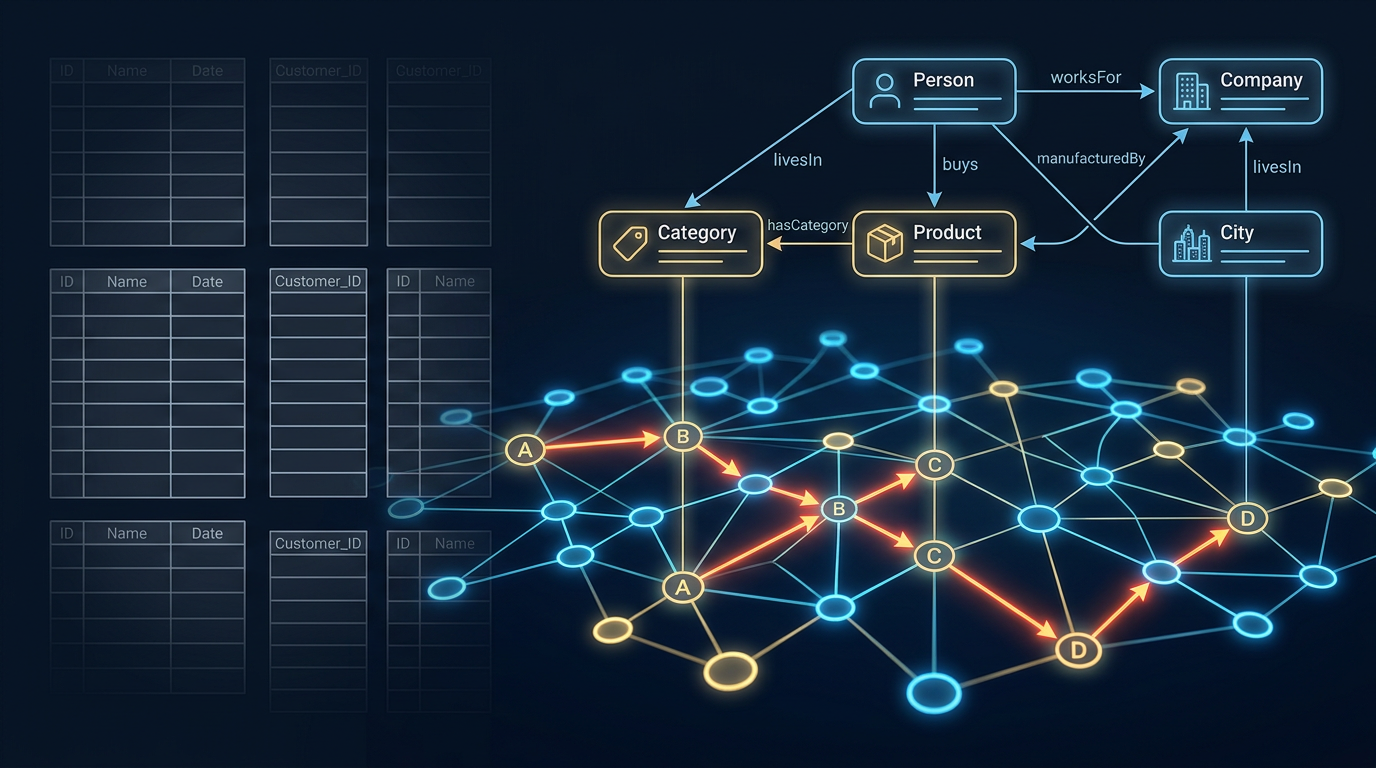
Stacking tables is the old way. Rows and columns look clean, but the problem is relationships. “User A bought Product B, Product B belongs to Category C, Category C is managed by Department D…” To untangle this chain in SQL, you need 4 or 5 JOINs. And as data grows, those JOINs kill your system.
Graph DB started from this problem: “Don’t calculate relationships — store them.”
What Is a Graph DB?
A graph database is a storage system that represents data using Nodes and Edges. Nodes are entities (people, products, places), and edges are the relationships between them. For example: “Tom Hanks → [:STARRED_IN] → Cast Away.”
The biggest difference from relational DBs is Index-Free Adjacency. RDBMS must scan indexes and compute JOIN operations to find relationships. Graph DBs, on the other hand, have each node directly hold the physical addresses of its connected nodes. This is why multi-hop traversals like “friend of a friend of a friend” are fast, regardless of overall data size.
There are two primary graph models:
- Labeled Property Graph (LPG): Attaches labels and properties (key-value pairs) to nodes and edges. Neo4j uses this model.
- RDF Graph: Represents all data as subject-predicate-object triples. This is closely tied to ontologies.
Where Did Neo4j Come From?
Neo4j started in 2000. Founder Emil Eifrem hit a wall while building a complex enterprise content management system. It was a system connecting users, permissions, files, and categories — and handling it with a relational DB meant repeating SQL JOINs endlessly, with query performance exploding exponentially as depth increased.
”Why do we have to make what we draw on a whiteboard with simple lines so complicated in a DB?” That single question changed the direction. An early version was released in 2002 and open-sourced in 2007. Today it is the most widely used graph DB by DB-Engines ranking.
Cypher: A Query Language You Draw
Neo4j uses its own query language called Cypher instead of SQL. What makes it unique is its ASCII art syntax. Nodes are written as (parentheses), and relationships as --[:ARROW]-->.
MATCH (p:Person {name: "Annemarie"})-[:KNOWS]->(friend)-[:LIKES]->(c:Comment)
RETURN c
ORDER BY c.creationDate
LIMIT 100
This query retrieves the “latest 100 comments liked by friends that Annemarie knows.” Writing the same query in SQL makes the code 4–7 times longer. Cypher is supported across multiple graph DBs including Neo4j, AgensGraph, Apache AGE, and Memgraph.
What Is an Ontology?
Ontology is about “how to define the world.” It’s not just storing data — it defines the logical structure between concepts. You embed rules like “mammals are animals” and “cats and dogs are mutually exclusive classes.”
There are two core standards for expressing ontologies:
RDF (Resource Description Framework) represents data as subject-predicate-object triples. “Seoul → isCapitalOf → South Korea.” Every piece of information is broken into this three-part structure.
OWL (Web Ontology Language) is a logic language layered on top of RDF. It enables class inheritance, constraints, and automatic reasoning. With OWL, if you input “Alice is a Facilitator” and “Facilitator is a subclass of Role,” a reasoning engine automatically infers “Alice is a Role.” Neo4j does not provide this automatic reasoning — this is the biggest difference between ontologies and graph DBs.
The query language for ontologies is SPARQL. It has a structure similar to Cypher but maps patterns to the RDF triple structure.
Where Is This Actually Used?
This isn’t just hype. There are concrete examples you can see right now.
Google Knowledge Graph. The info panel that appears on the right when you search “Yi Sun-sin” is a knowledge graph result. In June 2025, Google did a major cleanup of its Knowledge Graph, deleting over 3 billion entities in just one week — a strategy to remove ambiguous data and improve AI accuracy.
Financial Fraud Detection. Modeling transaction networks between accounts as a graph lets you catch abnormal connection patterns in real time, even when they appear normal on the surface.
E-commerce Recommendations. Platforms like eBay model users, purchase history, products, and categories as a graph to deliver real-time recommendations — high-quality, real-time recommendations that relational DBs simply can’t handle.
Healthcare. Patient data, disease classifications, symptoms, and treatments are defined via ontology and modeled with RDF/OWL for complex medical knowledge. Google Knowledge Graph and Wikidata leverage this approach at massive scale.
GraphRAG: Why AI Is Obsessed With This
There’s a reason graph DBs and ontologies are suddenly back in the spotlight: GraphRAG.
Traditional vector-based RAG is good at finding semantic similarity between sentences. But it can’t handle multi-hop reasoning like “If A is a subsidiary of B, and B manufactures Product C, what is the relationship between A and C?” Vectors calculate numerical distance — they can’t traverse logical relationships.
So knowledge graphs were added to the mix. LLMs automatically extract entities and relationships from text to build a graph. When a question comes in, vector search finds the entry point, then the system expands through the graph to gather connected knowledge. Microsoft Research proved that combining these two technologies significantly improves the ability to deliver comprehensive, global-scope answers.
LLMs can also directly convert queries. Natural language questions are automatically translated into graph query languages like Cypher or SPARQL to directly query the DB.
How Big Is the Market?
The graph DB market was valued at approximately 10.28 billion by 2032 at a CAGR of 18.2%. More aggressive forecasts project growth from 20.2 billion in 2034 at a CAGR of 24.13%.
AI-driven demand is fueling this growth. Neo4j, Oracle, and AWS Amazon Neptune are the major players. Neo4j officially announced expanded Korea-specific services in 2024.
So When Do You Use It?
There are situations where graph DBs shine — and situations where they’re overkill.
| Good Use Cases | Poor Use Cases |
|---|---|
| Friend-of-a-friend traversal (social networks) | Simple CRUD, row/column structures |
| Fraud detection (anomalous transaction patterns) | Aggregation/statistics-heavy analysis |
| Recommendation systems (purchase pattern linking) | Fixed schema, single-table queries with no joins |
| Knowledge graphs (AI reasoning enhancement) | Maximizing transaction throughput |
| Codebase dependency analysis | Numerical calculations, time-series data |
The time to use an ontology is different. It’s when automatic reasoning is needed — specifically, when you need to automatically determine which class an entity belongs to. It’s especially powerful in domains like healthcare, law, and complex knowledge systems.
One-Line Summary
Graph DB stores relationships. Ontology defines meaning. And in the AI era, both have re-emerged as core infrastructure for elevating the reasoning capabilities of LLMs.
References
- CNF - What is a Graph Database?: https://www.cncf.co.kr/ebook/graphdb/part1-graph-db-and-neo4j/1-graph-database-overview/1-1-what-is-graph-database/
- Ontology, RDF, and OWL Relationships (Brunch): https://brunch.co.kr/@oursophy/13
- Modeling Complex Relationships with Neo4j (jaenung.net): https://www.jaenung.net/tree/813
- Microsoft Fabric - Graph Database: https://learn.microsoft.com/ko-kr/fabric/graph/graph-database
- Difference Between OWL and RDF (Tistory): https://hyowong.tistory.com/entry/owl과-rdf-차이
- GraphRAG White Paper Analysis (Brunch): https://brunch.co.kr/@msapai/8
- CNF - GraphRAG: Data Connectivity Is the Future of AI: https://www.cncf.co.kr/blog/graph-rag/
- Graph Database Market Report (Fortune Business Insights): https://www.fortunebusinessinsights.com/ko/graph-database-market-105916
- Graph Database Market Analysis (Data Bridge): https://www.databridgemarketresearch.com/ko/reports/global-graph-database-market
- Background of Neo4j’s Creation (CNF): https://www.cncf.co.kr/ebook/graphdb/part1-graph-db-and-neo4j/1-graph-database-overview/1-3-neo4j-background/
- Neo4j Overview (devkuma): https://www.devkuma.com/docs/neo4j/overview/
- Protege vs Neo4j, SPARQL Concepts (Velog): https://velog.io/@gathers/Protege와-Neo4j의-차이-그리고-SPARQL-쿼리-개념-정리
- Most Popular Graph DB Query Languages (SKAI Worldwide): https://blog.skaiworldwide.com/557
- Google Knowledge Graph Major Restructuring (Artience): https://www.artience.com/blog/google-knowledge-graph-ai-seo-strategy
- GraphDB Code Structure Visualization (stoni.space): https://stoni.space/posts/ko/graphdb/01-graphdb
- Neo4j Korea-Specific Service Expansion (Digital Chosun): https://digitalchosun.dizzo.com/site/data/html_dir/2024/05/28/2024052880220.html
- CNF - Graph DB Use Cases and Tech Ecosystem: https://www.cncf.co.kr/ebook/graphdb/part2-graph-db-usecases-ecosystem/