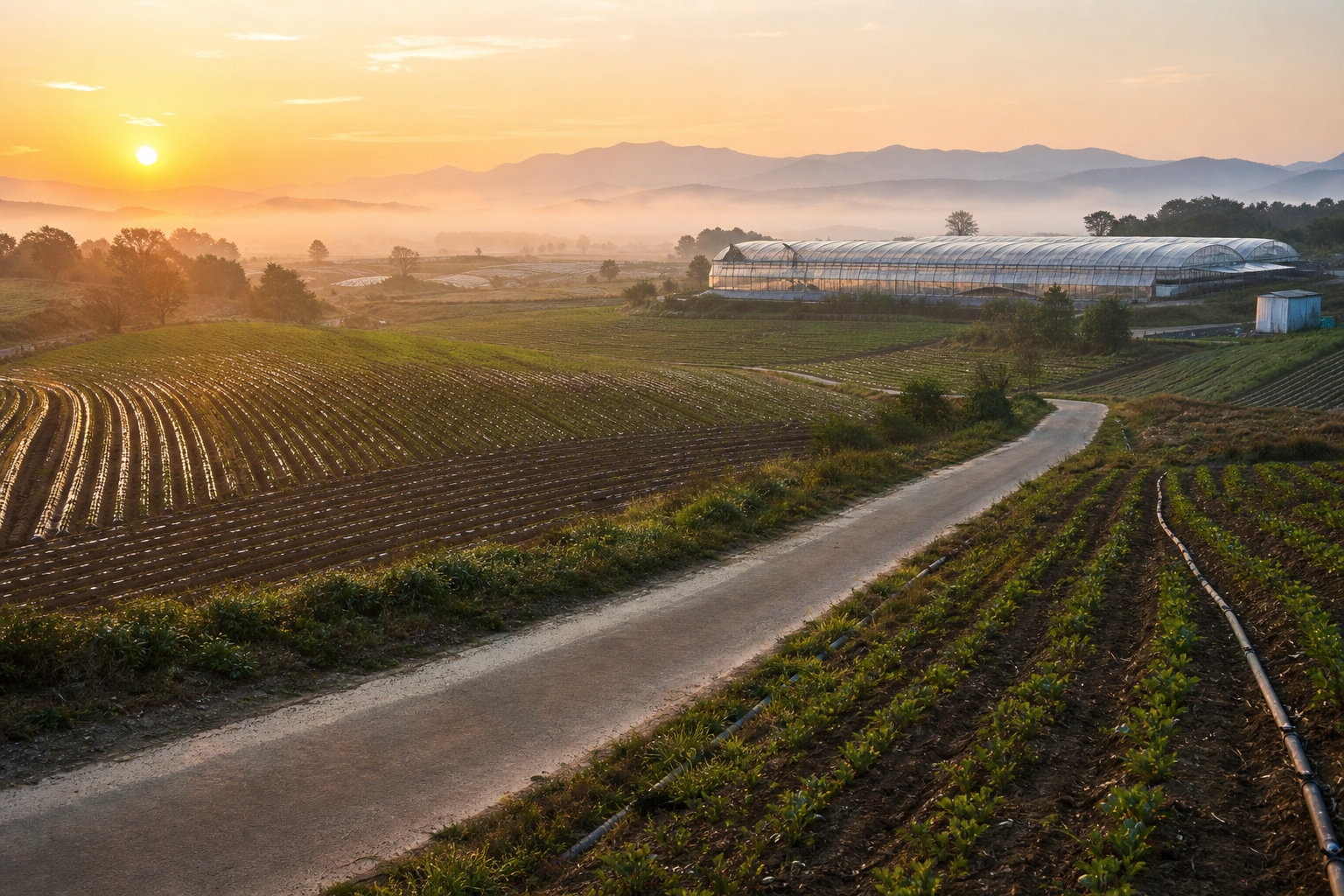
A practical guide to using Korea Farmland Bank leased farmland for a beginner smart farm: contracts, facility consent, restoration, utilities, subsidies, and risk control.
Can Beginner Return-to-Farm Founders Start a Smart Farm on Leased Farmland?
Many return-to-farm plans hit a wall at land price. The greenhouse estimate is already large. Buying land first can push the starting line too far away. That is why Farmland Bank leased farmland becomes attractive. If the founder can lease land instead of buying it, more capital can remain for facilities, crops, electricity, water, and sales.
Then comes the practical question. Can a beginner start a smart farm on Farmland Bank leased farmland. The short answer is yes, in some cases. But leased farmland does not mean the founder can install any facility freely. Smart farms are agricultural facilities, but facility consent, contract terms, restoration duties, electricity, water, local interpretation, and subsidy rules all matter.
Farmland Bank leasing is best understood as buying time before buying land. It is not ownership. It is a test period. For beginner farmers, that difference is critical. A safer approach is to validate the crop and business model first, then expand fixed facilities step by step.
1. Farmland Bank leasing is not a free startup permit
Farmland Bank connects farmland held by elderly farmers, retired farmers, non-farm owners, or public programs with farmers who need land. For young farmers and return-to-farm founders, it can be an important way to begin farming without buying land immediately. The Korean government has also expanded policies for public reserve leased farmland, lease-before-purchase programs, and smart-farm startup support for young farmers.
But leased farmland is still farmland for agricultural management. The Farmland Act limits the cases in which farmland can be leased or used free of charge. If a lessee does not use farmland for agricultural management without a justifiable reason, legal and administrative issues may arise. The Farmland Act also emphasizes written lease or free-use contracts for agricultural management.
So Farmland Bank leased land is an opportunity to farm. It is not a blanket permission to build anything. A smart farm must clearly remain agricultural in purpose. The larger the facility becomes, the more important the lease contract and local confirmation become. A small misunderstanding can later become a demolition cost.
2. Smart farming is possible, but it has stages
Not every smart farm facility is the same. Some tools are movable: irrigation automation, sensors, fertigation controllers, shading and ventilation controls, cameras, and data logging. Other facilities are deeply attached to land: multi-span greenhouses, glasshouses, heating rooms, fertigation rooms, cold storage, packing rooms, access roads, wells, and drainage work. This difference matters greatly on leased farmland.
Beginner founders should start with movable systems first. They can attach irrigation, sensors, and recordkeeping to open-field farming or small greenhouses, then test crops and sales. After that, they can review lease duration, facility consent, electricity and water capacity, and restoration clauses before considering fixed facilities. A large greenhouse may look impressive, but failure becomes heavy.
Korea Rural Community Corporation materials on customized farmland support have discussed improvements related to agricultural vinyl greenhouse installation approval timing after farmland lease contracts. This helps agricultural-facility planning. But it should not be read as automatic permission for solar structures, warehouses, housing, or other non-farming facilities. Even for smart farms, the founder must confirm whether the facility is agricultural, whether the lease allows it, and what must be restored at the end.
3. Public reserve leased smart farms are a separate path
Farmland Bank is not only about ordinary leased land. There are also public reserve farmland smart-farm lease programs. In these programs, smart-farm facilities can be installed on public reserve leased farmland and leased long term to young farmers who meet specific conditions.
Farmland Bank notices have described target groups such as graduates of Smart Farm Innovation Valley youth training programs or farmers with experience in practical training rental farms. Some program materials mention long-term lease structures, multi-span vinyl greenhouses, environmental control systems, fertigation, irrigation, and heating facilities.
This path can be attractive for beginners. It reduces the burden of preparing both land and facility at once. But it is competitive, has eligibility requirements, and may limit location and crop choice. It is not the same as freely choosing any land and building any greenhouse. A leased smart-farm program is an opportunity with conditions.
4. The lease contract comes before the facility quote
A smart-farm founder should read the lease contract before the greenhouse quote. How long is the lease. Can it be renewed. Can facilities be installed. Is prior consent required from the owner, Farmland Bank, or local authority. What happens when the contract ends.
For example, if the lease term is five years and the founder installs a 100 million KRW fixed greenhouse, the payback period may not match. If renewal is uncertain, the risk increases. If restoration is required, the final year can bring a large cost. Greenhouse frames, foundations, electrical lines, wells, drainage, paved roads, and storage buildings can all become restoration issues.
The contract should clearly cover facility consent, permitted facility types, electricity and water installations, subsidy applications, treatment of facilities at termination, restoration scope, renewal priority, early termination, and disaster responsibility. Verbal promises can become different memories later. Farming happens on soil, but disputes often end on paper.
5. Electricity and water are the real smart-farm location
A smart farm does not run on land alone. It needs electricity and water. Fertigation systems, pumps, fans, shading, heating, cooling, CCTV, networks, and controllers all use power. Water demand also changes by crop and system. Without checking contract power and connection capacity, a facility estimate is incomplete.
A leased field may look affordable, but if the power connection is far away, costs can grow quickly. The founder must check whether agricultural electricity can apply, whether general electricity is needed, how much contract power is required, and whether transformer upgrades are necessary. Water is similar. Is there a well. Is water quality suitable. Is supply stable. Does drainage work.
Beginner farmers should draw the electricity and water map before the greenhouse layout. The first smart-farm drawing is not a greenhouse plan. It is a utility-capacity sheet. Good land becomes expensive land if electricity and water are weak.
6. Subsidies and loans must match the lease conditions
Smart-farm startups can involve subsidies, loans, young-farmer programs, training programs, rental smart farms, and Farmland Bank support. These programs are helpful, but they always come with conditions. Ownership, lease period, farm business registration, self-funding, post-management period, facility-disposal restrictions, and change approval must be checked.
When facilities are installed on leased farmland, the founder must confirm whether the subsidy agency accepts the lease contract. If the lease period is shorter than the required post-management period, problems can appear. If the facility must be removed at the end of the lease, collateral value and payback assumptions also change.
Once public money enters the plan, freedom decreases. A subsidy is not free money. It is conditional capital. Beginner founders should read the post-management rules before celebrating the amount.
7. A small-start strategy is safer
For beginner return-to-farm founders, the safest strategy is to start small and learn quickly. Do not turn the entire leased field into fixed facilities at once. Start with open-field or small-house production, add sensors, irrigation automation, and basic environmental records, then track crop growth, sales, labor hours, electricity cost, and water use.
Year one validates the crop. Year two validates repeatable sales and workflow. Year three reviews fixed facilities and longer lease conditions. This may look slow, but it reduces failure cost. In farming, failing fast can still take a long time to recover.
A smart farm does not succeed because sensors are smart. It succeeds when crops, markets, logistics, electricity, labor, and contracts fit together. Leased farmland is a good test site for that fit. Using a test site like a factory from day one is dangerous.
8. Who fits this model?
Farmland Bank leased smart-farm planning fits people who want to test before buying land. It can fit return-to-farm beginners, young farmers, smart-farm training graduates, and small facility-crop founders. It is especially useful for people who do not want to spend most of their capital on land purchase first.
It is less comfortable for founders who plan a large glasshouse, heavy fixed facilities, long-term secured loans, or energy projects from the beginning. If the lease period and facility payback period do not match, the numbers break. A founder who invests heavily without owning the land may also have weaker negotiating power.
One more condition matters: recordkeeping. A founder on leased land should record sales, costs, labor, crop growth, failures, electricity bills, and water use. If the founder does not own land, data becomes the asset. Build records before building too much steel.
9. Checklist before starting
Before using leased farmland for a smart farm, check at least the following.
- Lease term and renewal possibility.
- Whether facility installation needs consent.
- Which facility types are allowed in writing.
- Restoration scope at the end of the lease.
- Farm business registration possibility.
- Electricity connection distance and contract power.
- Whether agricultural electricity can apply.
- Well, public water, water quality, and drainage.
- Whether subsidy post-management period matches the lease period.
- Permits for greenhouse, fertigation room, storage, packing room, and access road.
- Crop sales channel and logistics cost.
- Eligibility for public reserve leased smart-farm programs.
If these answers are clear, the starting probability improves. If many answers are blank, it is still the research stage. For a beginner, research is not delay. It is the cheapest insurance.
10. The conclusion: possible, but start small
Can beginner return-to-farm founders start a smart farm on Farmland Bank leased farmland. Yes, in some cases. It can be a good starting point for people who want to validate crops and markets before buying land. Government policy is also expanding public reserve leased farmland, lease-before-purchase, and public leased smart-farm programs for young and early-stage farmers.
But leased farmland is not owned farmland. Facility consent, lease duration, restoration duty, electricity, water, and subsidy conditions must be checked first. A smart farm is possible, but a short lease, heavy fixed facility, and no sales channel can create serious risk.
The beginner answer is to start small. Use movable smart equipment. Validate crops and sales. Build records. Confirm the lease. Then expand fixed facilities. The real value of Farmland Bank leased farmland is not that it gives ownership. It gives time before ownership.
One-line summary
Farmland Bank leased farmland can be a useful starting point for beginner smart-farm founders, but facility consent, lease period, restoration duty, utilities, and subsidy conditions must be checked before installing fixed facilities.
References
- Korea Law Information Center,
Farmland ActArticles 23 and 24. - Korea Rural Community Corporation Farmland Bank, public reserve farmland and leased smart-farm program notices.
- Korea Rural Community Corporation, customized farmland support improvement materials.
- Ministry of Agriculture, Food and Rural Affairs, press materials on expanding public reserve leased farmland.
- MAFRA and GreenDaero, young farmer support and smart-farm support materials.
- SmartFarm Korea, youth farmer and smart-farm startup policy materials.