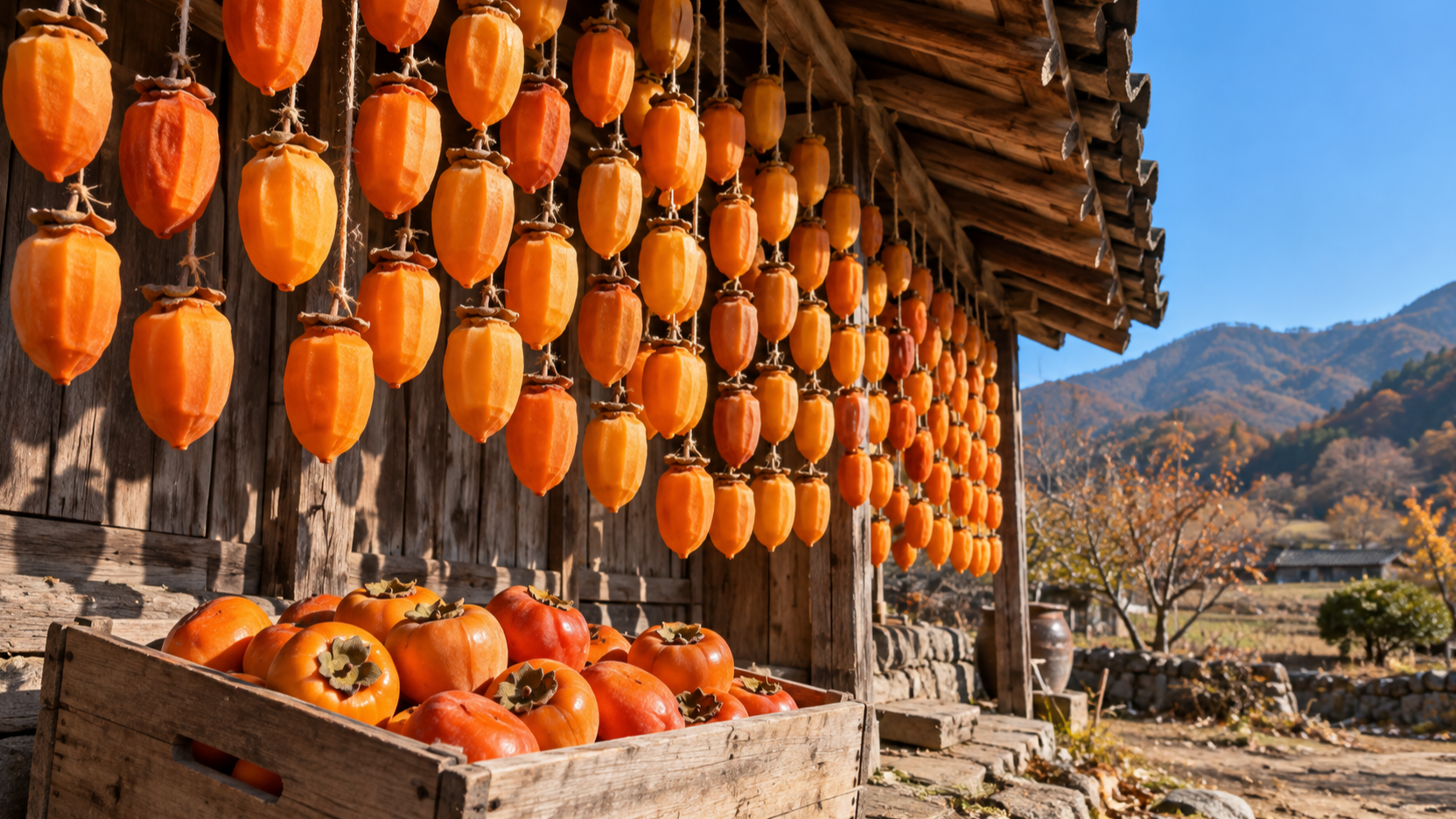
Daebong persimmon 10kg box prices (34,510–44,900 won on Coupang, October 25, 2026, 26–35 fruit), the Yeongam Geumjeong co-op advance purchase price (30,000 won per 20kg), sweet persimmon wholesale prices from KAMIS on October 23, 2026 for comparison, how to ripen soft hongsi and freeze it, and Korea Forest Service guidance on harvesting, peeling and drying gotgam (semi-dried in 7–8 days by hot air).
In late October, boxes of orange Daebong persimmons pile up at Korean front doors. The catch is that you cannot eat them straight from the box. Bite into a firm Daebong and your mouth puckers. So people search for when it turns into soft hongsi, how many fruit are in a box, and when to pick for gotgam (dried persimmon). On Naver, “Daebong persimmon” is searched 31,410 times a month, “Daebong price” 5,310 times and “Daebong 10kg” 5,240 times. This note answers buyers and growers with listing prices, an origin purchase price and the Korea Forest Service cultivation manual.
Bottom line: A 10kg box of Daebong persimmons sold for 34,510–44,900 won on Coupang on October 25, 2026, with roughly 26–35 fruit per box. Daebong is not in the KAMIS daily survey, so there is no official daily price. The origin benchmark is the Yeongam Geumjeong co-op advance purchase price of 30,000 won per 20kg. Hongsi ripens on its own at room temperature; in a Forest Service trial, astringent persimmons treated with ethylene softened in 5 days at 15–20℃ and 9 days in cold storage. For gotgam, pick firm fruit at proper maturity; hot-air drying to semi-dried takes 7–8 days.
Earlier notes: chestnut storage and prices, dried jujube prices and drying, and choosing a food dehydrator.
1. What a Daebong persimmon is
Daebong is an astringent persimmon. Unlike sweet persimmons, it only turns sweet once it is ripened soft (hongsi) or dried (gotgam). The Gyeongbuk Agricultural Research and Extension Services refers to it as ‘Gapjubaengmok (Daebong)‘. The Korea Forest Service manual lists Gapjubaengmok as:
| Trait | Gapjubaengmok (Daebong) |
|---|---|
| Weight | About 250g, a large-fruit variety |
| Sugar | 22 Brix |
| Ripens | Late October |
| Astringency | Partially astringent (slight browning by seeds in warm areas) |
| Best use | Soft ripe persimmon (hongsi) |
| Gotgam | Hard to dry because of its size, but large and good texture |
The classic gotgam variety in Sangju, Dungsi, weighs about 150g. Daebong is much bigger. Yeongam’s Geumjeong area, Korea’s largest Daebong district, has 904 farms on 809 ha; Yeongam Daebong was registered as Geographical Indication No. 17 in 2008. KREI surveys persimmon crops in Sancheong, Hadong, Sangju, Cheongdo, Gwangyang, Yeongam and Yeongdong.
2. Daebong price 2026: what does 10kg cost?
KAMIS has sweet persimmons but no astringent (Daebong) item, so there is no official daily price. Three numbers can be checked.
Origin advance price. The Yeongam Geumjeong co-op set its 2026 advance purchase price at 30,000 won per 20kg box, about 1,500 won/kg. The final price is set during the main harvest, late October to early November (Korea Farmers Newspaper, September 29, 2026).
Listing prices. Coupang Partners product search, October 25, 2026:
| Listing | Price | Per kg |
|---|---|---|
| Daebong hongsi 10kg, extra large (26–32) | 34,510 won | 3,451 won |
| Yeongam Daebong 10kg, about 35 fruit | 40,900 won | 4,090 won |
| Jeolla Daebong 10kg (21–55 fruit) | 41,900 won | 4,190 won |
| High-sugar Daebong 10kg | 43,900 won | 4,390 won |
| Daebong 10kg, extra large (29–31) | 44,900 won | 4,490 won |
Discounts change daily. Sorting, boxes, delivery and margins sit between the origin price and the retail price. We could not verify when Daebong is cheapest.
Comparison: sweet persimmon wholesale. On October 23, 2026 (KAMIS survey date), Fuyu sweet persimmons (top grade, 10kg) averaged 44,980 won across five cities, 19.2% above 37,740 won a year earlier. Seoul was 46,300 won, up 29.3% from 35,800 won. Daily prices are on the sweet persimmon price page.
The crop is weak. KREI’s October forest outlook, cited by Kyunghyang Shinmun on October 13, 2026, expects national persimmon output to fall 14.1% from last year because of sunburn, drought-shrunken fruit and fruit drop. In the September issue, 61.4% of sample farms already said fruit was smaller than last year.
3. How many fruit in a 10kg box?
| Label | Fruit per 10kg | Weight per fruit |
|---|---|---|
| Extra large | 26–32 | About 310–385g |
| Extra large | 29–31 | About 320–345g |
| Medium-large | About 35 | About 285g |
| Mixed (choose) | 21–55 | About 180–475g |
At the manual’s 250g, a 10kg box would hold 40 fruit. Big fruit suit hongsi; very large fruit dry slowly as gotgam. Check the count, not just the price.
4. How to ripen hongsi
Spread the fruit out at room temperature so they do not press on each other, and they soften one by one. Eat when the whole fruit gives under light pressure.
To speed it up, add an apple. The Rural Development Administration notes that apples give off a lot of ethylene and help fruit that needs ripening; the Forest Service manual says ethylene speeds the softening of astringent persimmons. Put a few Daebong with one or two apples in a bag or lidded box. Days vary with ripeness and temperature. The Forest Service trial with an ethylene generator (Cheongdo Bansi) shows the effect of temperature:
| Where | Days to soft |
|---|---|
| Cold (0–4℃) | 9 |
| Room (15–20℃) | 5 |
| Warm (30℃) | 3 |
To remove astringency while the fruit stays firm, the manual describes sealing fruit with 80–100㎖ of 35% alcohol per 10kg (5–6 days at 20℃, 8–10 days for harder varieties) or soaking in water at about 45℃ for 15–24 hours.
5. Frozen hongsi
Freeze fully ripe hongsi one by one. Half-thawed, it eats like sorbet. Rubbing a frozen hongsi under tap water slips the skin off. Freezing firm Daebong does slowly remove astringency at about −20℃, but takes 20 to over 80 days, so ripen first.
6. Picking Daebong for gotgam (growers)
The manual rates Daebong as hard to dry but commercially good as gotgam because of its size and texture. Pick firm fruit at proper maturity: later picking adds sugar but softens the fruit and makes peeling hard, and poorly colored fruit gives dull, less sweet gotgam. Farms that harvest only once or twice let fruit after-ripen 4–5 to 7 days before peeling. Discard damaged, diseased, sunburned or loose-stemmed fruit, and dry similar sizes together.
7. Persimmon peelers
The manual says to peel thin with a stainless knife, because iron blackens the cut flesh; a powered peeler raises output 1.6–2.0 times. On Coupang (October 25, 2026), hand-crank fruit peelers were 10,400–11,800 won and dedicated persimmon peelers 228,990 and 229,000 won. Check that a 250g+ Daebong fits.
8. Drying gotgam and persimmon chips
Sun drying needs a windy, dust-free spot away from livestock sheds. For hot-air drying, start at 30–32℃ for 1.5 days (ripe) to 2 days (overripe), rest a day, alternate drying and resting, then lower to 28–30℃ with slightly higher humidity, and finish for 0.5–1.5 days to reach 45–50% moisture. Drying too hot hardens the surface and leaves astringency.
| Type | Moisture | Hot air | Sun | Rest at 2–5℃ |
|---|---|---|---|---|
| Semi-dried | 45–50% | 7–8 days | 16–20 days | 3–4 days |
| Fully dried | About 35% | n/a | 30–35 days | 5–7 days |
Semi-dried gotgam yields 30–40% more but molds easily: in paper boxes it keeps under 10 days at room temperature and 2 months cold; nitrogen flushing extends that to 2 and 4 months. The white bloom is glucose and fructose (6:1), not mold. We found no official temperature for persimmon chips; dry slowly around 30℃. KREI reported domestic gotgam retail at 25,474 won/kg in August 2026, 2.6% below a year earlier.
FAQ
Is hongsi a different persimmon? No. Hongsi is the soft ripe stage; Daebong is the variety.
Does the fridge stop ripening? It slows it. In the trial, cold storage took 4 days longer than room temperature.
Wrap-up
With Daebong you choose when to eat: room temperature to ripen, an apple to hurry it, a cool spot to wait, the freezer for later. Growers should pick firm and dry slowly. This year’s fruit is smaller and fewer, so check the count per box.
References
- Naver Search Ad keyword tool monthly searches, checked October 25, 2026.
- Korea Forest Service, “Persimmon” cultivation manual (varieties, gotgam harvest, peeling, drying, sweating, packaging, astringency removal, ethylene ripening trial 1993–1994, frozen hongsi). PDF
- Kyongbuk Maeil, Gyeongbuk ARES astringent persimmon variety licensing (‘Gapjubaengmok (Daebong)’), June 13, 2024.
- Korea Farmers Newspaper (Youngnong), Yeongam Geumjeong co-op advance price for Daebong, September 29, 2026. Article
- Newspim, Yeongam Daebong processing facility completion, October 22, 2026. Article
- Korea Rural Economic Institute, Forest Outlook (Persimmon), September 4, 2026; October issue as cited by Kyunghyang Shinmun, October 13, 2026.
- aT KAMIS daily wholesale prices, Fuyu sweet persimmon top grade 10kg, five cities, October 23, 2026 and October 23, 2025 (simple average computed by IMUN.FARM).
- Newsis, Rural Development Administration fruit storage guidance (apples and ethylene), January 23, 2023.
- Coupang Partners product search prices, October 25, 2026.