Agricultural Drone Review: Should Founders Choose 10L or 20L?
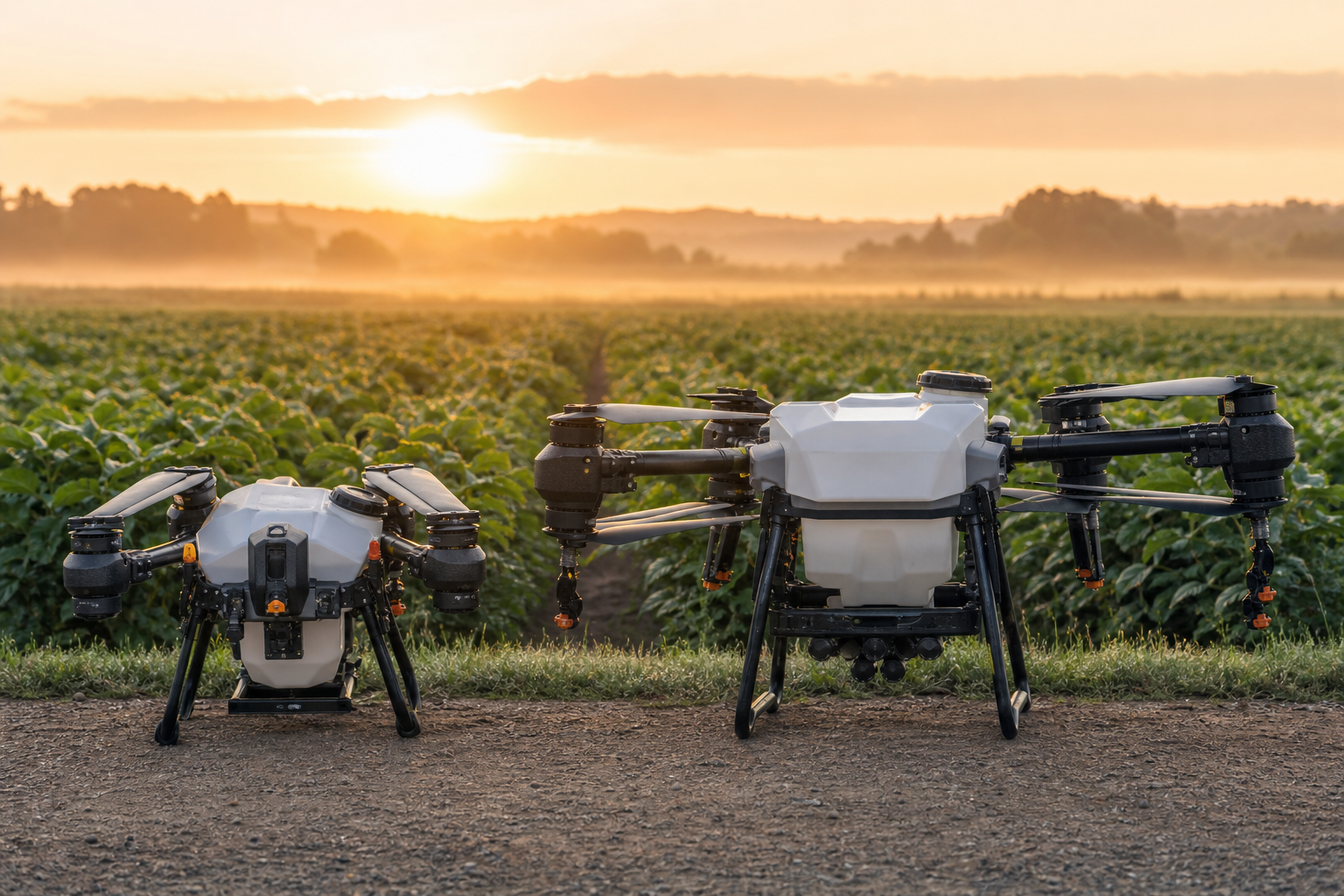
Agricultural Drone Review: Should Founders Choose 10L or 20L?
The first time a founder shops for a spraying drone, the machine looks impressive. Large propellers. A clean chemical tank. A salesperson saying it can cover a lot of land in one day. Then the founder meets the real question. Should it be 10L or 20L.
At first, the answer looks simple. A 20L drone carries more liquid, so it should finish faster. But agricultural drone spraying is not decided by tank size alone. Field size, travel distance, batteries, vehicle loading, operator skill, chemical refill flow, service support, insurance, pilot certification, flight approval, and aerial pest-control reporting can all matter. A spraying drone is not a toy. It is both an aircraft and farm equipment.
This review compares 10L and 20L spraying drones from a startup perspective. A farmer doing only self-spraying and a founder selling spraying services may need different answers. In farm equipment, bigger is not always better. Fit comes first.
1. A 10L drone is small, but not trivial
A 10L spraying drone is usually easier to handle. It is easier to load into a vehicle and easier for one person to prepare. In narrow fields, orchards, small parcels, and areas with many obstacles, a smaller aircraft can be more comfortable. It also feels less intimidating for farmers learning drone spraying for the first time.
But 10L has a clear productivity limit. The tank must be refilled more often, and battery changes are frequent. If the operator is covering large rice fields or broad open-crop areas, refill time becomes noticeable. In the field, flight time is only part of the work. Chemical mixing, battery charging, moving between parcels, washing, and handling complaints can take more time than expected.
For self-use, 10L can be enough. If a farmer wants to spray their own fields, keep the setup simple, and avoid building a large operation, a 10L drone may be realistic. For a paid spraying business, one 10L aircraft can feel slow. It can be like filling a big tank with a small cup.
2. A 20L drone brings productivity and more operating burden
A 20L spraying drone improves productivity. It reduces refills and can cover larger areas faster. For a spraying business, weather windows are short and customer demand often comes at the same time. In that situation, 20L is closer to a business-class machine.
The trade-off is operating burden. The aircraft is heavier. Batteries are larger. Charging equipment becomes more serious. The vehicle needs more loading space. One person can operate some systems, but fatigue rises. A drone filled with chemical liquid is not light. It also has more inertia in flight, which matters in tight or obstacle-heavy fields.
A founder choosing 20L should not buy only the aircraft. They need a vehicle, charging system, water tank, mixing area, spare batteries, cleaning tools, insurance, and maintenance plan. The drone is the center of the business, but it does not earn alone. The refill and support system earns with it.
3. Field size changes the answer
For small self-spraying work, 10L is often more realistic. Family fields, small parcels, orchards, greenhouse surroundings, and occasional crop protection work may benefit from the smaller setup. Equipment must be easy to take out, use, clean, and store. If a machine feels annoying to prepare, it sleeps in the shed.
For a paid spraying business, 20L often has an advantage. Rice spraying, large open fields, grower-group work, and repeat contracts make refill reduction valuable. Daily coverage becomes the revenue ceiling. Good spraying days are limited, and many farmers call during the same short season.
Still, 20L is not always the right answer. Mountain fields, small parcels, utility poles, trees, narrow access roads, and fragmented land can make a large drone inconvenient. A beginner may end up being controlled by the machine rather than controlling it. In small and complex fields, smaller equipment can win.
4. Regulation depends more on maximum takeoff weight than tank size
In drone regulation, the key checkpoint is not only tank capacity. Maximum takeoff weight and operating purpose matter. Korean aviation law covers ultralight vehicle reporting, pilot certification, and flight approval. Agricultural drones become heavier when loaded with liquid and batteries, so the certification class and reporting requirements must be checked for the actual model.
Local agricultural drone support documents often explain that pilot qualification can vary by drone weight and that aircraft reporting and flight approval may be required. Some local materials use 10L agricultural spraying as an example for qualification guidance. The exact requirement must be checked based on the drone’s maximum takeoff weight.
If the operator sells spraying services, the business enters another layer. Ultralight vehicle use business registration, aviation insurance or mutual aid, and possible aerial pest-control reporting under pesticide-related rules must be reviewed. Drone One-Stop is also a practical portal for checking flight approval zones. Once money is received for flying, the operation is no longer just personal farm use.
5. Batteries and charging decide real productivity
Beginners look at the tank. In the field, the battery becomes the boss. A 20L drone cannot cover much if batteries are insufficient. A 10L drone can work steadily if battery rotation and charging are well managed.
A founder should calculate battery count, flight time per battery, charging time, and whether field charging is possible. They must decide whether to use a generator, vehicle inverter, or multiple chargers. Battery heat management also matters in summer. Forcing hot batteries back into service can hurt both lifespan and safety.
Battery cost should be treated as part of the business model. The aircraft price is visible at purchase. Battery replacement cost follows for years. A spraying business should treat batteries as consumables. If battery depreciation is missing from the calculation, the ledger is flattering the owner.
6. The 10L and 20L business models are different
A 10L drone fits small self-spraying, narrow parcels, support work, and training-stage operation. It is useful for a farmer who wants to handle their own fields. It can also serve a few nearby farms informally, depending on the legal and business structure. For a full paid spraying business, though, it may not move enough acreage.
A 20L drone fits operators with repeat acreage. Grower groups, rice-field spraying, cooperative work, and broad field-crop areas favor larger tanks. In low-price local markets, productivity becomes even more important. The operator must cover enough area to overcome travel, labor, and equipment cost.
A startup founder should calculate confirmed customer acreage first. How many hectares are already likely this season. How far are the fields. How many orders arrive during the same weather window. Buying the drone first and finding customers later is risky. In rural service businesses, regular customers matter more than equipment dreams.
7. Chemical safety and cleaning must be part of the review
A spraying drone handles pesticides. Public safety manuals for unmanned aerial sprayers emphasize safe pesticide use, equipment management, cleaning, drift prevention, and recordkeeping. The drone may look impressive, but many customer complaints come from drift, missed strips, overlap, crop damage, or poor communication.
Whether the aircraft is 10L or 20L, the operator must follow pesticide labels, registered crops, dilution rates, and safe-use standards. Strong wind should stop the job. Nearby crops, homes, livestock, beehives, and waterways require extra care. Before/after photos, GPS routes, pesticide use records, and cleaning logs can protect both farmer and operator.
A larger aircraft can also create larger mistakes if setup is poor. Nozzle choice, droplet size, flight height, speed, and wind must be controlled. Drone spraying is not only about speed. It is about accurate work that can be explained later.
8. Service and parts may matter more than the brand name
A breakdown during spraying season is expensive. Propellers, pumps, nozzles, hoses, flow meters, batteries, chargers, motors, and arms must be available quickly. A drone with impressive specifications is not useful if repair takes two weeks during the peak season.
A 10L system may be simpler and cheaper to repair. A 20L system can bring higher battery and parts cost. Before buying, the founder should check nearby service centers, mobile repair support, spare-part prices, and training support.
The most important question in equipment review is simple. If it breaks, can it be fixed tomorrow. A spraying business fights the calendar. A drone waiting for repair is an expensive decoration.
9. So which should a founder choose?
For self-spraying, start by reviewing 10L. If the area is small, movement is frequent, the operator works alone, and the budget is limited, 10L is practical. It is also easier for learning flight, cleaning, chemical handling, and battery management.
For paid spraying with repeat acreage already secured, 20L is usually a stronger candidate. If daily coverage matters, refills must be reduced, and the founder can support the drone with a vehicle and charging system, 20L can create productivity. But buying 20L before securing customers is risky. A larger machine also creates larger fixed costs.
A practical rule is this. Own fields and nearby small work: 10L. Grower-group or village-scale repeat contracts: 20L. Mountain fields and small parcels: 10L. Open plains and peak-season order concentration: 20L. In every case, certification, reporting, insurance, pesticide safety, and service support must be checked first.
10. The real difference is not tank size, but business structure
The difference between 10L and 20L is not just tank volume. It changes the work pattern, customer structure, vehicle, batteries, charging, certification, insurance, cleaning, and maintenance plan. A beginner founder should study the daily operation sheet, not only the specification sheet.
Drone spraying looks easy in videos. In the field, wind, water, chemical mixing, batteries, complaints, schedules, and laws arrive together. A 10L drone is light and flexible. A 20L drone is faster and closer to commercial operation. There is no universally better machine. There is only the machine that fits the customer base and field conditions.
One-line summary
Agricultural spraying drone founders should choose 10L or 20L not by tank size alone, but by repeat acreage, field logistics, battery and charging systems, certification, reporting, insurance, pesticide safety, and service support.
References
- Ministry of Agriculture, Food and Rural Affairs, Rural Development Administration, and Korea Forest Service,
Safe Use Manual for Unmanned Aerial Sprayers. - Nongsaro, materials on agricultural drone use.
- Aviation Safety Act Articles 122, 125, and 127.
- Aviation Business Act Articles 48 and 70.
- Pesticide Control Act Article 3-2 and aerial pest-control reporting materials.
- Drone One-Stop service materials for flight approval and airspace checks.
- Local government agricultural drone support and pest-control service program guides.