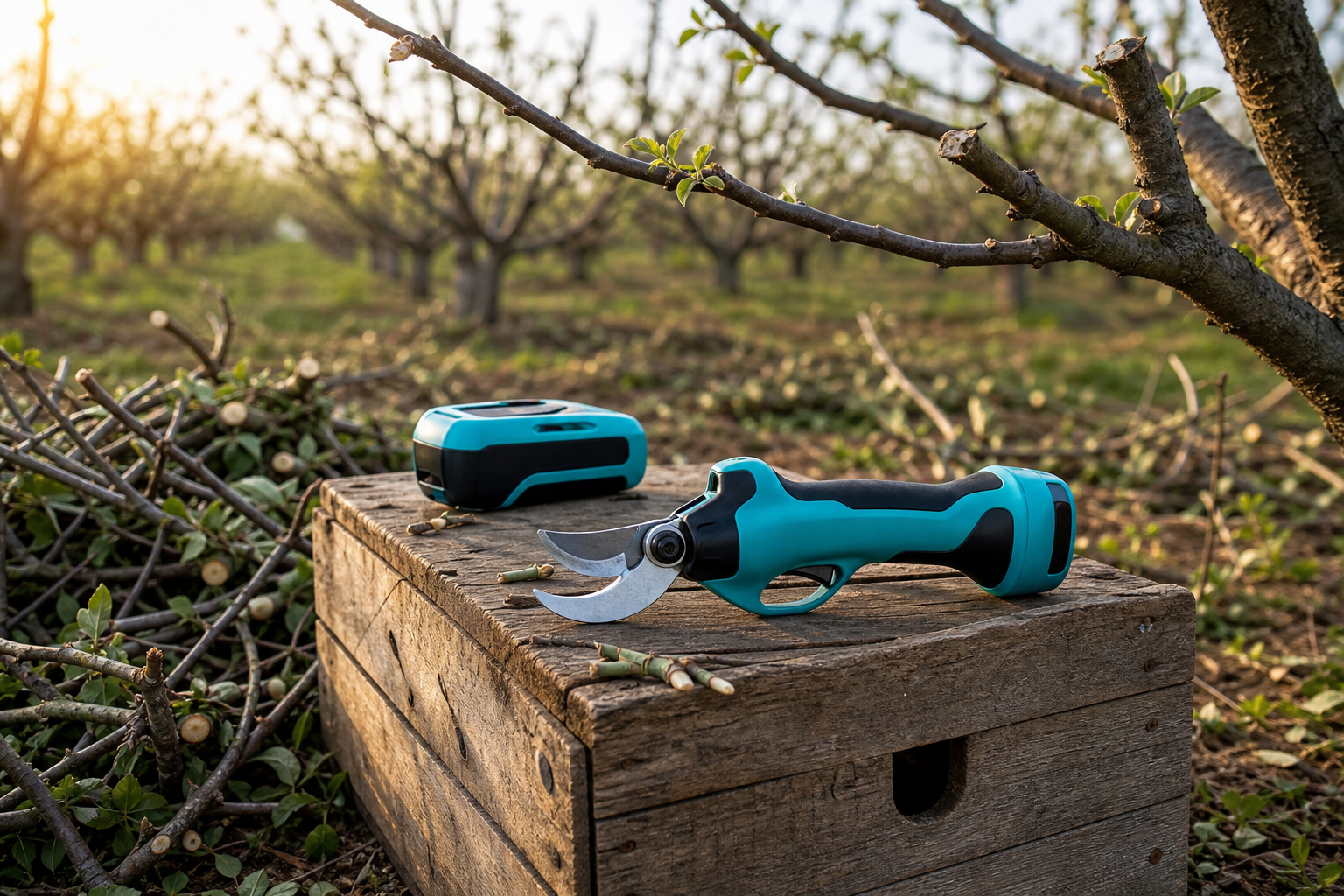
A practical equipment review for orchard farmers: labor savings, payback period, battery, blade, safety, and service risks when buying electric pruning shears.
Electric Pruning Shears: How Much Labor Can Orchard Farms Save?
When pruning season arrives, the hand knows first. Fingers stiffen. The wrist becomes heavy. The shoulder rises and stays there. One or two trees are fine. Five hundred, one thousand, or two thousand trees are a different story. A pruning shear looks like a small tool, but in an orchard it decides the speed of the day.
That is why electric pruning shears attract attention. Pull the trigger and the blade closes. Thicker branches can be cut with less grip strength. The first use can feel surprisingly satisfying. The hand hurts less, and the work rhythm becomes faster. Then the price tag slows the excitement. Some models cost a few hundred thousand KRW. Professional models can exceed two million KRW.
Should beginner orchard farmers buy one. How much labor can it actually save. And there is a more important question. Can it be used safely. Electric pruning shears are useful, but if handled carelessly, they become very fast tools near very human fingers.
1. Pruning is a hidden labor block in orchards
Orchard farming is not busy only at harvest. Winter and early spring bring pruning work. The farmer shapes the tree, opens sunlight, removes diseased branches, and prepares the fruiting structure for the next season. Rural Development Administration materials treat pruning as an important task for productivity and canopy management.
The problem is repetition. Look at a branch, cut it, move, look again, cut again. Many tasks involve raising the arm above the shoulder or tilting the neck upward. RDA health and safety materials describe overhead arm posture and looking upward in orchard work as possible musculoskeletal burden factors.
Manual pruning shears require grip strength. Cutting thicker branches again and again tires the fingers, wrist, and elbow first. When the hand slows, the schedule slows. Trees do not wait politely. In pruning season, the hand becomes the calendar.
2. Electric pruning shears reduce grip load and repetitive fatigue
The core value of electric pruning shears is not just cutting power. It is the reduction of repetitive fatigue. Cutting a thick branch matters, but the bigger value comes from reducing the grip force used hundreds or thousands of times per day.
RDA research materials have introduced electric pruning shears as a tool for reducing work burden. Farm convenience-equipment materials also describe electric pruning shears as assistive equipment that can increase pruning speed and reduce labor burden in orchards. In a rural labor environment shaped by aging and labor shortages, this is not just convenience. It is equipment that helps farmers keep working.
The difference is felt quickly. With manual shears, grip strength fades in the afternoon. With electric shears, the same rhythm can often be maintained longer. For apples, pears, peaches, citrus, grapes, and other crops with heavy annual pruning, the benefit becomes larger. One small tool can change the face at the end of the day.
3. How many hours can be saved?
The exact saving depends on tree form, branch thickness, worker skill, battery weight, and cutting capacity. Still, a simple calculation helps.
Assume manual pruning handles 8 trees per hour, and electric pruning handles 11 trees per hour. For a 500-tree orchard, manual pruning takes about 62.5 hours, while electric pruning takes about 45.5 hours. That saves about 17 hours. For 1,000 trees, it saves about 34 hours. For 2,000 trees, it saves about 68 hours.
If work speed rises to 13 trees per hour, the difference becomes larger. At 1,000 trees, manual work takes 125 hours, while electric work takes about 77 hours. That saves about 48 hours. At 2,000 trees, the saving can approach 96 hours. Not every farm will reach these numbers. But the direction is clear: the more trees and pruning work, the stronger the tool effect.
Labor saving is not only about money. It is about finishing pruning at the right time. For farms that struggle to find workers, finishing several days earlier can be a real relief. In farming, schedule is money, and fatigue is risk.
4. Payback depends on farm size
Electric pruning shear prices vary widely. Entry-level models can be relatively affordable. Professional models often sit in the one-million-KRW range. High-end models can exceed two million KRW. Extra batteries, blade replacement, and repair cost must also be counted. At first, the tool looks expensive.
Labor value changes the calculation. If the tool saves 35 hours per year and labor is valued at 15,000 KRW per hour, annual value is about 525,000 KRW. An 800,000 KRW tool pays back in about 1.5 years. A 1.5 million KRW tool pays back in about 2.9 years. A 2.8 million KRW tool pays back in about 5.3 years.
If the tool saves 60 hours per year, payback becomes faster. At 15,000 KRW per hour, annual value is 900,000 KRW. An 800,000 KRW tool pays back in about one year. A 1.5 million KRW tool takes about 1.7 years. A 2.8 million KRW tool takes about 3.1 years. If the saving is only 20 hours per year, a 1.5 million KRW tool may need about five years.
So the answer is farm size. If the orchard has many trees and heavy pruning every year, electric pruning shears can be an investment. If the farm has only a small number of trees, the tool may become an oversized purchase. A large tractor does not fit a tiny field. A high-end electric shear does not fit every small orchard.
5. Which farms benefit most?
The best-fit farms are clear. First, orchards with many trees and heavy annual pruning. Second, family-labor farms that need to reduce wrist and shoulder fatigue. Third, farms that struggle to hire seasonal workers or need to shorten the pruning period.
Older farmers and women farmers may also benefit because the tool reduces grip-force demand. But weight and battery style must fit the user. A thick handle or heavy body can create wrist discomfort. A light tool is not always weak. A powerful tool is not always better. The best tool is the one that fits the hand.
Grapes, citrus, apples, pears, peaches, and similar crops with significant pruning volume are strong candidates. If the farm has only a few young trees or occasional landscape-level pruning, an entry-level model, shared purchase, or rental may be better. Farm equipment becomes valuable when it is used every year.
6. Buying criteria are not only cutting diameter
The most visible number in product descriptions is often cutting diameter. 30 mm, 35 mm, 40 mm, and similar figures appear first. They matter. But buying only by cutting capacity can lead to regret.
Weight comes first. Body weight and battery style matter. Integrated batteries are convenient but can increase wrist load. Separated battery packs reduce hand weight but add cables and pack management. During all-day work, small differences become large.
Blade quality and replacement cost also matter. Blades are consumables. A dull blade produces rough cuts and can damage the tree more than necessary. Service and parts supply matter even more. If the shear fails during pruning season, the schedule loss hurts more than the repair bill. Safety functions also matter. Finger detection, double-action triggers, standby lock, and immediate stop functions should be checked.
The key is not the lowest price. The key is reliable work during the short pruning window. A cheap tool that fails in one season becomes an expensive tool.
7. Safety is not optional
Electric pruning shears are convenient, but dangerous. The blade closes quickly and has enough force to cut thick branches. If that force reaches a finger, it becomes an accident.
Recent safety reports show the issue clearly. Jeju agricultural technology materials report that 159 accidents related to shredders and electric pruning tools occurred over three years in citrus thinning and pruning work, with serious cutting and entanglement accidents concentrated in March and April. RDA farm safety materials also repeatedly emphasize machinery, hand tools, unsafe posture, and protective equipment as important risk factors.
Electric pruning shears should be used with safety gloves, eye protection, proper shoes, lock habits, and disciplined hand positioning. The branch-holding hand and shear-holding hand must stay separated. Turn off the tool while moving. Do not prune while talking, looking at a phone, or rushing. Remove the battery before cleaning or replacing blades.
Electric pruning shears reduce grip force. They do not reduce the need for attention. The more comfortable the tool feels, the more careful the operator must be.
8. Buying checklist for beginner farmers
Before buying, check the following. Try holding the tool in person if possible. Ask farmers growing the same crop what they use.
- Count your orchard trees and annual pruning hours.
- Check whether typical branch thickness fits the cutting capacity.
- Hold the tool and check body and battery weight.
- Confirm real working time per battery.
- Check spare battery price.
- Check blade replacement cost and availability.
- Check safety features such as finger detection.
- Confirm service center location and repair time.
- Check water and dust limitations.
- Check whether case, lubricant, tools, and charger are included.
This checklist reduces the chance of regret. Electric tools must fit the hand. Farm equipment is also a matter of compatibility.
9. Shared purchase can be a realistic option
Not every farm needs to buy a premium tool immediately. A grower group, family farm, or neighboring farms can buy together or rent before buying. If pruning seasons do not overlap perfectly, shared use may work.
But shared use needs rules. Who charges the battery. Who pays for blade damage. Who handles repair. How is the tool booked during peak season. Electric pruning shears are small, but they have consumables and batteries. Shared tools begin with friendship and survive with rules.
For beginner farmers, a good path is to start with a rental or entry-level model for one pruning season. After one season, the hand and the orchard will tell the truth. The wrist is not good at lying.
10. The answer is tree count, wrist fatigue, and safety
Electric pruning shears can reduce orchard pruning labor and fatigue. For orchards with 1,000 trees or more, annual savings of dozens of hours can be realistic under the right conditions. When labor value is included, many 800,000 to 1.5 million KRW tools can pay back in one to three years for farms with enough pruning volume.
But they are not the answer for every farm. Small orchards may see long payback periods. Weak safety functions create risk. Poor service support can stop the tool during the most important week of the season. Electric pruning shears should be judged by work continuity and safety, not cutting power alone.
A beginner orchard farmer can decide this way. If tree count is high, wrist fatigue is real, and pruning time is a bottleneck, the tool is worth reviewing. If the orchard is small, borrow or rent first. Above all, choose a safe model and change work habits. Electric pruning shears can reduce work. They cannot replace caution.
One-line summary
Electric pruning shears can reduce orchard pruning time and wrist fatigue, but payback depends on tree count and annual pruning volume, and safety functions, service, battery, and blade costs must be checked before buying.
References
- Rural Development Administration,
Major Research Achievements, materials on electric pruning shears for reducing work burden. - Rural Development Administration and Agricultural Health and Safety Information Center,
Assessment and Management of Agricultural Occupational Hazard. - Rural Development Administration,
Safe Use of Agricultural Machinery. - Gyeonggi Agricultural Research and Extension Services,
Farm Work Environment Improvement Convenience Equipment Projectcasebook. - Jeju Special Self-Governing Province Agricultural Research and Extension Services, press material on shredder and electric pruning tool accidents.
- Rural Women Newspaper,
Personal Protective Equipment and Assistive Tools for Farmers, based on RDA-provided material.