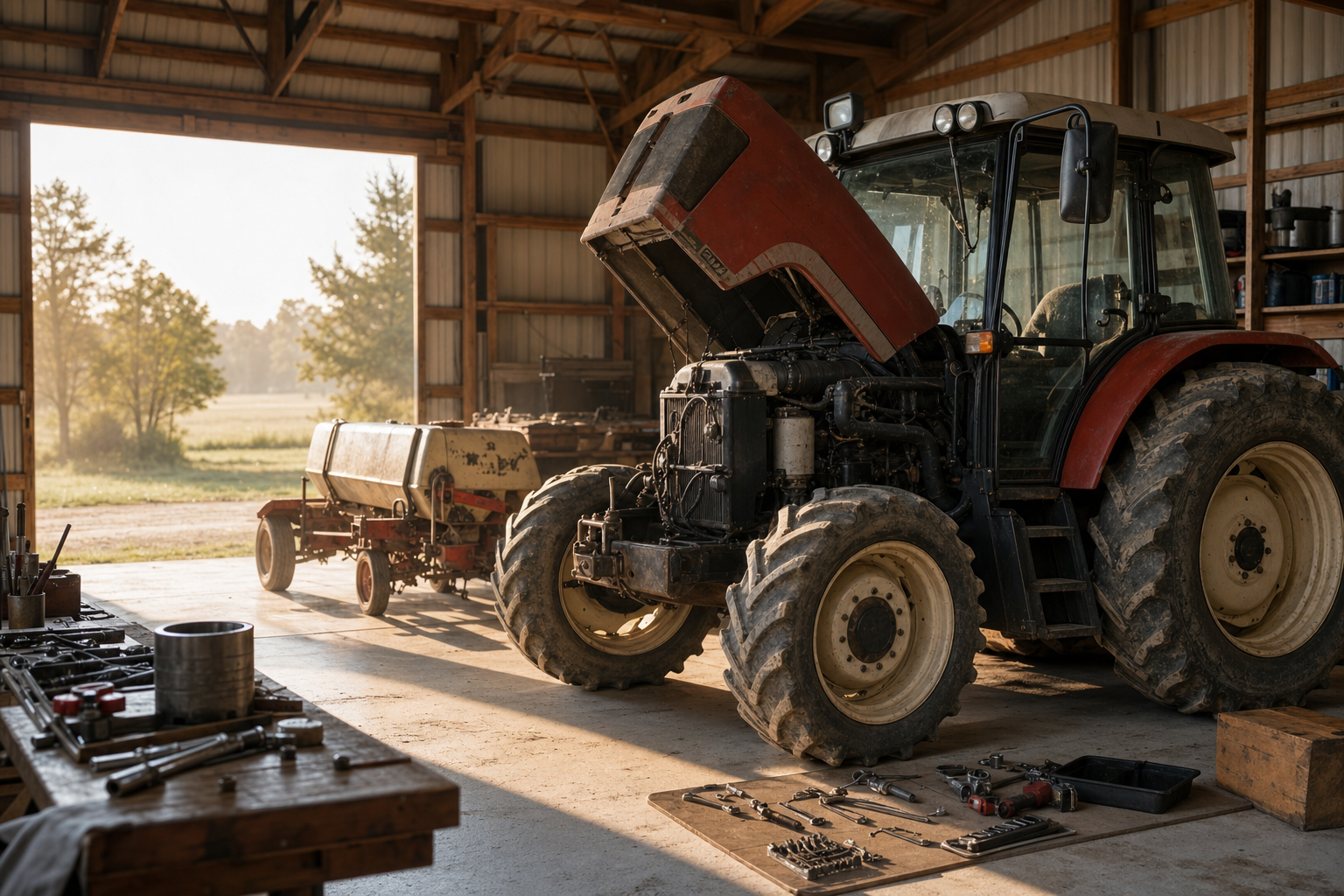
A practical checklist for buying used tractors, tillers, transplanters, combines, and implements: engine, hydraulics, PTO, tires, parts, service, and contracts.
Used Farm Machinery Buying Checklist: Avoid a Cheap Machine That Becomes an Expensive Repair
Used farm machinery can look very tempting. The price tag is often far below a new machine. A used tractor, tiller, transplanter, or implement may seem like the fastest way to reduce labor without draining cash.
But farm machinery does not live an easy life. It works in dust, mud, water, vibration, heat, and heavy load. A machine can look fine from a few meters away and still have leaking hydraulics, a noisy PTO, worn tires, weak brakes, or parts that are hard to find. A cheap machine can become an expensive lump of metal if it stops during the busy season.
This article is not about choosing a specific brand. It is a field checklist for inspecting used farm machinery before buying. Spending 30 more minutes before purchase can save several million won in repairs later.
1. Start with the work, not the price
A used machine is only a good deal if it fits your farm. A tractor that is too wide for an orchard is not cheap. A small machine that takes too long in a large field is not cheap either. The right question is not “Is this machine popular?” The right question is “Can I use this machine every week on my own land?”
Write down your crop, field size, soil condition, slope, access road width, storage space, and the implements you plan to use. For greenhouse work, overall width and height matter. For wet paddy work, tire condition and traction matter. For dry-field work, implement width, working depth, and hitch compatibility matter.
A machine that cannot enter the field or fit the shed will soon become decoration.
Fit checklist
- Check whether the machine fits your farm road and shed.
- Match the machine to paddy, dry field, greenhouse, orchard, or slope work.
- Confirm compatibility with your existing implements.
- Check whether you can attach and detach implements safely.
- Include storage, charging, fuel, and maintenance space in the decision.
2. Age matters, but working history matters more
Used equipment listings usually show the model year first. That is useful, but not enough. Two machines from the same year can be in very different condition. One may have worked only a few times each season. Another may have done heavy custom work year after year.
Check the hour meter, but do not trust it blindly. Meters can be replaced or damaged. Ask what crop the machine was used for, whether it worked in wet fields, whether it was used for custom service, and what major repairs were done.
Low hours are not always perfect either. A machine that sat unused for years can have weak rubber hoses, old seals, battery problems, fuel-system trouble, and dried grease. Machines need movement. A machine that slept too long may wake up grumpy.
History questions
- Was it used mainly in paddy fields, dry fields, orchards, or livestock work?
- Was it used for paid custom work or rental work?
- How much did it actually work during the last year?
- Has the engine, transmission, hydraulic pump, or clutch been repaired?
- Has the hour meter or instrument panel ever been replaced?
3. Start the engine when it is cold
If the seller has already warmed up the engine before you arrive, be careful. A warm engine can hide starting problems. A machine that struggles when cold may look normal after running for a while.
Ask to see a cold start if possible. Watch for white smoke, black smoke, metallic noise, rough idle, heavy vibration, and delayed starting. Check engine oil level and color. Look for milky oil, coolant leaks, cracked hoses, clogged radiator fins, loose belts, and oil marks around the engine.
You do not need to be a professional mechanic to catch the big warnings. Ask four simple questions. Does it start easily. Does the idle stay stable. Does it smoke too much when accelerated. Does it leak oil, fuel, or coolant.
Engine checklist
- Start the engine from cold.
- Check engine oil level and color.
- Check coolant, radiator, belts, and hoses.
- Watch idle vibration and exhaust smoke.
- Look under the machine for fresh or old oil stains.
4. Test hydraulics and PTO under real movement
A tractor does not work with the engine alone. Hydraulics and the PTO do much of the work. Do not finish the inspection just because the loader moves up once. Hydraulic problems may appear only when the oil gets warm or when load is applied.
Raise and lower the loader or three-point hitch several times. Hold it in the air and see whether it slowly drops. If an implement is available, connect it and run the PTO. Listen for noise, vibration, shaft wobble, and rough engagement. Check hydraulic hoses, cylinders, couplers, and fittings for wet dust or oil marks.
PTO and hydraulic repairs can be expensive. A loose shaft, heavy vibration, or strange gearbox noise should not be treated as a small bargaining point. It may be a reason to walk away.
Hydraulic and PTO checklist
- Operate the loader, three-point hitch, and implement if possible.
- Check whether raised equipment slowly drops.
- Inspect hydraulic hoses, cylinders, and couplers for leaks.
- Run the PTO and listen for noise or vibration.
- Check implement connection points for wear and looseness.
5. Tires and consumables are real costs
Worn tires are not just a cosmetic issue. Agricultural tires can be expensive, and transport or mounting costs may be added. The same applies to belts, batteries, filters, oil, blades, chains, bearings, rotary tiller blades, transplanter parts, and combine cutting parts.
A seller may say, “Consumables are supposed to be replaced.” That is true. It also means the price should reflect them.
If a machine costs 10 million won but immediately needs tires, a battery, fluids, filters, and implement blades, the real price is not 10 million won. Add transport and first maintenance before judging the deal. Used machinery often sends two bills: one when you buy it and one when you fix it.
Consumables checklist
- Check tire cracks, uneven wear, and tread depth.
- Check battery age and starting power.
- Inspect belts for cracks and tension.
- Ask when oil, filters, and coolant were changed.
- Inspect blades, chains, bearings, planting units, and cutting units.
6. Parts and service can matter more than the purchase price
The most dangerous phrase in used machinery is “You can find the parts somewhere.” During the busy season, one stopped machine can cost more than the discount you received.
Before buying, call a nearby dealer or repair shop with the exact model name and serial number. Ask whether common parts are still available. For older models, imported machines, or parallel-import equipment, check not only filters and belts but also major parts such as hydraulic pumps, clutch parts, transmission parts, sensors, and electrical components.
If you cannot repair the machine yourself, service distance matters. Farm machinery is not easy to ship by parcel. A repair truck, transport vehicle, and waiting time all become part of the cost.
Service checklist
- Photograph the model nameplate and serial number.
- Call a local dealer or repair shop before buying.
- Ask about major parts, not only filters and oil.
- Check whether local mechanics have worked on that model.
- Put any seller warranty or post-sale support in writing.
7. A proper test drive is more than one lap in the yard
Many used machines are inspected by moving forward and backward in a yard. That is not enough. Try to test the machine in conditions close to real work.
For a tractor, check forward and reverse, low and high range, four-wheel drive, brakes, clutch, steering play, gear engagement, and abnormal vibration. For a tiller, check the rotary unit, handle control, forward and reverse movement, and vibration. For transplanters and combines, the working section is the heart of the machine. A machine that can move is not always a machine that can work.
If you are new to farming, do not inspect alone. Bring an experienced farmer, a local mechanic, or someone who has used similar machines often. One more pair of eyes can change the deal.
8. Keep documents, photos, and contract details
Private used-equipment deals often rely on spoken promises. That is risky. Farm machinery can cost a lot of money, and disputes become difficult after the machine is transported.
At minimum, write down the seller, buyer, machine name, model, serial number, hour meter reading, sale price, delivery date, included implements, known defects, and warranty terms if any. Take photos of the hour meter, serial plate, engine bay, hydraulic parts, tires, implements, leaks, and visible damage.
Also decide who pays transport costs and who is responsible for damage during loading or unloading. A cheap machine far away may no longer be cheap after transport, time, and first maintenance.
9. Do a simple payback calculation
A used machine should earn its place on the farm. You do not need a perfect financial model, but you do need a rough calculation.
Suppose a used tractor costs 9 million won. Transport costs 400,000 won. Initial maintenance costs 1.2 million won. Partial tire replacement costs 800,000 won. The real initial cost is 11.4 million won. If the machine reduces annual custom work costs by 2.5 million won and annual maintenance costs 700,000 won, the net annual benefit is 1.8 million won. The simple payback is about 6.3 years.
The exact number is less important than the habit. Do not look only at the purchase price. Look at purchase price plus transport, first repair, implement cost, and annual maintenance.
Initial cost = purchase price + transport + first maintenance + required implements
Annual net benefit = reduced custom work + reduced labor - annual maintenance
Simple payback = initial cost ÷ annual net benefit
10. When you should not buy
Some machines are better left alone. Be careful if the seller avoids showing the serial number, refuses a test drive, dismisses oil leaks as normal, or cannot explain the machine history. A machine with no service records, poor local parts availability, and urgent timing right before the busy season is also risky.
New farmers should be especially careful with broken machines sold cheaply. If you have repair skills and a parts network, it may work. If not, a broken machine is not a bargain. It is a lesson with a large tuition fee.
The goal is not to find a perfect used machine. The goal is to find a machine with problems you can understand, repair, and afford. If the defect can be explained, the parts can be found, the repair is manageable, and the condition is written in the contract, it may be worth considering. If not, walk away.
20-minute field checklist
Save this list before visiting a used machinery seller.
- Photograph the model name, serial number, and hour meter.
- Start the engine from cold.
- Check engine oil, coolant, fuel, and leak marks.
- Watch idle, acceleration, smoke, and abnormal noise.
- Test forward, reverse, gears, brakes, steering, and clutch.
- Operate the loader, three-point hitch, and PTO.
- Check tires, belts, battery, filters, and worn implement parts.
- Call a repair shop about parts and service before buying.
- Add transport and first maintenance to the purchase price.
- Write down defects, included items, warranty, and delivery terms.
One-line conclusion
Buying used farm machinery is not about finding the lowest price. It is about choosing a machine that will not stop during the season. Test drive, hydraulics, PTO, consumables, parts supply, service access, and a written contract matter more than the first number on the price tag.
References
- Rural Development Administration and Nongsaro agricultural machinery management guidance. Seasonal and type-specific maintenance guidance emphasizes inspection before use after long storage, including oil, coolant, brake, and safety-related checks.
- Rural Development Administration press materials on agricultural machinery safety-device inspection. These materials confirm that safety devices and field inspection are part of practical machinery management.
- Local agricultural technology center materials on mobile repair service and machinery safety training. These were used to frame local service access and operator training as part of ownership cost.
- Used farm machinery transaction practices and repair-shop inspection norms. Model name, serial number, hour meter, included implements, defects, transport terms, and written records were reflected as practical buyer protections.