Where to place a winter shelter for community cats at a rural house or farm shed, choosing or building an EPP or styrofoam shelter, straw versus blankets, water, the Korean government care guideline, Animal Protection Act rules for outdoor dogs, and fire risks of heated pads.
Stray cats find their way into farm sheds and rural storerooms before winter arrives. You see one curled up in a greenhouse corner or under a tiller and want to put out a shelter. But a random box can get wet and freeze, start a quarrel with neighbors, or trap a cat inside when you lock the shed for the week. Yard dogs on a chain need their own winter preparation. Here is what official sources say.
Bottom line: Place a cat shelter in a quiet spot away from people and cars, with its back to the wind and raised off the ground. Line it with straw, not blankets. On land you do not own, get the manager’s consent first (Ministry of Agriculture community cat care guideline). For outdoor dogs, Korea’s Animal Protection Act rules require shelter from cold, snow and rain, a tether of at least 2m, and clean water. Do not leave electric pads or heating cables running in an empty shed.
1. Where to place it
The Ministry of Agriculture, Food and Rural Affairs issued a community cat care guideline in 2023 and revised it around March 2026. It is not legally binding, but it sets the norms: get consent on land you do not own; choose quiet places with little exposure; avoid parking lots, under cars, roadsides, playgrounds and wildlife protection areas; and when a spot must move, move it about 10m at a time. In 2022 Jongno-gu in Seoul placed 34 EPP box shelters near feeding stations and in parks, skipped places that would bother residents, numbered each for volunteers, and collected them in spring.
2. Choosing a shelter
We found no Korean official size standard. The US group Alley Cat Allies recommends an entrance no wider than 15–20cm (6–8 inches) to keep wind and larger animals out. A shelter that is too big will not warm up from a cat’s body heat.
| Type | Strength | Watch out |
|---|---|---|
| EPP shelter (ready-made) | Insulated, lasts several winters | Light; weigh it down or tie it |
| Styrofoam box (DIY) | Almost free | Cats chew it; wrap it in a tarp |
| Wood or plastic house | Sturdy | Poor insulation; add a liner |
3. Building one from a styrofoam box
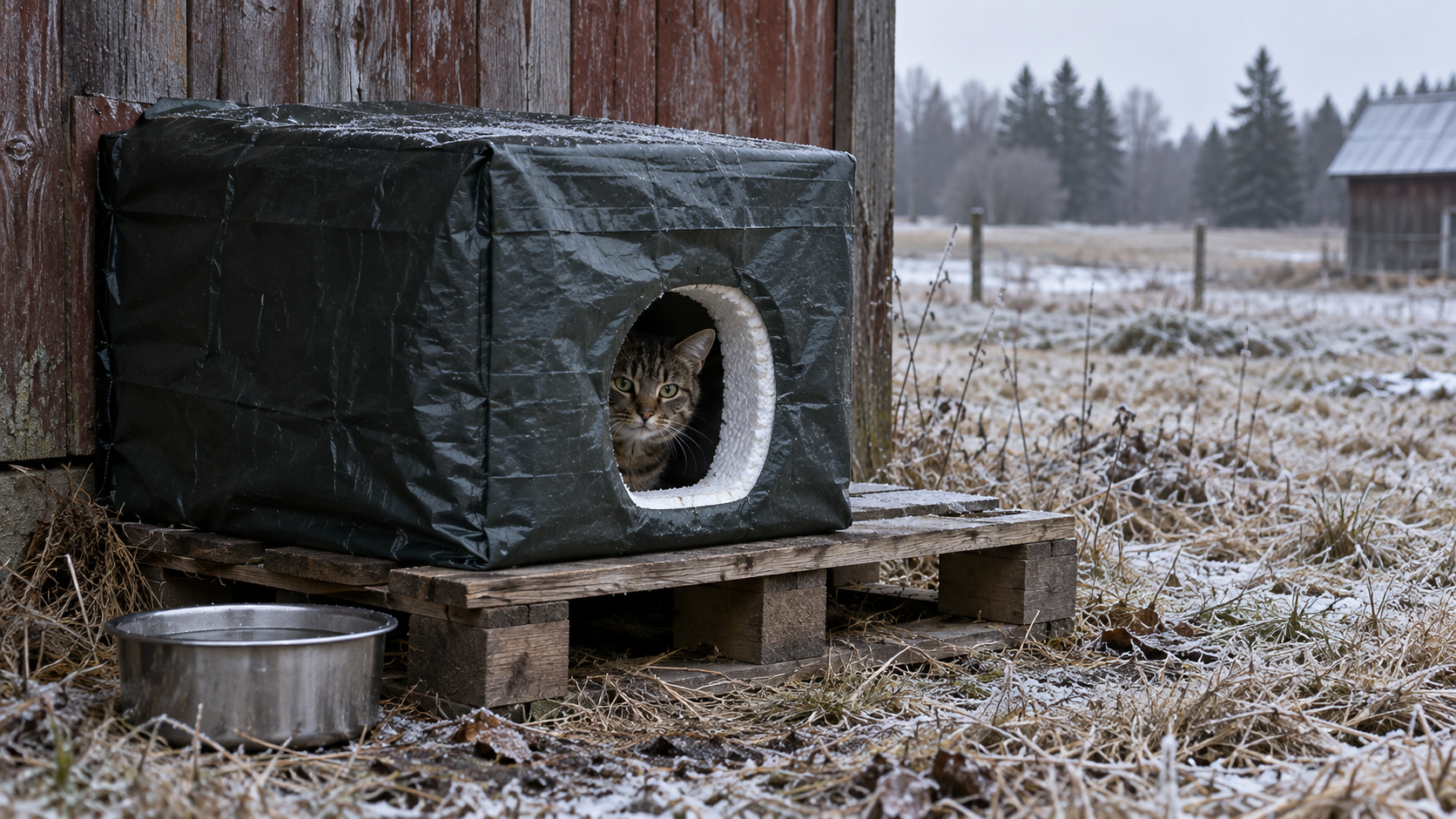
Use a thick lidded box. Cut the entrance in a long side, slightly above the floor. Tape the lid, wrap the outside in a tarp or heavy plastic, set it on a pallet or bricks, face the entrance away from the northwest wind, and weigh it down.
4. Straw, not blankets, and water
Alley Cat Allies recommends straw instead of blankets, towels or hay. Blankets soak up moisture and freeze; straw stays drier and lets cats burrow. The ministry guideline asks caretakers to provide clean water and clear bowls and leftover food right away. In winter, check the water morning and evening and break the ice.
5. Leaving the shed and starting the car
Look inside sheds and greenhouses before locking them for the week, and keep the shelter outside. The ministry runs a “knock before you start” campaign every winter: tap the hood, shut the door hard, stamp your feet, and sound the horn (not late at night). For TNR, the guideline covers cats of 2kg or more, marks neutered cats by trimming about 1cm from the left ear tip, and says neutering 70% or more of a colony stabilizes its size.
6. Outdoor dogs
Since April 27, 2023, Schedule 2 of the Enforcement Rule of the Animal Protection Act requires the following for dogs kept outdoors.
| Item | Rule |
|---|---|
| Shelter | A resting space protected from heat, cold, snow, rain and direct sun |
| Tether | At least 2m, unless unavoidable for safety, without shrinking the space |
| Space | Each side at least 2.5 and 2 times body length; tall enough to stand on hind legs |
| Food and water | Suitable food and clean water |
| Cleaning | Remove waste regularly |
| Remote sites | Check hygiene and health regularly |
In November 2025 the ministry reminded owners that keeping outdoor animals warm during cold-wave warnings is a basic legal duty. Turn the doghouse away from the wind, raise it, line it with straw and hang a flap over the door.
7. Electric pads and heating cables
Gyeonggi fire authorities count an average of 34 heating-cable fires each December, 28% of fires from seasonal appliances. In South Jeolla, 49.1% of livestock-barn fires were electrical. Do not leave heated pads on in an empty shed; insulation and dry straw are safer.
References
- Ministry of Agriculture, Food and Rural Affairs, community cat care guideline (2023, revised around March 2026; Daily Vet, March 27, 2026).
- Enforcement Rule of the Animal Protection Act, Article 6(5) and Schedule 2 (Ordinance No. 731, in force June 3, 2026), Korean Law Information Center.
- Ministry of Agriculture, Food and Rural Affairs press release, November 27, 2025.
- Seoul Shinmun, November 30, 2022 (Jongno-gu winter shelters).
- Alley Cat Allies, How to Build a Winter Shelter for Community Cats.
- Gyeonggi Fire and Disaster Headquarters heating-cable fire data (News Seoul); Seoul Shinmun, November 23, 2023 (South Jeolla barn fires).