Complete Revenue Analysis for Solar Power Plants in Gumi (2026 Basis)
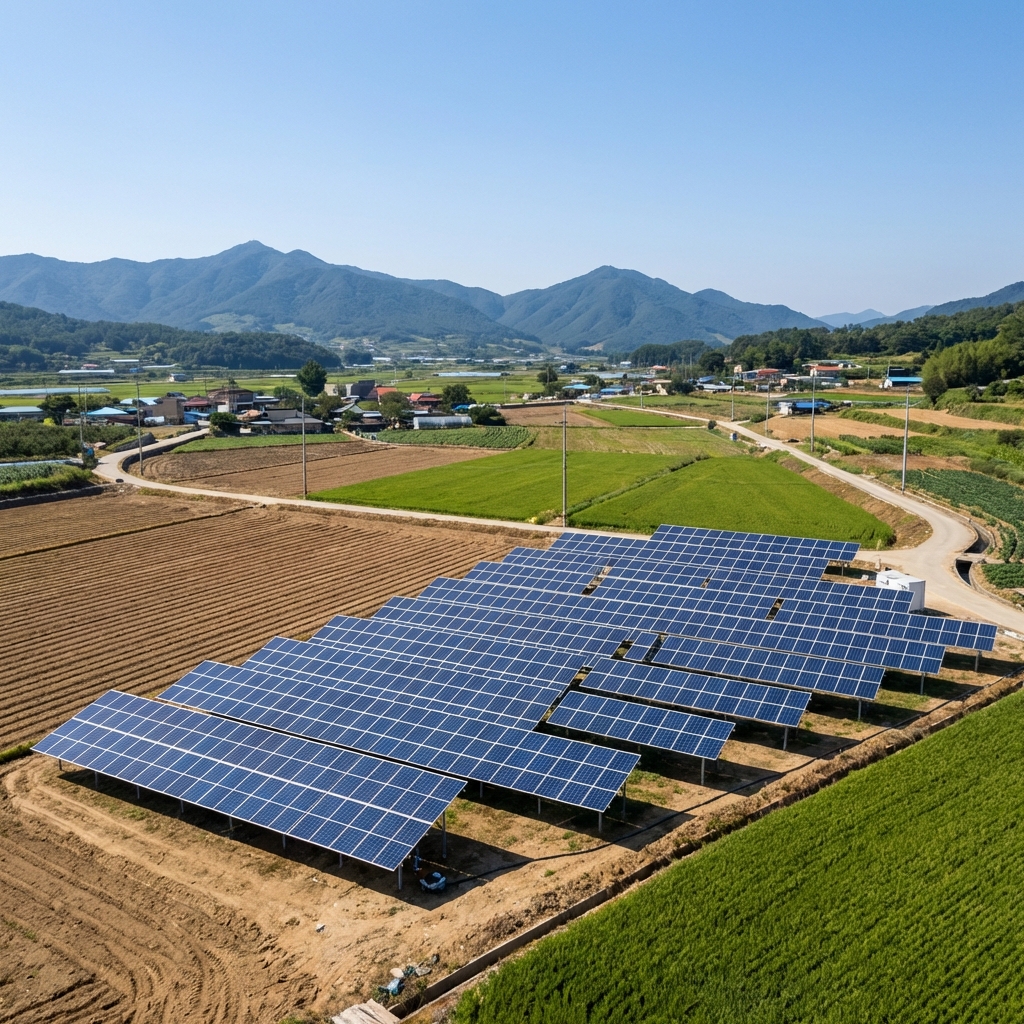
Introduction
If you own farmland or forestland in Gumi, Gyeongbuk, you’ve probably considered the solar power business at least once.
But when you actually try to calculate the revenue, where do you even start?
What’s SMP? What’s an REC weight? How do you calculate solar irradiance? Information overflows, but a revenue table with actual Gumi-specific numbers is hard to find.
In this post, we’ll calculate the projected annual revenue for 100kW, 300kW, and 500kW solar plants in Gumi as realistically as possible, using only government/public data and actual plant cases.
Gumi’s Solar Irradiance — Where Does It Rank Nationally?
The starting point for revenue calculation is solar irradiance. How long the sun shines determines generation.
1. Gumi’s Irradiance, by the Numbers
Looking at national sunshine-hours statistics, Gyeongsangbuk-do ranks in the upper tier.
- Gyeongbuk average sunshine hours: approximately 6.13 hours/day.
- Gumi’s annual sunshine hours are estimated at approximately 2,100–2,400 hours per climate data sites.
Interestingly, winter generation data reveals:
- In December 2023 to February 2024, Gyeongbuk averaged 2.49 hours/day of solar generation, ranking #1 nationally.
Surprisingly, even winters hold up well in this region.
2. Sunshine Hours ≠ Actual Generation Hours
Here’s a commonly misunderstood point.
”Sunshine hours ≠ solar generation hours.”
Looking at actual generation data from Gumi/Gyeongbuk solar plants:
- A 275.94kW plant in Gyeongju, Gyeongbuk shows actual average generation of 3.6–4.0 hours/day when monthly data is broken down by day.
- Many 100kW-class case studies also use an average of ~3.6 hours/day utilization rate when back-calculating from annual generation.
After subtracting for clouds, fog, fine dust, panel temperature rise, and inverter losses, the realistic “effective generation time” is about 3.6–4 hours.
SMP and REC Pricing — Must Be Nailed Down Before Revenue Makes Sense
Knowing generation alone isn’t enough. The real money comes from the SMP + REC structure.
1. Recent SMP (System Marginal Price) Trends
SMP is the wholesale electricity price — essentially the rate at which KEPCO purchases power from generators.
The 2024–2025 trend clearly turned downward:
- Expanded renewable energy share (solar, wind)
- Stabilized international fuel prices
- Slowing electricity demand growth
These three factors combined are pushing SMP steadily lower.
- 2024 annual average SMP: approximately 126.91 KRW/kWh
- 2025 annual average SMP: 113.98 KRW/kWh, down from 2024
- December 2025 mainland SMP per KEPCO exchange: dropped to 89.77 KRW/kWh
- Late December 2025 weekly averages: 85–88 KRW/kWh range
For early 2026, a conservative high-80s to low-90s estimate is reasonable.
This article uses 87 KRW/kWh as the baseline — the midpoint of December 2025 weekly averages.
2. REC (Renewable Energy Certificate) Price
A REC is issued for every 1 MWh (= 1,000 kWh) of renewable energy produced. Selling these to power companies or obligated suppliers generates additional revenue.
- August 2025 spot market: approximately 71,890 KRW/REC
- Late December 2025: traded at 67,054–72,800 KRW/REC
- Early January 2026 references: 71,748 KRW/REC as the baseline
Since 1 REC = 1 MWh = 1,000 kWh: 71,748 KRW/REC = 71.748 KRW/kWh.
This article uses 71.748 KRW/kWh as the baseline REC rate.
3. REC Weighting — This Is the Real Game Changer
Even producing the same 1,000 kWh, where you install determines how many RECs you receive. This is where outcomes diverge.
Key weights:
- Farmland (general site, under 100kW): 1.2
- Farmland (general site, 100kW+): 1.0
- Forestland (mountain): 0.5
- Building rooftop (under 100kW): 1.5
- Over 300kW: partial 0.8 weighting applies
Older references may show forestland at 0.7, but post-2021 revisions generally apply forestland 0.5. Intentionally lowered due to deforestation and sprawl concerns.
Interpretation: “Same generation, but farmland 1.0 vs. forestland 0.5 → forestland revenue is roughly half” — this rough sense plays out almost exactly in actual calculations.
100kW in Gumi — Let’s Put Real Numbers Down
The most common installation capacity is the 99kW/100kW range. A single design decision here creates tens of millions KRW difference over 20 years.
1. 100kW Generation Baseline
Various sources typically estimate 100kW annual generation as:
- At 15% utilization: 100kW × 24hrs × 365 days × 0.15 = 131,400 kWh/year
Gyeongbuk/Gumi’s irradiance conditions aren’t bad, so 131,400 kWh/year as baseline seems realistic.
2. Case A: Gumi Farmland 99kW (REC Weight 1.2)
99kW falls within the 1.2 weighting bracket on farmland. The revenue structure already shifts here.
Annual generation: ~130,140 kWh/year
Rate composition:
- SMP: 87 KRW/kWh
- REC base: 71.748 KRW/kWh
- REC with 1.2 weight: 71.748 × 1.2 = 86.0976 KRW/kWh
- Total rate = 87 + 86.10 ≈ 173.1 KRW/kWh
Annual gross revenue: 130,140 × 173.1 ≈ 22.52 million KRW/year
Annual operating costs (~3.5 million KRW: O&M, insurance, monitoring, misc.)
Annual net profit ≈ 19 million KRW
3. Case B: Gumi Farmland 100kW (REC Weight 1.0)
Just 1kW more — and the REC weight drops to 1.0. This is why the industry designs to “cap at 99kW.”
Total rate = 87 + 71.748 = 158.748 KRW/kWh
Annual gross revenue: 131,400 × 158.748 ≈ 20.86 million KRW/year
Annual net profit ≈ 17.36 million KRW
99kW vs. 100kW: 1.64 million KRW/year difference → 32.8 million KRW over 20 years
The “design to 99kW” advice isn’t just a sales pitch — the numbers fully support it.
4. Case C: Gumi Forestland 100kW (REC Weight 0.5)
Forestland’s 0.5 weight is brutal.
Total rate = 87 + 35.874 = 122.874 KRW/kWh
Annual gross revenue: 131,400 × 122.874 ≈ 16.14 million KRW/year
Annual net profit ≈ 12.64 million KRW
Versus farmland 100kW (weight 1.0): 4.72 million KRW/year gap → 94+ million KRW over 20 years.
300kW and 500kW — Larger Plants in Gumi
Same formulas, but scaling up changes the investment structure slightly.
300kW Farmland Plant
- Annual generation: 394,200 kWh/year (at 15% utilization)
- Total rate: 158.748 KRW/kWh (weight 1.0)
- Annual gross revenue: ~62.58 million KRW
- Operating costs: ~8 million KRW/year
- Annual net profit ≈ 54.58 million KRW
- Simple payback on 500 million KRW: ~9.2 years
500kW Farmland Plant
REC weight drops partially to 0.8 at this scale.
- Annual generation: 657,000 kWh/year
- Total rate: 144.398 KRW/kWh
- Annual gross revenue: ~94.87 million KRW
- Operating costs: ~12 million KRW/year
- Annual net profit ≈ 82.87 million KRW
- Simple payback on 800 million KRW: ~9.7 years
Installation Costs, Financing, and Payback — Practical Numbers
100kW Installation Cost
Various quotes converge around:
- Ground-mount (farmland/forestland): equipment + structure + foundation — approximately 100–130 million KRW
- Rooftop: including structural reinforcement — 80–90 million KRW
- Budget options: imported modules at 74 million KRW; premium domestic at 97.3 million KRW
Add KEPCO connection fees, permit processing, and additional earthwork: can easily reach 150–200 million KRW.
This article uses 100 million KRW as baseline for return calculations.
Government and Local Support & Financing
Korean FIT (fixed-price contract): For sub-30kW or farmer-owned sub-100kW small solar — fixed-price electricity purchase for 20 years. Previous contracts around 184.4 KRW/kWh, but recent competitiveness vs. spot market is debatable.
Gyeongbuk Province financing: Aggressive loan programs including “Sunshine Pension” type — for farmers, up to 140 million KRW at 1% interest, 6-month grace + 11.5-year repayment.
Realistic Payback Period
For the 99kW farmland plant:
- Installation: 100 million KRW (fully financed)
- Annual net: 19 million KRW
- Annual interest: 100 million × 1% = 1 million KRW
- Real annual income ≈ 18 million KRW
- Simple payback ≈ 5.6 years
The commonly cited “7–8 year payback, 10+ years of cash flow” accounts for construction periods, early failure risks, SMP/REC decline, and taxes.
Farmland vs. Forestland vs. Rooftop — What’s the Answer in Gumi?
Farmland
Pros: REC weight 1.0–1.2, typically flat (lower earthwork costs), closer to KEPCO lines
Cons: Farmland conversion levy (tens of thousands KRW/pyeong), strict Farmland Act regulations, significant resident complaint risk
Forestland
Pros: Cheaper land, easier to secure large areas, physical distance may reduce complaints
Cons: REC weight 0.5 = roughly half the revenue, mountain conversion permits, slope restrictions (typically no steeper than 15°), mudslide risk avoidance — stringent regulations, potentially high earthwork costs
Analyses consistently show forestland solar revenue 10–13%p lower than farmland with 1–2 additional years for payback.
Building Rooftop (livestock barns, warehouses)
Pros: REC weight 1.5 (under 100kW) — highest; zero land cost; no conversion levy; fewer resident complaints
500kW livestock barn rooftop cases report: 630,000 kWh/year, 100+ million KRW annual revenue (due to 1.5 weighting).
Cons: Structural and seismic reviews mandatory; aging roofs may need expensive reinforcement.
Gumi’s Regulatory and Complaint Realities
Regulations
Gyeongbuk/Gumi solar permit requirements include:
- Setback distances from roads, rivers, cultural heritage sites
- Installation restrictions near residential clusters
- Mountain slope and mudslide risk zone regulations
In practice, resident opposition is typically a bigger variable than regulatory paperwork.
Real Cases
One media report highlighted a Gumi livestock barn solar installation where the permit was granted within 2 hours — sparking favoritism allegations while other residents spent months in consultation.
Another case featured year-long resident resistance against farmland solar near a village entrance, citing “landscape damage, glare, and property rights infringement.”
Getting the permit and operating conflict-free are entirely different problems.
How to View Gumi Solar Investment in 2026
Headwinds
- Declining SMP: 126.91 → 113.98 → low-to-mid 80s by late 2025. Near-term surge unlikely.
- REC price volatility: Once above 100K KRW, now in a 60–80K range.
- Curtailment risk: Output curtailment surging especially in Honam; Gyeongbuk grid congestion could follow.
Tailwinds
- Strong irradiance: Winter generation #1 nationally; annual 15% utilization realistic.
- Policy push: Gyeongbuk province announced 300MW solar on industrial/idle sites (500 billion KRW investment).
- Low-interest financing: 1%-rate farmer loans significantly boost capital returns.
Realistic Conclusion for Gumi
- Small-scale (99kW) farmland/rooftop: Best profitability with relatively manageable regulations.
- Forestland owners: The 0.5 REC penalty rapidly erodes returns. Same capital may be better spent on farmland/rooftop.
- Mid-to-large (300kW, 500kW): Meaningful for entities seeking long-term stable cash flow, but grid capacity, community acceptance, and mountain regulations need individual evaluation.
Summary
| Case | Annual Generation | Annual Net Profit |
|---|---|---|
| 99kW Farmland (weight 1.2) | ~130,140 kWh | ~19 million KRW |
| 100kW Farmland (weight 1.0) | ~131,400 kWh | ~17.36 million KRW |
| 100kW Forestland (weight 0.5) | ~131,400 kWh | ~12.64 million KRW |
| 300kW Farmland | ~394,200 kWh | ~54.58 million KRW |
| 500kW Farmland | ~657,000 kWh | ~82.87 million KRW |
Before investing, always check:
- Is your site farmland, forestland, or rooftop-eligible?
- KEPCO grid connection availability and distance
- Neighbor relations and complaint potential
- Gyeongbuk/municipal financing and subsidy eligibility
Limitations: SMP/REC rates are based on late 2025 to early 2026 values and are subject to change. Generation estimates use combined Gyeongbuk/Gumi regional data due to limited site-specific long-term measurements. Equipment efficiency variations can produce ±10% revenue variance.
Still, compared to vague claims like “solar makes 20 million KRW a year,” these Gumi-specific numbers — broken down by capacity, land type, weight, and price — should provide a useful baseline for investment decisions.
”With my land and rooftop, which of the above scenarios can I realistically pursue?”
From that point on, you’ll need detailed design drawings, KEPCO grid consultation, and on-site irradiance analysis. Use these figures as directional guidance, and always finalize decisions with actual quotes from professional installers and designers.