Agrivoltaics Only for 3-Year Farmers? The Bar Just Got Higher
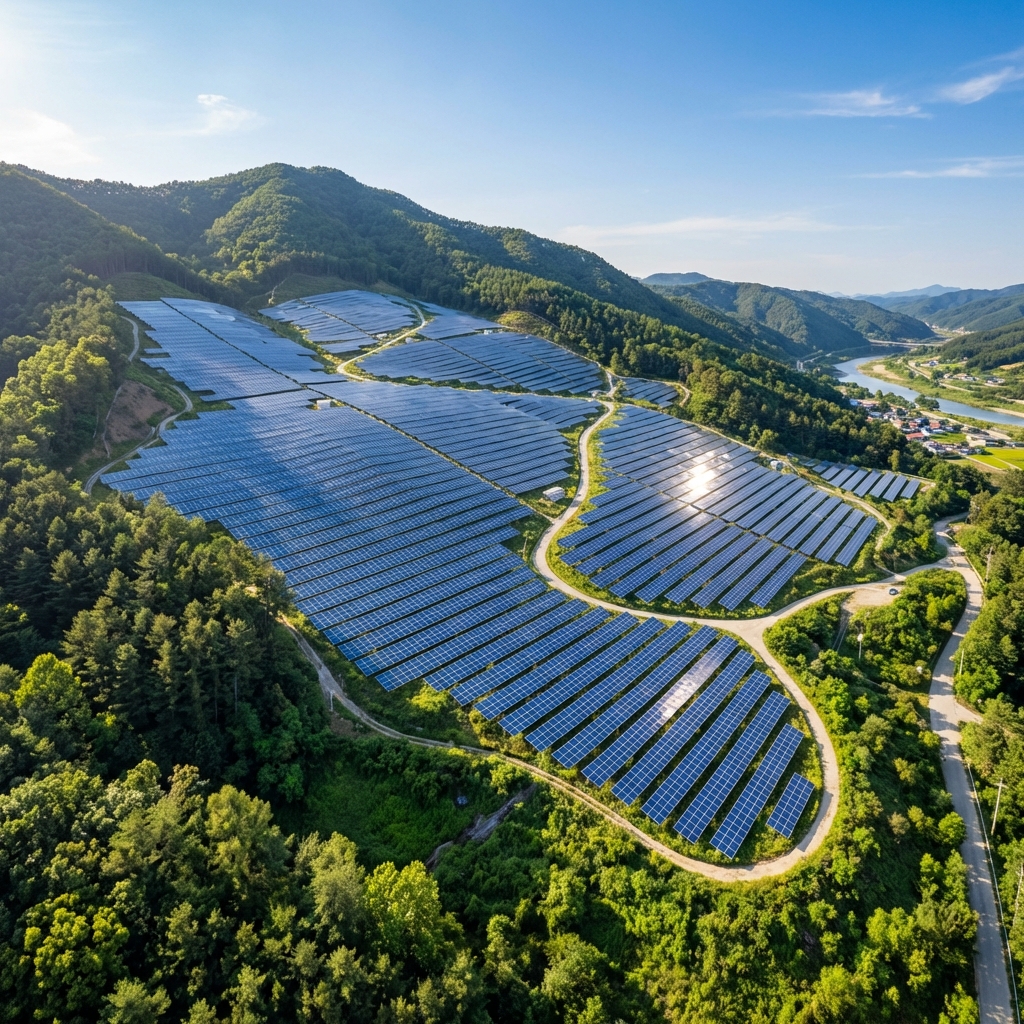
A bridge to rural areas just collapsed.
In January 2026, the government announced that agrivoltaics permits would be restricted to farmers with 3+ years of actual farming experience. Farming while earning solar power revenue — so-called “sunshine farming” — just had its entry bar dramatically raised. For people contemplating rural migration, it was like a bolt from the blue. Three years of waiting.
Who exactly is this policy for?
Why Did the Government Impose the 3-Year Restriction?
The Ministry of Agriculture, Food and Rural Affairs stated the reason clearly: to block fake farmers.
The problem was indeed severe. A 2023 Board of Audit and Inspection investigation found that out of 2,994 small solar power operators, 851 were improperly receiving agricultural benefits. This included 200 employees of public institutions and 64 local government officials. Six public officials even fraudulently registered agricultural management entities to run solar businesses.
In 2021, schemes using mushroom or insect cultivation houses to circumvent regulations were rampant. People who didn’t actually farm, doing only paper farming while pocketing generation revenue. YouTube even had videos promoting these workarounds.
From the government’s perspective, with abuse cases emerging before the system was even properly established, they had no choice but to draw the sword. The result: 3 years of actual farming + 605 pyeong limit + 100kW capacity limit.
What About Young Rural Migrants?
But this policy has a fatal blind spot.
For young people just trying to establish themselves in rural areas, three years is too long. The hardest part of early rural settlement is income instability. The land is unfamiliar, crops are unfamiliar, sales channels are unclear — and you have to survive three years before you can access solar income.
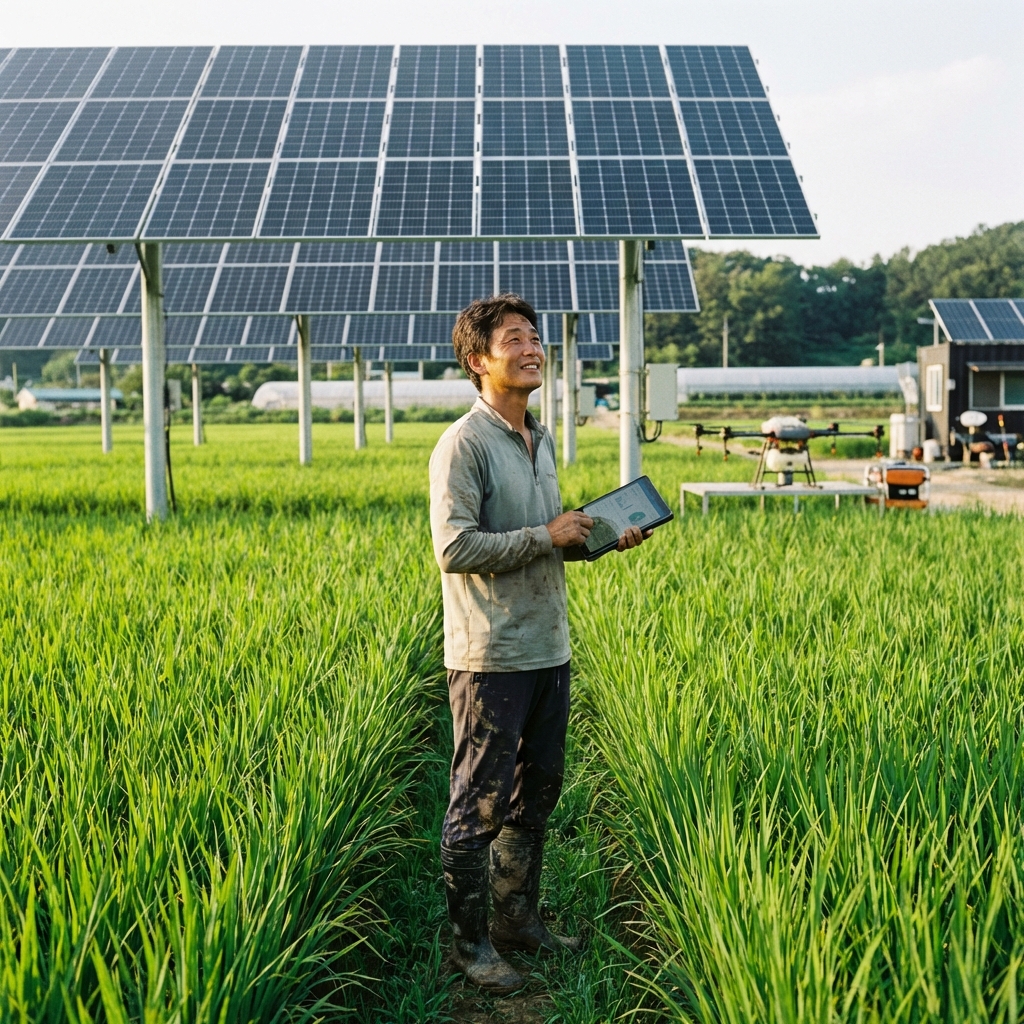
The economics of agrivoltaics are actually stunning. One farmer in Boseong installed 99.7kW on a 650-pyeong paddy and saw revenue jump from 1.16 million KRW in crop income to 12.78 million KRW in electricity sales — more than 10× increase. In Yeongam-gun field trials, total revenue increased 8.4× compared to standalone rice farming. As of 2025, a 100kW system generates roughly 2.21 million KRW per month.
With this income, young rural migrants can survive. Pay for home repairs, buy farming equipment, cover living expenses while learning agricultural skills. But they’re told to wait three years.
How about Japan? Japan introduced agrivoltaics in earnest in 2013 and now has over 3,300 sites. They grant 10-year temporary alternative use permits, with approval given for 93.5% of prime farmland. At renewal, they just check crop production — and there hasn’t been a single permit revocation to date. France is stricter but rational. Yields must be 90%+ of a comparison site, and agricultural income must equal or exceed pre-installation averages. Checked at 6 years; violations result in fines or revocation. Crystal clear.
We, on the other hand, erected a wall of 3 years of actual farming at the entrance.
Tenant Farmers Are Completely Shut Out
The bigger problem is tenant farmers.
Half of Korean farming households are tenants. They lease land and farm it. Under this policy, they effectively cannot do agrivoltaics at all. The 3-year requirement is already demanding, and even if they meet it, they have to worry about the landowner.
What happens when generation revenue goes up? The landowner raises the lease, or kicks out the tenant to run the solar business themselves. The government promised to “prepare tenant protection measures within the year,” but there’s nothing concrete. Lawmaker Im Mi-ae proposed legislation limiting installation to landowner-owned farmland — if this passes, tenants are completely excluded.
A structure where skilled farmers are excluded while people who merely own land get the benefits. Is this really right?
Fake vs. Real — Where’s the Balance?
The government’s position is understandable.
They set a food self-sufficiency goal of 55.5% by 2027, but reality has dropped to 47.9%. Rice self-sufficiency fell to 96%. Wheat is 1.5%, corn 4.3%. With solar going up on prime farmland, anxiety about food security is legitimate.
In fact, data released by an opposition lawmaker in October 2025 showed rice yield dropping up to 71% in Geochang, Gyeongnam. 51% in Hamyang, 40% in Haman. The government says the average reduction is 15.7%, but regional and crop variations are massive.
But this is early-stage trial data. Farmers in Boseong countered that “the 70% reduction was because they weren’t farming properly.” Actual Boseong trials showed 20–25% reduction. Yeongam-gun also at 21%. Technology is advancing — high-transmittance panels are coming, and research on LED-assisted photosynthesis at night is underway.
Blocking fake farmers is right. But the method is the problem. The 3-year restriction has become a lock that blocks real farmers too.
Why Not Do It Like France?
Look at the French model.
France evaluates by results. 90%+ of yield, income maintained. Meet these two things and you’re good. Checked at 6 years, then regular follow-ups. Fail and it’s fines or permit revocation. Clean and clear.
We could do something similar.
- Stage 1: Submit a farming plan. Specific crops to cultivate, projected yields, sales plans.
- Stage 2: Mandatory agricultural training in year 1. Local government agricultural extension centers monitor.
- Stage 3: Compare yields over 3 years. Warning if below 80% of conventional farmland yields.
- Stage 4: If no improvement after warning: penalties → permit revocation.
This way, genuine farmers earn solar income from year 1. Fake farmers? They don’t actually farm, so they get caught by year 3.
Initial investment is 150–200 million KRW for 100kW. The government allows NH (Nonghyup) participation in Sunshine Income Village projects and supports low-interest financing up to 85%. Break-even in 7 years.
Real farmers plan 7-year investments. Fake farmers run when yield numbers expose them in 3 years. Evaluating by results is more rational.
Food Security vs. Rural Extinction — Can’t We Have Both?
Rural areas are crumbling right now.
2024 food self-sufficiency 47.9%, rice 96%, wheat 1.5%. These numbers say one thing clearly: you can’t make a living from farming alone. Average farmer age in the 70s, young people don’t come, villages are empty.
Agrivoltaics creates a money-flowing structure in rural areas. Generation revenue 5–10× crop income. At village level, 10 million KRW per year in shared revenue. With this money, young people come back, schools revive, shops reopen.
But the government blocked the entrance with a 3-year restriction. Because of fake farmers.
Of course fakes must be blocked. But not at the cost of blocking the real ones. Japan grew 3,300 sites over 18 years. We still have just 70 pilot sites. And we’re hobbling ourselves from the start.
How about Year 1 entry + Year 3 evaluation? Year 1 with mandatory training, quarterly local government checks. Year 2 yield verification. Year 3: warning if below standard, opportunity to improve. Still no improvement: penalties and restoration to original state.
This way, real farmers receive their sunshine pension within one year, and fake farmers are filtered out within three. Food security preserved, rural areas revived.
605 pyeong, 100kW, 2.21 million KRW monthly. Add farming income for 3 million KRW monthly. Numbers worth returning to rural areas for. Tell them to wait 3 years? They just stay in the city.
Conclusion: Lower the Bar, But Watch Closely
The agrivoltaics 3-year actual farming restriction.
The intent to block fake farmers is correct. But the method is wrong. Don’t block the entrance — manage the process.
France evaluates by results. Japan grants 10-year permits and checks at renewal. We? Built a wall called 3 years of actual farming.
Young rural migrants can’t wait 3 years. Tenant farmers are completely excluded. A policy that tried to block only fake farmers ended up blocking real farmers too.
How about trying this instead:
- Year 1 entry allowed (with mandatory agricultural training)
- Quarterly on-site monitoring (local agricultural extension centers)
- 3-year yield evaluation (80% benchmark vs. conventional farmland)
- Below standard: warning → penalties → permit revocation
Lower the bar, but watch closely.
605 pyeong for 2.21 million KRW monthly, farming added for 3 million KRW monthly. Numbers worth returning for. A structure where rural areas can survive.
If the government truly wants to save rural Korea, it needs to revisit the 3-year restriction. A system that blocks the fakes but welcomes the real ones. That’s real policy.
References
- Jeonbuk Agricultural Broadcasting, “Agrivoltaics restricted to 3+ year farmers,” 2026.1.27
- Jeonju MBC, “Agrivoltaics permits restricted to actual farmers,” 2026.1.29
- NBS Today, “800+ fake farmers receiving solar benefits,” 2023.11.15
- Kyunghyang Shinmun, “Lessons from Japan’s 18 years of agrivoltaics,” 2022.11.21
- National Assembly Research Service, “France’s agrivoltaics system,” 2024.8.7
- BizHankook, “Agrivoltaics: capturing both food and energy,” 2025.10.22
- Hankook Kyungjae, “Agrivoltaics captures both food and energy,” 2025.8.2
- YA Energy, “Rice farming + solar on paddies yielded ~8× revenue,” 2025.11.11
- Jeonju MBC, “Domestic food self-sufficiency at 47.9%,” 2026.1.8
- Dong-A Ilbo, “Opposition: Lee gov’t agrivoltaics reduced rice harvest up to 71%,” 2025.10.12
- Hankyoreh, “‘70% rice loss from agrivoltaics is false’,” 2025.11.11
#Agrivoltaics #SolarPolicy #RuralMigration #3YearRequirement #RuralEconomy #YoungFarmers #SolarIncome #FarmlandAct #FoodSecurity