Solar Panel Research as of January 2026
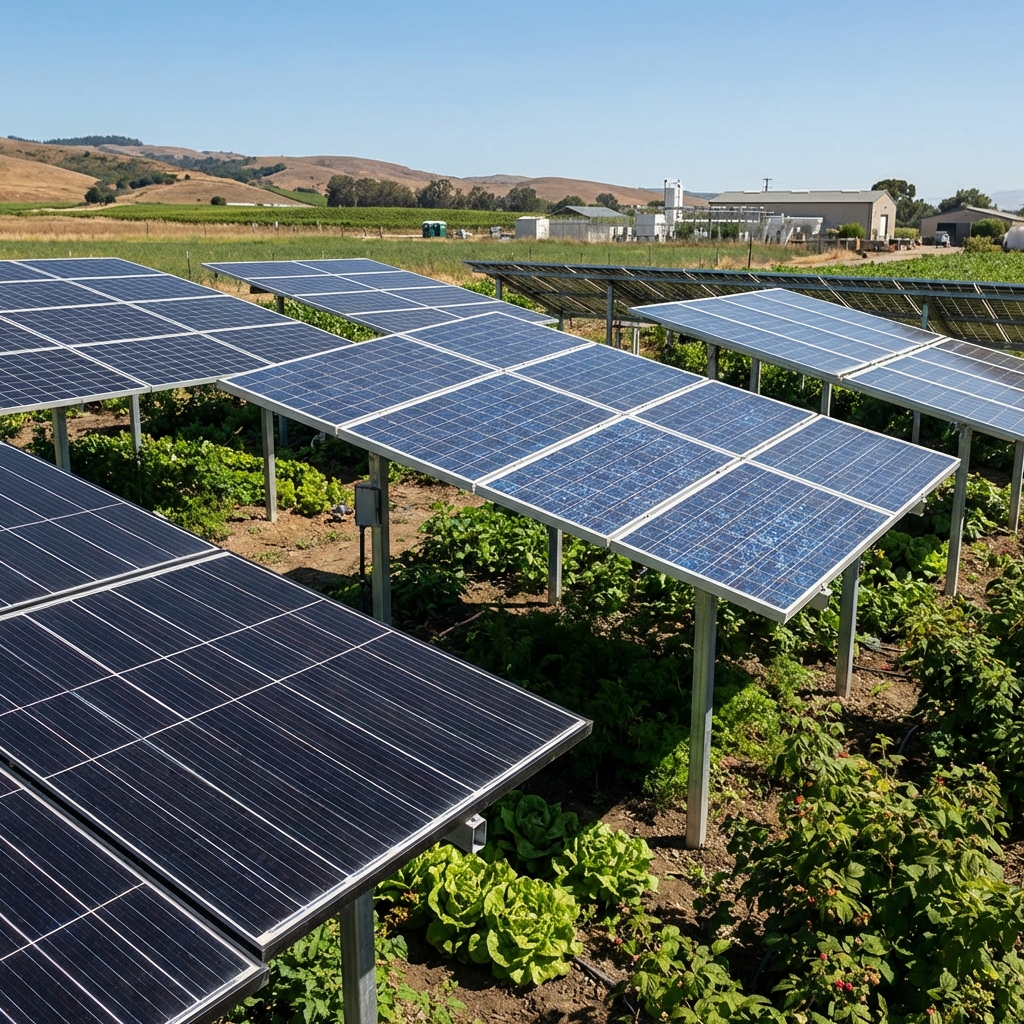
The Core of Solar Business — Panel Selection Determines Profitability
When preparing an agrivoltaics business, the very first question you hit is “which panels should I install?” The market has dozens of solar panel types — monocrystalline, polycrystalline, PERC, TOPCon, HJT, bifacial — and specs and warranty terms vary wildly by manufacturer.
For agrivoltaics especially, panel selection is even more critical than conventional solar. You need to maximize power generation while maintaining a shading rate under 30%, ensure stable operation for 25+ years, and secure returns relative to initial investment.
This post provides a detailed analysis of solar panels currently available as of January 2026, based on authoritative government data, official manufacturer specifications, and research institute field trial data, along with recommendations for panels best suited for agrivoltaics and farmland solar.
Basic Solar Panel Classification
Solar panels are broadly classified by the following criteria.
1. Classification by Silicon Crystal Structure
- Monocrystalline Silicon
Monocrystalline panels are solar cells made from a single pure silicon crystal. Characterized by a uniform black appearance and octagonal cell shape, they boast the highest efficiency among solar panels.
Key Specifications
| Category | Details |
|---|---|
| Appearance | Uniform black, octagonal cell structure |
| Efficiency | 20%+, max 23.4% |
| Lifespan | 25–30 years |
| Annual efficiency decline | 0.3–0.9% |
| Efficiency after 25 years | ~80–86% retained |
Advantages
- High conversion efficiency enables significant power production even in limited space
- Excellent performance in low-light conditions
- Long lifespan with stable performance retention
- Relatively stable in high-temperature environments
Disadvantages
- Higher manufacturing cost than polycrystalline
- Somewhat higher initial investment
Agrivoltaics Suitability: Very High
Thanks to high efficiency, monocrystalline panels can secure sufficient power generation while maintaining a shading rate under 30%, making them most suitable for agrivoltaics. The 25+ year lifespan aligns with the government’s push for extended business periods (23–30 years).
- Polycrystalline Silicon
Polycrystalline panels are made by melting and bonding multiple silicon fragments, characterized by a blue tint and uneven surface.
Key Specifications
| Category | Details |
|---|---|
| Appearance | Blue, irregular surface |
| Efficiency | Lower than monocrystalline (~15–18%) |
| Lifespan | 25+ years |
| Manufacturing cost | Cheaper than monocrystalline |
Advantages
- Lower manufacturing cost reduces initial investment
- Lower energy consumption in manufacturing
- Proven stability
Disadvantages
- Lower efficiency than monocrystalline
- Requires more installation space for equivalent output
- Greater efficiency drop in high-temperature environments
Agrivoltaics Suitability: Medium
While cost-effective, lower efficiency may make it difficult to meet the agrivoltaics shading requirement of under 30%. May be considered for large farmlands seeking to minimize initial investment, but monocrystalline is more advantageous for long-term generation and profitability.
2. Classification by Technology
- PERC (Passivated Emitter and Rear Cell)
PERC adds a passivation layer to the rear of the cell to reduce electron recombination and boost efficiency. Currently the most widely deployed mainstream technology, applicable to both mono and polycrystalline.
Key Specifications
| Category | Details |
|---|---|
| Efficiency | 19–22% |
| Technology maturity | Very high (fully commercialized) |
| Price competitiveness | Excellent |
| Application | Both mono and polycrystalline |
Advantages
- High energy yield from reduced electron recombination
- Proven technology with established stability
- Reasonable price range
- Suitable for residential, commercial, and agricultural applications
Disadvantages
- Possible LeTID (light and elevated temperature induced degradation)
- Performance degradation risk with P-type silicon
Agrivoltaics Suitability: High
PERC technology is suitable for agrivoltaics thanks to its proven stability and reasonable pricing. The monocrystalline PERC combination in particular delivers both high efficiency and cost-effectiveness, making it a popular choice among agrivoltaics operators.
- TOPCon (Tunnel Oxide Passivated Contact)
TOPCon applies tunnel oxide technology to form passivated contacts on both front and rear sides. Based on N-type silicon, it’s evaluated as a next-generation technology that overcomes PERC’s limitations.
Key Specifications
| Category | Details |
|---|---|
| Efficiency | 25%+ |
| Efficiency gain over PERC | 1.5–2% higher |
| Bifaciality ratio | Up to 85% (PERC: 70%) |
| LID/LeTID resistance | Excellent |
| Temperature coefficient | -0.30%/°C (excellent high-temp stability) |
Advantages
- Industry-leading conversion efficiency (25%+)
- N-type cells virtually eliminate LID/LeTID
- High bifaciality ratio maximizes reflected light utilization
- Stable performance in high temperatures
- Low power loss and long lifespan
Disadvantages
- Somewhat higher price than PERC
- Relatively new — limited long-term verification data
Agrivoltaics Suitability: Very High
TOPCon is currently evaluated as the optimal technology for agrivoltaics. Top efficiency (25%+) minimizes shading while maximizing generation. When manufactured as bifacial, it captures ground-reflected light from farmland for 15–30% additional generation. N-type cell characteristics ensure low degradation rates for 25+ years of stable operation.
- HJT (Hetero-Junction Technology)
HJT combines monocrystalline and amorphous silicon in a sandwich structure, leveraging the strengths of both materials to minimize energy loss.
Key Specifications
| Category | Details |
|---|---|
| Efficiency | Up to 25% |
| Structure | Monocrystalline (center) + amorphous (front/rear) |
| Temperature coefficient | Very low (excellent high-temp performance) |
| Bifacial generation | Possible |
Advantages
- High conversion efficiency
- Excellent low-light performance
- Stable in high temperatures (summer advantage)
- Minimized energy loss
- Bifacial generation capable
Disadvantages
- Very high manufacturing cost
- Limited domestic producers
- Complex manufacturing process
Agrivoltaics Suitability: High
HJT is technically excellent but the high price is a drawback. Suitable for operators with budget flexibility seeking top performance, particularly advantageous in regions with sustained summer heat.
3. Classification by Generation Method
- Monofacial
Traditional method that absorbs sunlight only from the front side.
Specifications
| Category | Details |
|---|---|
| Structure | Single-side generation |
| Manufacturing cost | Low |
| Installation flexibility | Flexible |
Agrivoltaics Suitability: Medium
- Bifacial
Absorbs sunlight from both front and rear sides. The most attention-grabbing technology in agrivoltaics.
Key Specifications
| Category | Details |
|---|---|
| Additional generation | 5–30% (varies by environment) |
| Bifaciality ratio | 70–85% |
| Optimal environment | High-reflectance ground (farmland, snow, desert, etc.) |
| Durability | Longer lifespan with dual glass |
Advantages
- Increased generation through reflected light utilization
- Optimized for ground-reflected light from farmland
- Enhanced durability with dual-glass structure
- Superior long-term cost efficiency
Disadvantages
- 10–20% higher initial cost than monofacial
- Sensitive to installation angle and ground conditions
- Minimal effect in low-reflectance environments
Agrivoltaics Suitability: Very High
Bifacial panels are core technology for agrivoltaics. Farmland soil generally has high reflectance (especially flooded rice paddies), enabling 15–20% additional generation from the rear side. Major manufacturers including Hanwha Q CELLS, LONGi Solar, and JA Solar have released bifacial modules for agrivoltaics.
4. Thin-Film
Thin semiconductor layers deposited on substrates, structurally different from crystalline silicon.
Key Specifications
| Category | Details |
|---|---|
| Efficiency | 10–13% (lower than crystalline) |
| Lifespan | 10–20 years |
| Weight | Very light |
| Flexibility | High |
Advantages
- Lightweight reduces structural load
- Flexible forms enable diverse installation
- Low-light performance
- Low manufacturing cost
Disadvantages
- Very low efficiency
- Short lifespan (10–20 years)
- Rapid performance degradation
- Requires large installation area
Agrivoltaics Suitability: Low
Thin-film’s low efficiency and short lifespan make it unsuitable for agrivoltaics. Doesn’t align with government business period extension policies (23–30 years) and may have difficulty meeting the under-30% shading requirement.
Semiconductor Type Classification: N-Type vs P-Type
Solar cells are categorized as N-type or P-type based on dopant material.
N-Type
Dopant: Phosphorus (P) — electron excess
Key Specifications
| Category | Details |
|---|---|
| Efficiency | Up to 25.7% |
| LID resistance | Excellent |
| High-temp stability | High |
| Lifespan | Longer life, slower degradation |
Advantages
- Industry-highest efficiency
- Virtually no light-induced degradation (LID)
- Stable performance in high temperatures
- Strong resistance to defects and impurities
- Long lifespan
Disadvantages
- Higher manufacturing cost than P-type
Agrivoltaics Suitability: Very High
P-Type
Dopant: Boron (B) — hole excess
Key Specifications
| Category | Details |
|---|---|
| Efficiency | ~23.6% |
| Market share | Legacy mainstream technology |
| Price | Lower initial cost |
Advantages
- Lower initial investment
- Radiation resistance
Disadvantages
- LID/LeTID risk
- Rapid degradation
- Shorter lifespan than N-type
Agrivoltaics Suitability: Medium
The market is rapidly transitioning to N-type. For businesses requiring 25+ years of long-term operation like agrivoltaics, N-type panels are more advantageous.
Classification by Installation Method
1) Fixed-Tilt
The most common method where panels are installed at a fixed angle.
Specifications
| Category | Details |
|---|---|
| Installation cost | Low |
| Maintenance | Simple |
| Generation efficiency | Baseline 100% |
| Installation area | Small |
Advantages
- Low initial investment
- Stable structure
- Easy maintenance
- Low failure risk
Disadvantages
- Lower generation than tracking systems
Agrivoltaics Suitability: Medium
2) Tracking System
Automatically adjusts panel angles to track the sun’s position in real time.
Types
- Single-axis tracking: tracks east-west movement only
- Dual-axis tracking: tracks both east-west movement and altitude changes
Key Specifications
| Category | Details |
|---|---|
| Generation increase | 15–30% over fixed-tilt |
| Installation cost | 1.5–2× fixed-tilt |
| Maintenance | Regular inspection needed |
| Payback period | 2+ years shorter |
Advantages
- Maximum generation efficiency
- Crop sunlight regulation possible (advantageous for agrivoltaics)
- Automatic seasonal angle optimization
- Remote control capable
Disadvantages
- High initial investment
- Software/sensor failure risk
- Large installation area required
- Wind vulnerability
Agrivoltaics Suitability: High
Dual-axis tracking systems from domestic specialists like PARU are specifically designed for agrivoltaics. During crop heading stages when maximum sunlight is needed, panel angles can be adjusted to provide sufficient light to crops below.
Manufacturer Comparison
1) Hanwha Q CELLS
Flagship Product: Q.PEAK DUO Series
| Model | Output | Efficiency | Warranty | Features |
|---|---|---|---|---|
| Q.PEAK DUO L-G8.3 | 420–425W | 19.6–19.8% | 12yr product / 30yr output | Bifacial |
| Q.PEAK DUO L-G9.3 | 450–460W | 20.4–20.8% | 12yr product / 30yr output | Bifacial, half-cell |
Pricing (2026 basis)
- 3kW system: 3.3–3.95 million KRW (installed)
- 5kW system: 6.5–8 million KRW (installed)
Agrivoltaics Suitability: Very High
2) LG Electronics
Flagship Product: NeON Series
| Category | Specs |
|---|---|
| Output | 395–415W |
| Efficiency | Monocrystalline high-efficiency (7%+ above competitors) |
| Warranty | 12yr product / 25yr output |
| Annual efficiency decline | 0.5% (86% retained at year 25) |
Agrivoltaics Suitability: High (Note: LG exited the business in 2022; based on existing products)
3) Hyundai Energy Solutions
Flagship Product: HiS Series
| Category | Specs |
|---|---|
| Output | 400–640W |
| Type | Bifacial module |
| Warranty | 10yr product / 25yr output |
Agrivoltaics Suitability: High
4) Chinese Manufacturers (LONGi, JA Solar, Trina, Jinko)
Market Position
- World’s top 1–4 by production volume
- 2024 figures: Jinko Solar 90GW, JA Solar 73GW, LONGi 68GW, Trina 66GW
Advantages
- Overwhelming price competitiveness
- High output (400W+)
- Latest technology (TOPCon) applied
- Diverse bifacial modules
Disadvantages
- Limited domestic after-sales support
- Lower brand recognition
- Insufficient long-term quality verification (some products)
Agrivoltaics Suitability: High
Excellent price-performance ratio makes them suitable for large-scale agrivoltaics projects. However, verify after-sales support and warranty compliance in advance.
Solar Module Lifespan and Degradation
1) Lifespan Standard
A solar panel’s “lifespan” doesn’t mean the point when it stops generating entirely — it means the point when performance drops below 80% of initial capacity.
2) Annual Efficiency Decline Rate
| Panel Type | Annual Decline | Efficiency After 25 Years |
|---|---|---|
| N-type TOPCon | 0.3–0.5% | 86–92% |
| P-type PERC | 0.5–0.7% | 83–87% |
| Monocrystalline standard | 0.5–0.8% | 82–87% |
| Polycrystalline | 0.6–0.9% | 80–85% |
| Thin-film | 1.0–1.5% | 65–75% |
N-type TOPCon panels show the lowest degradation rates and are most suitable for agrivoltaics’ long-term operation (23–30 years).
3) Major Degradation Causes
- LID (Light Induced Degradation)
- Occurs from boron-oxygen defects in P-type silicon
- 1–3% efficiency drop within weeks of initial operation
- LeTID (Light and elevated Temperature Induced Degradation)
- Occurs from combined light and high temperature in PERC cells
- Up to 7% efficiency drop reported over 3 years
- PID (Potential Induced Degradation)
- Leakage current from high potential difference between solar cells and frame
4) Degradation Minimization
- Choose N-type TOPCon or HJT panels
- Select products with ANTI-PID technology
- Regular cleaning and inspection (2+ times per year recommended)
- Proper grounding and voltage management
- Use high-quality inverters
Agrivoltaics Panel Selection Guide
1) Government Standards and Specifications
Shading rate requirement (legal)
- Under 30%
Crop yield reduction standard
- Within 20% (maintain 80%+ of yield)
Ground clearance standard
- 3–4m+ above ground (space for farming equipment)
Recommended panel specifications
- Cell type: 36-cell, 24-cell (smaller than standard 72-cell)
- Size: ~2/3 of standard panels
- Rationale: Smaller panels provide more sunlight below and reduce drip damage
2) Optimal Panel Recommendations for Agrivoltaics
1st Choice: N-type TOPCon Bifacial Monocrystalline
- Highest efficiency and long-term stability
- Recommended for: Large-scale projects prioritizing long-term returns
2nd Choice: P-type PERC Bifacial Monocrystalline
- Best value with proven technology
- Recommended for: Small-to-medium scale, initial cost reduction
3rd Choice: Monocrystalline Bifacial (legacy technology)
- Lowest cost
- Recommended for: Small scale, cost-first approach
3) Farmland Solar (Outside Agricultural Promotion Areas)
1st Choice: N-type TOPCon Bifacial Tracking
- Maximizes generation efficiency
- Recommended: PARU and other specialist systems
Panel Cost Comparison Summary
Price Trends as of January 2026
Module unit price (per watt)
- Polycrystalline standard: 200–250 KRW
- Monocrystalline PERC: 300–350 KRW
- N-type TOPCon: 350–400 KRW
- HJT: 400–450 KRW
- Chinese TOPCon: 250–300 KRW
Sources
- Ministry of Agriculture, Food and Rural Affairs: Agrivoltaics institutionalization and policy guidance
- Rural Development Administration, National Institute of Crop Science: Crop-specific agrivoltaics field trial research
- Korea Rural Economic Institute: Agrivoltaics economic analysis reports
- Ulsan Buk-gu Office: Agrivoltaics pilot project implementation plans