Robots Pollinating Zucchini?
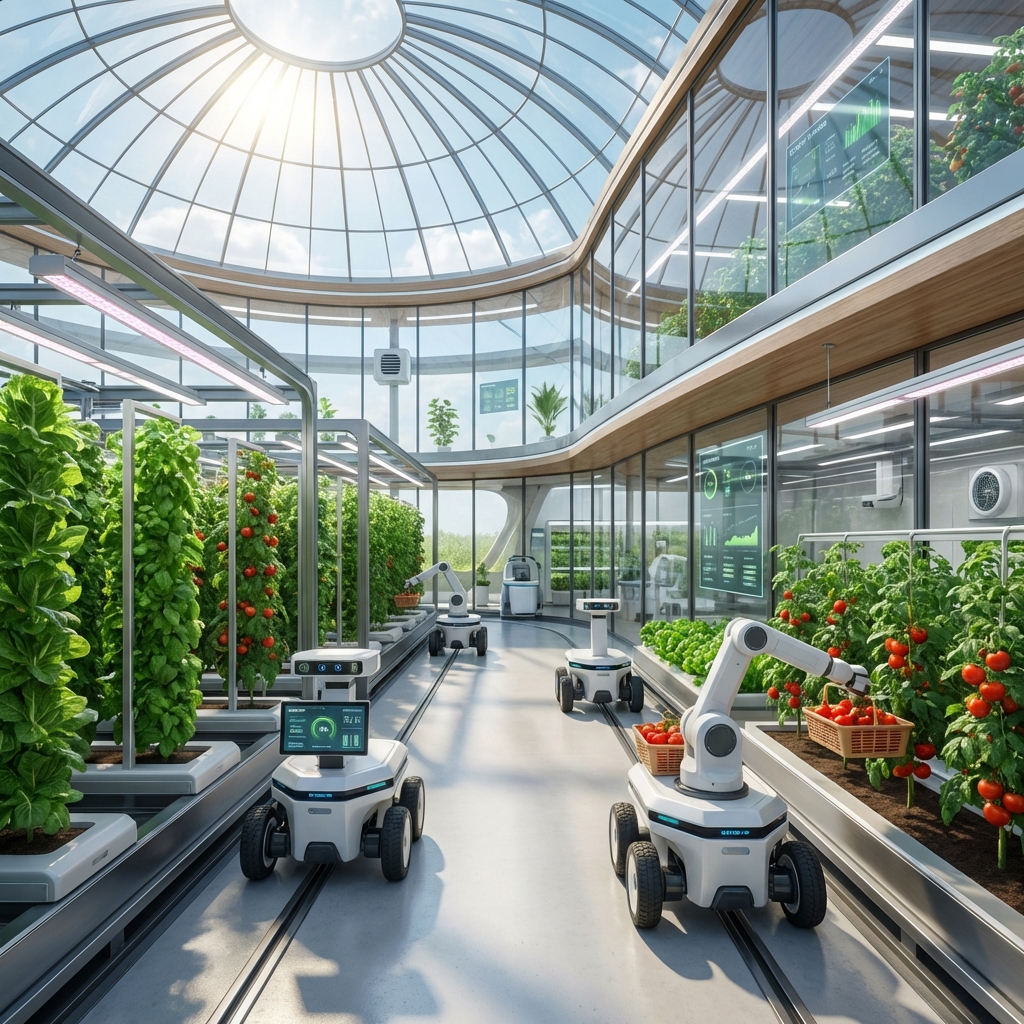
A zucchini farm in Goseong-gun, Gyeongnam. In a 2,400㎡ greenhouse, every morning — 4 hours — spent hand-pollinating flowers. Zucchini can’t pollinate naturally, so humans have to do it one by one. The farmer can’t leave in the morning.
But this year, a replacement is arriving.
How Is This Different from ChatGPT?
Physical AI. The name itself sounds unfamiliar. In simple terms, it’s “artificial intelligence with a body.”
AI like ChatGPT lives only inside screens. Ask a question and it answers, writes text, generates images. But physical AI is different. It sees with cameras, measures distance with lasers, and does things with robot arms. See, think, move. All three must sync up.
NVIDIA CEO Jensen Huang said this in early 2025:
“We are entering the era of physical AI that can reason, plan, and act on its own.”
That prediction has already become reality. In factories, in warehouses, and now in our rural communities.
What the Gyeongnam Agricultural Research Institute Is Building
The Digital Agriculture Research Center at the Gyeongnam Agricultural Research and Extension Services. They’re currently developing three physical AI robots.
First: the zucchini pollination robot. Built to solve the problem at that Goseong-gun farm. Recognizing flowers, identifying stamen positions, and depositing pollen precisely. Work that’s confusing even to human eyes — and a robot handles it. A prototype is coming soon.
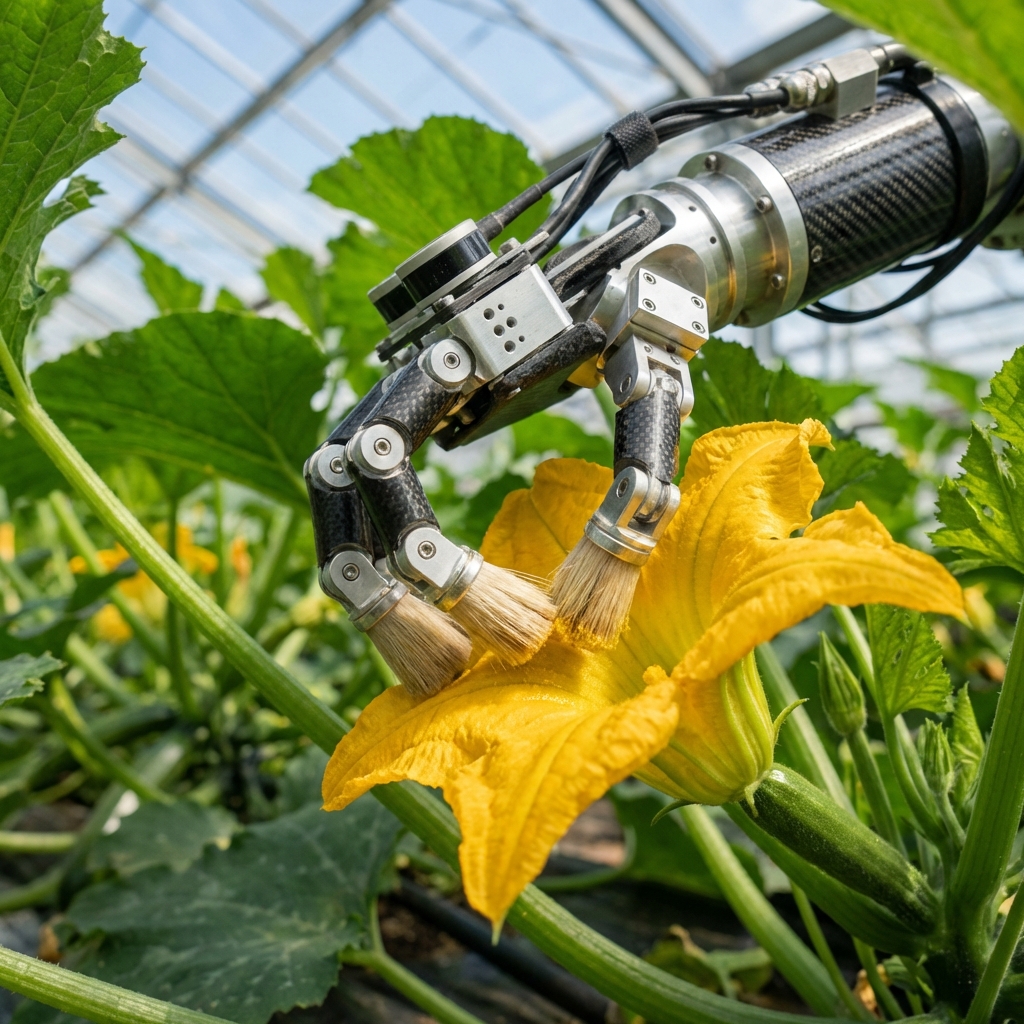
Second: the sweet persimmon sorting robot. Already demonstrated. It sorts persimmons by size, culls damaged ones, and packages them. Work that used to require five or six workers all day.
Third: strawberry cultivation experiments. This is the more ambitious project. Beyond harvesting, they’re researching production systems that respond to climate crisis. Researcher Ahn Hye-bin says: “We can grow target crops at target times, even without sunlight.”
Researcher Nam Jin-woo put it this way: “When physical AI takes over, it’s not just labor cost savings — farmers’ lives get a little easier.”
The Secret Behind Robot Eyes: Camera + Laser
For physical AI to work, it needs to see the world. But not casually, like human eyes. It needs precision.
Two technologies converge here.
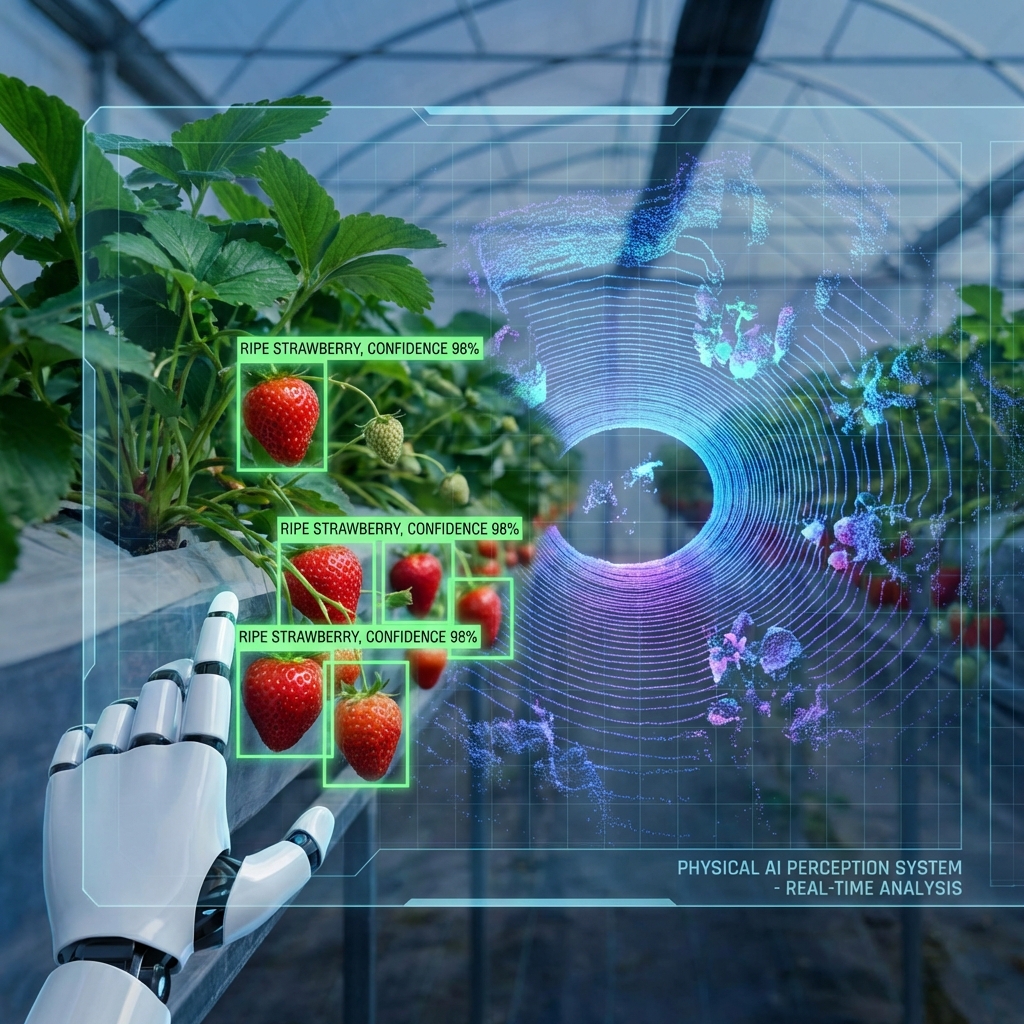
Computer vision. Simply put, an AI-equipped camera. It looks at strawberry color to judge ripeness, distinguishes leaves from stems, and spots damaged areas. The fascinating part: it can see things human eyes can’t. By detecting plant stress in the infrared spectrum, it can tell days before leaves start wilting.
LiDAR. Fires lasers and measures the time for reflection to calculate distance. Millimeter-accurate. Works in dark or bright conditions. Even in fog. Research on strawberry harvesting robots has reported ±0.05 meter accuracy.
Using either alone gets about 85–90% accuracy. But combine them? It jumps above 95%. A case where 1+1 equals 3.
An $86.5 Billion Market Is Opening
The agricultural robotics market projections are eye-popping.
$86.5 billion by 2033. Over 120 trillion KRW. A compound annual growth rate of 20.5%. At this rate, it’s not just growth — it’s an explosion.
Why is it growing this fast? The answer is simple. There’s nobody to farm.
Korea’s average farmer age has passed 65. Over 65% are 65 or older. Young people don’t come to rural areas. Foreign workers are hard to find too. Labor costs keep rising. But we can’t just stop farming. People need to eat.
Robots are the only answer. That’s why the government has jumped in.
The Government Is Pouring In 290 Billion KRW
February 3, 2026. At an economic ministers’ meeting, the ‘National Agricultural AX Platform’ initiative was announced. AX stands for AI Transformation.
Total project cost: 290 billion KRW. Government contribution alone: 140 billion KRW. In the Ministry of Agriculture’s own words: “Building an intelligent agricultural ecosystem that even elderly and beginner farmers can easily use.”
If existing smart farms were hardware-centric, this is software and AI at the center. Not just attaching sensors and calling it done — the sensors send data, and AI judges and acts on it.
Jeonnam Province is already moving. An Agricultural AX Global Business Center (45 billion KRW), a demonstration center (40 billion KRW), and an AI-based growth support data center (30 billion KRW). A total of 115 billion KRW facility complex planned for Muan-gun.
Hurdles That Remain
Let’s be honest — physical AI isn’t a cure-all. There are challenges.
Price. Still expensive. Small farms can’t easily afford them. But solutions are emerging. RaaS (Robot as a Service) — instead of buying robots, you rent them when needed. Lease robots only during harvest season, pay based on work volume.
Learning. Agricultural environments are too diverse. Temperature, humidity, and crop conditions differ from farm to farm. You can’t program every scenario. So teleoperation learning was developed. A skilled farmer remotely controls the robot, and the robot learns from those movements. Converting 20 years of farming instinct into data.
Field adaptation. Things that work in the lab might fail in the field. Rocks, mud, sudden gusts of wind. Too many variables. This requires thorough field testing.
Before Rural Communities Disappear
The label “at risk of disappearing” has been attached to rural areas for a long time. Empty houses multiplying, schools closing, only the senior centers bustling. As MBC News put it: “Our rural communities face extinction due to aging populations and rural depopulation.”
Physical AI farming robots won’t solve this crisis overnight. But they can buy time. If a robot handles work that one person used to do, that person can do other things. Or maybe just rest a little.
Researcher Nam Jin-woo’s words keep echoing.
”Farmers’ lives will get a little easier.”
Getting a little easier. Isn’t that the reason technology exists?
Note: The Gyeongnam Agricultural Research Institute prototype release schedule and National Agricultural AX Platform application period (2026.2.5–4.3) mentioned in this article are based on information as of February 2026.
#PhysicalAI #AgriculturalRobots #SmartFarm #AgricultureAX #ZucchiniRobot #LiDAR #ComputerVision #FutureFarming #RaaS