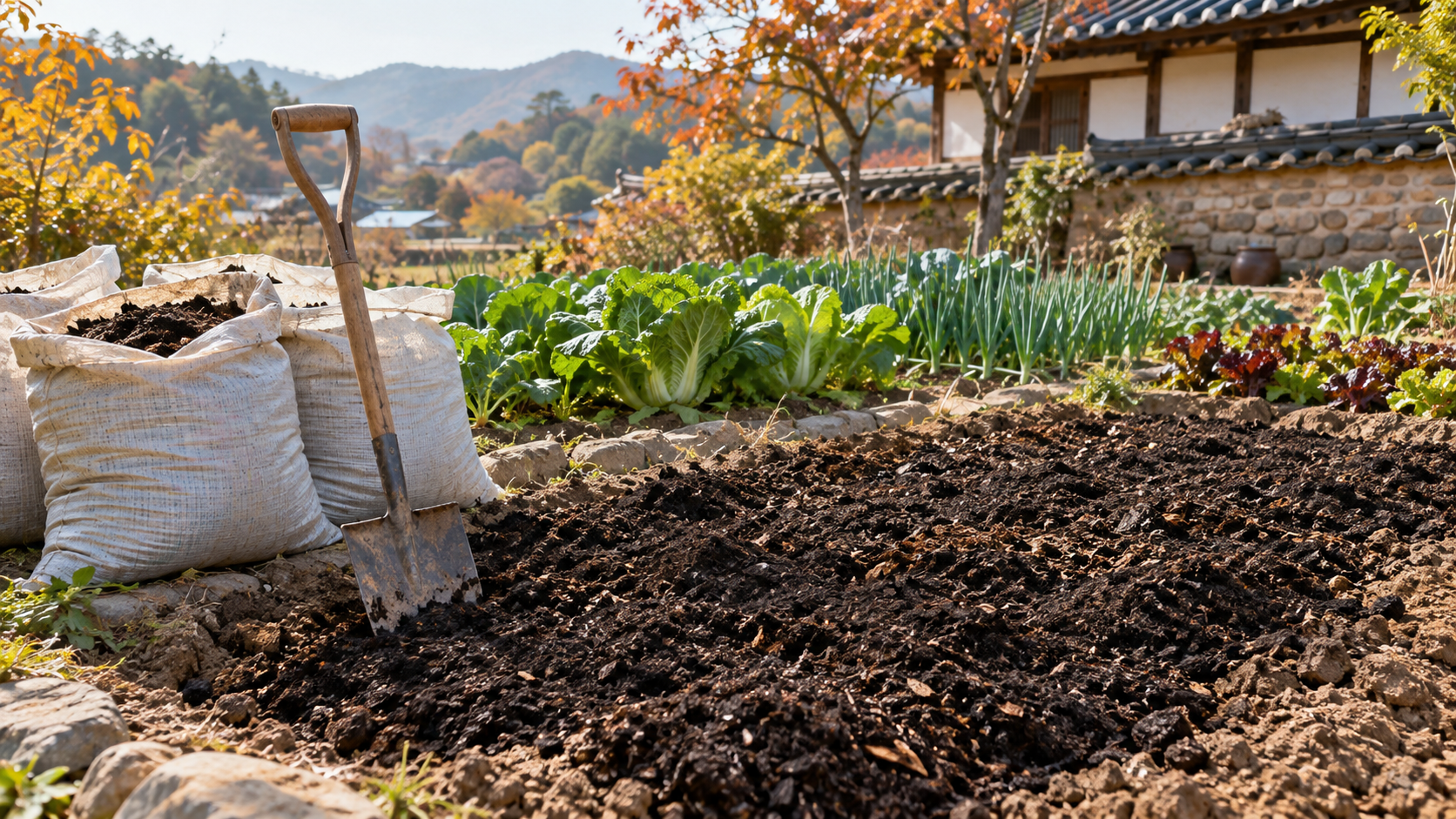
Oil-cake organic fertilizer and livestock manure compost are different products. When to spread lime and mature compost before planting garlic and onions (1–2 weeks before, chemical fertilizer 1–2 days before), how many 20kg bags a 33㎡ plot needs (3–5 at 2,000–3,000 kg per 10a), how to tell mature compost, and Korea's compost grades and subsidy of 1,300–1,600 won per bag.
With garlic cloves split and ready, the first thing you trip over is the sacks. Farm supply shops stack “organic fertilizer” next to “livestock manure compost”, both in 20kg bags at similar prices. In Korea, “organic fertilizer” is searched about 1,360 times a month, “base fertilizer” 1,060, “chicken manure compost” 650 and “livestock manure compost” 620. This note sorts out which to buy, how many bags, and when to spread them, using Rural Development Administration (RDA) and extension-centre guidance and the official fertilizer specifications.
Bottom line: Manure compost builds the soil; oil-cake organic fertilizer adds nutrients. For garlic and onion beds, spread lime and mature compost 1–2 weeks before planting and dig them in deeply; add chemical fertilizer 1–2 days before planting. The recommended 2,000–3,000 kg of compost per 10a works out to 66–99 kg for a 33㎡ plot, or 3–5 bags of 20kg. Subsidised supply gets 1,300–1,600 won per bag (2026, Jeonnam and Goheung examples).
1. Two different products
Under Korea’s by-product fertilizer specifications, mixed oil cake is “two or more plant oil cakes mixed”, must contain at least 7% of two or more of N, P and K combined, and explicitly excludes composted material. It is a fertilizer that feeds the crop.
Livestock manure compost is a composted organic fertilizer: at least 50% animal manure, “fermented and cured”. Instead of nutrient minimums it must have at least 30% organic matter, no more than 55% moisture, and pass a maturity test. Its job is to add organic matter and improve soil.
| Organic fertilizer (oil cake etc.) | Manure compost | |
|---|---|---|
| Made from | Plant oil cake, animal residues | 50%+ livestock manure plus sawdust etc. |
| Composted | No | Fermented and cured |
| Key spec | N+P+K (two or more) at least 7% | Organic matter 30%+, moisture 55% or less |
| Role | Nutrients | Soil improvement, organic matter |
Because oil cake carries nitrogen, cut chemical fertilizer by the amount on the label. Products containing castor oil cake must carry a red warning that dogs and cats can die if they eat it, and that it must be mixed into the soil after spreading.
2. Base dressing order before garlic and onions
| Step | When | What |
|---|---|---|
| 1 | 1–2 weeks before planting | Spread lime and mature compost evenly and dig deeply |
| 2 | 1–2 days before planting | Add chemical base fertilizer and soil insecticide, rotavate |
| 3 | Same day | Form beds 120–140 cm wide, higher on poorly drained ground |
| 4 | Before planting | Lay mulch film |
| 5 | Planting day | Garlic 5–7 cm deep, onion seedlings 3 cm deep |
Compost, lime and phosphate go in entirely as base dressing; nitrogen and potassium are split with spring top-dressing. Inland cold-type garlic is planted from mid October to early November and inland onions in mid-to-late October (see garlic planting time and onion planting time), so late October is the time to prepare beds.
3. How many bags for a 33㎡ plot
| Area | 2,000 kg/10a (garlic) | 3,000 kg/10a (onion) | 20kg bags |
|---|---|---|---|
| 3.3㎡ | 6.6 kg | 9.9 kg | about half |
| 16.5㎡ | 33 kg | 49.5 kg | 2–3 |
| 33㎡ | 66 kg | 99 kg | 3–5 |
| 10a (1,000㎡) | 2,000 kg | 3,000 kg | 100–150 |
2,000 kg over 1,000㎡ is 2 kg/㎡; 2 kg × 33㎡ = 66 kg, or 3.3 bags. More is not better: an RDA field case found poorly formed garlic cloves where manure compost exceeded the recommended 2,000 kg per 10a (foliar feeding was judged the main cause, but the advice was to keep to the standard rate). Lime is 100–150 kg per 10a in the RDA garlic table and 150–200 kg in Taean County guidance, or 3.3–6.6 kg for 33㎡; a soil test is the best guide. One 11st listing for a 20kg manure compost bag showed 10,500 won, discounted to 9,810 won, on October 25, 2026.
4. Telling mature compost
| Check | Mature | Immature |
|---|---|---|
| Smell | Original manure odour almost gone | Sharp manure or ammonia smell |
| Colour | Brown or black | Raw material colour |
| Texture | Crumbles; raw material hard to recognise | Lumps and sawdust still visible |
| Squeeze | No water seeps between fingers | Water oozes out |
| Warmth | Same as outside air | Warm inside, steaming |
Immature compost keeps decomposing in the soil, releasing heat and gas near young roots. RDA testing in 2019 found harmful microbes in immature compost but not in fully composted product; a Solvita score of 7–8 out of 8 means fully mature.
5. Lime and compost together?
RDA garlic guidance and Taean County both spread lime and compost together 1–2 weeks before planting. The problem is lime with nitrogen fertilizer: the Jeju Agricultural Research and Extension Services explains that alkaline lime turns fertilizer nitrogen into ammonia that escapes, and warns that adding organic matter speeds microbial activity and gas, especially under cover. So spread lime and mature compost first, and add urea or compound fertilizer (and oil cake) 1–2 weeks later, just before planting.
6. Subsidy and compost grades
Korea’s organic fertilizer subsidy covers mixed oil cake, mixed organic and organic compound fertilizers, and livestock manure and other compost, for registered farm businesses. Under the 2024 guidelines the national payment is 1,000 / 900 / 700 won per 20kg for special, first and second grade compost plus at least 600 won from local government, giving 1,600 / 1,500 / 1,300 won (Goheung’s 2026 figures). Farmers pay at least 20% of the price, and compost support is capped at 2,000 kg per 10a.
| Grade | Organic matter | OM:N ratio | Moisture |
|---|---|---|---|
| Special | 40%+ | 35 or less | 35–50% |
| First | 33%+ | 35 or less | 55% or less |
| Second | 30%+ | 45 or less | 55% or less |
Application timing varies: Jeonnam and Imsil took 2027 applications from June 1 to July 10, 2026, while Goheung took 2026 applications until December 10, 2025. Silicate fertilizer and lime are usually supplied separately as free soil conditioners on a three-year cycle per field in many local governments.
Summary
Compost is for the soil, fertilizer is for the crop. Spread lime and mature compost 1–2 weeks before planting garlic and onions, add chemical fertilizer just before planting, and 3–5 bags will cover a 33㎡ plot.
References
- Fertilizer Control Act, by-product fertilizer specifications, Annex 3 (amended April 2, 2024).
- Ministry of Agriculture, Food and Rural Affairs, 2024 organic fertilizer support standard guidelines (payments, 20% co-payment, 2,000 kg/10a cap, Annex 5 grade criteria).
- Financial News, Jeonnam organic fertilizer supply, May 31, 2026; Wikitree, Imsil 2027 applications, June 5, 2026; Wikitree, Goheung 2026 support, November 24, 2025.
- RDA, garlic seed disinfection and planting (compost 2,000 kg, lime 100–150 kg, timing).
- Taean County, garlic cultivation (lime 150–200 kg/10a, compost 1,500–2,000 kg/10a, two weeks before planting).
- RDA Nongsaro, onion planting guide (compost 3,000 kg/10a); field support case on over-fertilized garlic, June 18, 2012; video “Choosing and using good compost”.
- RDA release on fully composted manure, reported by NewsFM, September 25, 2019.
- Jeju Agricultural Research and Extension Services consultation answer, May 10, 2021.
- 11st listing for 20kg manure compost, checked October 25, 2026 (seller price, subject to change).
- Naver Search Ad keyword tool, checked October 25, 2026.
- Bag counts are worked examples; real needs depend on soil tests and field conditions.