Can I Install Agrivoltaics on My Land? (Eligibility by Land Type)
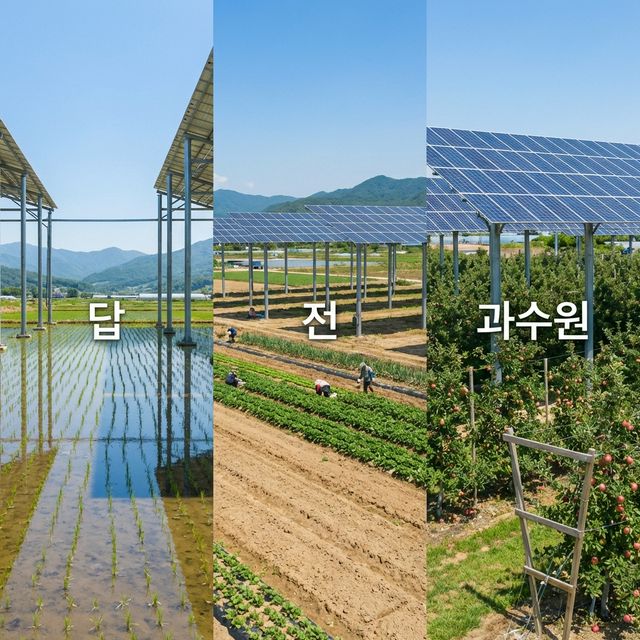
Paddy, field, orchard. On paper, the land category is all “agricultural land,” but when you bring up solar, the answers come back different. Possible here, impossible there, ambiguous somewhere else. That’s what makes it confusing. Which category does my land fall into?
1. Start by Checking the Land Category — the Land Register, Not the Title Deed
The very first thing to do isn’t about the law — it’s about the map. You need to see what your land is officially classified as.
- Under the Farmland Act, agricultural land means land categorized as field (전), paddy (답), or orchard (과수원).
- If the land register category shows field/paddy/orchard, the Farmland Act applies.
- Whether it’s in an ‘Agricultural Promotion Area’ or ‘Agricultural Protection Zone’ changes the regulations.
A common mistake: judging based on the property title deed category. What actually matters for permits is not the title deed, but the land register. Log into gov.kr with your authentication certificate and look up the land (or forest) register — it’s right there.
Before physically visiting the land, check the paperwork first. Getting your head around it once will change what you notice on site.
2. Agricultural Promotion Area vs. Protection Zone — “Will Absolute Farmland Be Possible?”
You’ve probably seen news about “solar allowed even on absolute farmland.” The “absolute farmland” they’re referring to is the Agricultural Promotion Area.
- Pre-2025: Agrivoltaics installation in Agricultural Promotion Areas was prohibited.
- October 2025 government announcement: Pursuing Farmland Act amendment to allow agrivoltaics in Agricultural Promotion Areas when designated as ‘Renewable Energy Zones.’
- January 2026 Ministry of Agriculture clarification: “Requirements for agrivoltaics businesses have not yet been finalized.”
Summary:
- Agricultural Promotion Area (absolute farmland): Until the law is amended, it’s effectively impossible except for demonstration pilot sites.
- Agricultural Protection Zone: Solar is possible, but with conditions such as area limits (e.g., under 10,000㎡).
If your land is in an Agricultural Promotion Area, the safe move right now is to stop at the feasibility study stage. Wait until the amendment actually passes and you can see what conditions are attached.
3. Field/Paddy/Orchard — Theoretically All Possible, But…
On paper, fields, paddies, and orchards are all agrivoltaics candidates. Looking at demonstration sites run by the government and municipalities:
- Rice paddy demonstration sites (Naju and Yeongam in Jeonnam, etc.).
- Field crop targets (chili peppers, potatoes, radishes, vegetables).
- Orchard demonstrations (pear, grape, blueberry, fig, etc.).
The Jeonnam Provincial Green Energy Research Institute is conducting demonstrations across rice, field crops, pear, grape, green tea, blueberry, and fig by structural type. Orchards look particularly appealing. Panels floating above trees with fruit growing underneath. A beautiful picture.
However, legally, the trend is moving toward whether you’re “continuing to farm” mattering more than the land category.
- Standards requiring a design that maintains at least 80% of yields are under discussion.
- A genuine cultivation obligation requiring the farmer to personally farm the land is very likely to be included.
Bottom line: field, paddy, and orchard are all candidates in principle, but the details depend on crop, region, and municipal ordinances.
4. A 5-Step Checklist for Your Land
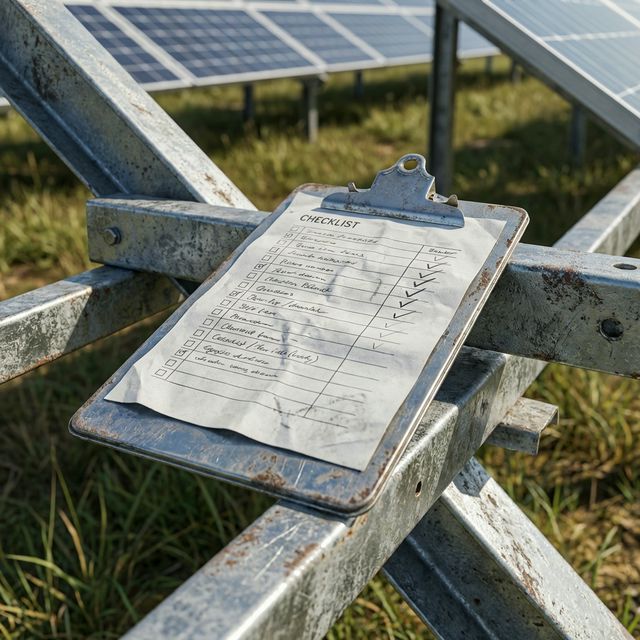
Forget the headache-inducing legal provisions — just check these five things.
Step 1: Verify Land Category
- Is the land register category field/paddy/orchard?
Step 2: Verify Area Classification
- Is it Agricultural Promotion Area, Agricultural Protection Zone, or general farmland?
Step 3: Check Municipal Setback Distances
- What setback distance does your city/county ordinance require?
- What’s the measurement reference — residential, roads, rivers, cultural heritage sites?
Step 4: Check Grid (KEPCO) Feasibility
- Is the location in a grid-accessible zone?
- Is there already a lot of solar in the surrounding area?
Step 5: Review Crop and Farming Plan
- What are you currently growing on that land?
- Can the structure maintain 80%+ yields after panel installation?
Write these five points down on paper, plug in your land’s specifics, and the rough picture emerges. Not “yes or no,” but “what’s missing” becomes visible.
5. Paddy (답) — Most Tested, But Also Most Risky
Paddy-based agrivoltaics is the model the government is pushing hardest. So there’s plenty of trial data. At the same time, it’s the most politically sensitive. Rice equals food security.
- A significant share of the roughly 60 demonstration sites nationwide are rice paddies.
- Most trials maintained 80%+ yields; some even reported quality improvements.
- However, some cases (like in Geochang) saw yield reductions as high as 71%.
Paddies have unique requirements: water management, machinery operations, and harvesting methods. If the pillar spacing, height, or shading rate design is even slightly off, yields take a direct hit.
If your land is a paddy:
- Find existing operating agrivoltaics paddies nearby and ask questions in person.
- Verify same variety, same cultivation method.
- Don’t copy-paste someone else’s structure design (pillar spacing, panel height, shading rate) — redesign it for your paddy’s conditions (irrigation method, tractor width, etc.).
Honestly, paddies are a zone where you need to proceed carefully, based on trial data.
6. Field (전) — Crop Selection Makes or Breaks It
Fields offer more flexibility. But more choices, too.
Looking at Green Energy Research Institute trial data, among field crops, shade-tolerant crops pair well with agrivoltaics.
- Leafy greens, ginseng, medicinal herbs, and some specialty crops can actually benefit from shading.
- Sun-dependent crops like chili peppers, potatoes, and carrots may see larger yield reductions.
Having a field doesn’t automatically mean you’re advantaged. But compared to paddies, structural design is more flexible and crop switching is relatively easier. Take your current crop yield and revenue data, and run shading rate scenarios at 20%, 30%, and 40% in a spreadsheet.
If your land is a field, the first decision is: “Keep the current crop, or switch to one better suited for agrivoltaics?” That answer fills the first page of your business plan.
7. Orchard (과수원) — Beautiful Picture, Tougher Permitting
Orchards look great on camera. Panels floating above trees, fruit ripening below. In fact, demonstration sites at pear orchards in Naju, Jeonnam showed no significant differences in yield, size, or sweetness compared to conventional orchards.
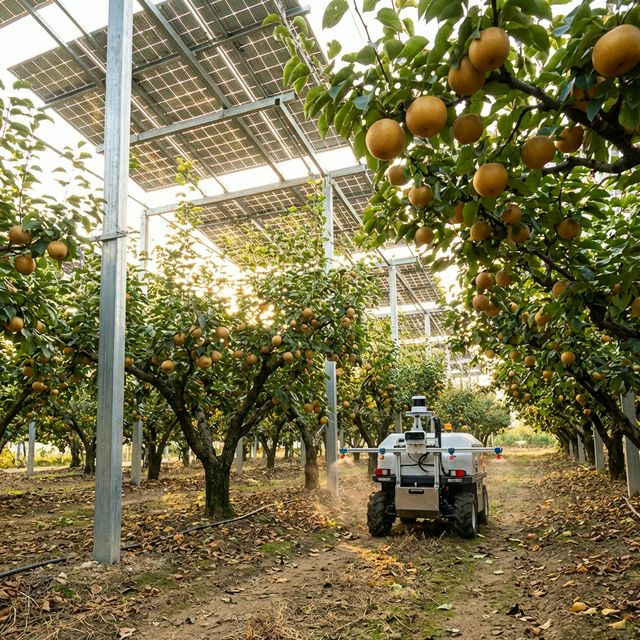
Yet orchards come with several practical challenges.
- Spacing and height design between trees and panels is far more complex.
- You must account for staking, pruning work, and harvest traffic flow.
- Orchards are often on slopes, making construction costs higher than for paddies or fields.
But the advantages are clear.
- Since orchards already produce high-value crops, adding solar revenue creates a more stable overall portfolio.
- The protection effect against heatwaves, hail, and frost damage helps reduce climate risk.
Orchards aren’t so much “impossible” as a zone that requires more capital and design expertise.
8. The Honest Conclusion as of 2026
If you’re considering agrivoltaics for your land right now, here’s the summary.
- Agricultural Promotion Area paddies/fields/orchards: Unless part of a demonstration site, you’re effectively in standby. Prepare, but just prepare, until the Farmland Act amendment and special act details emerge.
- Agricultural Protection Zone and general farmland: If municipal setback distances, grid conditions, and crop requirements align, there’s theoretical feasibility.
- Rather than “which land category is most advantageous,” the real question is what crop and what structure lets you continue farming.
So the answer for your land comes down to three questions.
- What zone (Promotion/Protection/General) is this land in?
- Considering KEPCO grid, municipal setback distances, and village sentiment, is permitting and profitability realistic for this location?
- Even with panels above, is a design possible where I can keep farming?
When you can say “yes” to all three, that’s when it’s truly time to break out the blueprints and cost estimates.
#Agrivoltaics #FarmlandAct #LandCategory #SmartFarm #SolarProfitability #CarbonNeutrality
This article is based on publicly available government materials, media reports, and field trial results as of February 2026. When actually pursuing a project, always separately verify the latest Farmland Act, Agrivoltaics Special Act, and municipal ordinances.