KAMIS data as of October 12, 2026: domestic and imported white soybean wholesale prices per kilogram, online prices for Korean meju soybeans, when and how meju blocks are made, how to judge soybean harvest time and the losses from harvesting late, and whether growers should sell right away or hold until meju season.
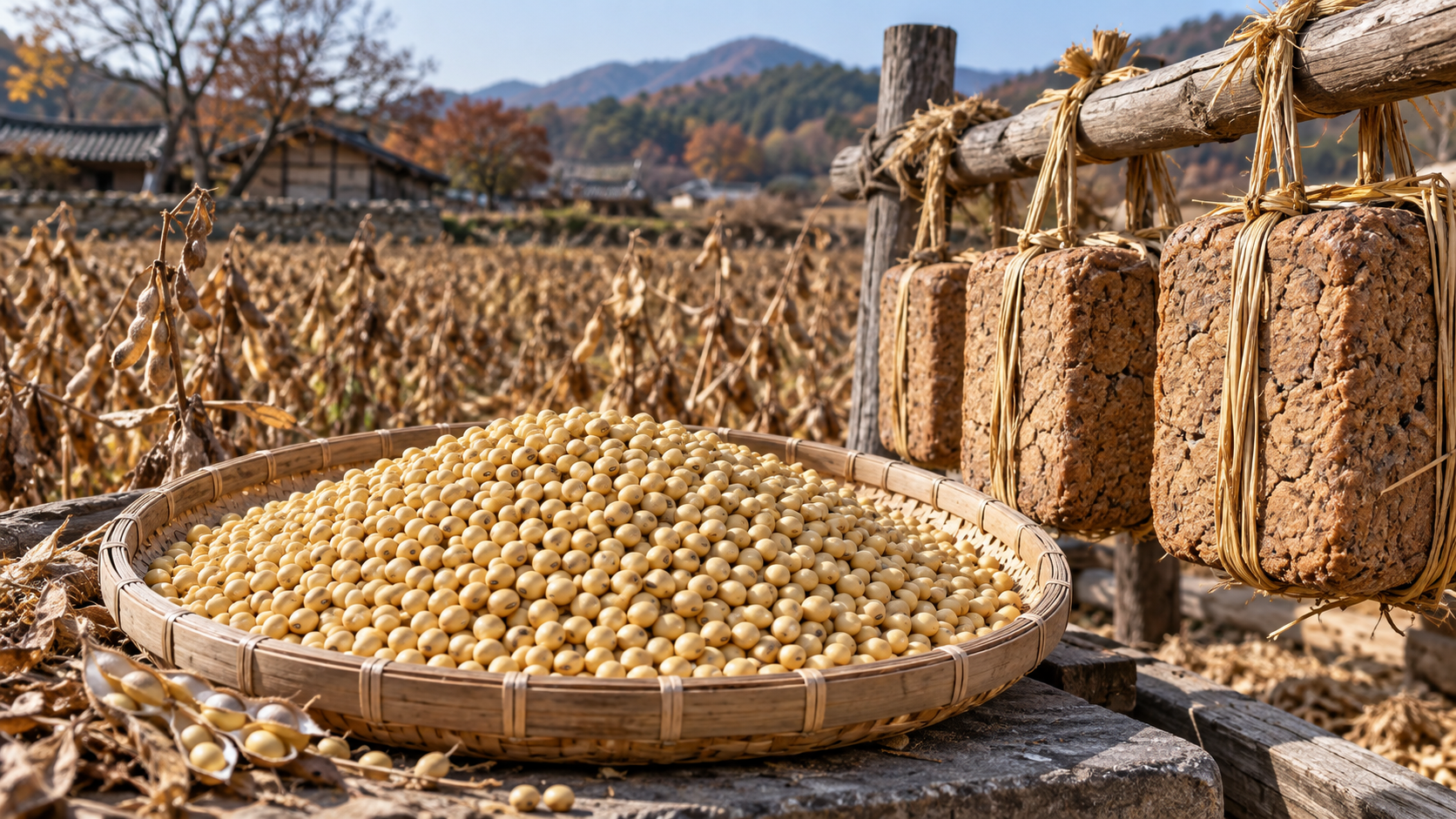
When soybean leaves turn yellow in October, two questions come up at once. Households that make soybean paste ask what meju soybeans will cost this year. Growers ask whether to sell right after harvest or hold until meju-making season. Meju soybeans are white (yellow) soybeans, called baektae; KAMIS lists them as “white soybean (domestic)“.
Bottom line: In the KAMIS survey on October 12, 2026, domestic white soybeans (top grade, 40 kg) averaged KRW 228,600 at wholesale across five cities, about KRW 5,700 per kilogram, almost unchanged from a year earlier (−0.7%). Imported white soybeans averaged KRW 127,800 per 35 kg, about KRW 3,650 per kilogram. Domestic baektae sold online for KRW 6,750–7,950 per kilogram on October 13. Harvest when all leaves have dropped and 80–90% of pods are brown.
Earlier notes: seoritae black soybean harvest and price and red bean harvest time.
1. Wholesale price of domestic white soybeans
| City | Top grade 40 kg (Oct 12) | Per kg | Oct 13, 2025 |
|---|---|---|---|
| Daegu | KRW 243,000 | KRW 6,075 | KRW 250,000 |
| Daejeon | KRW 234,000 | KRW 5,850 | KRW 224,000 |
| Seoul | KRW 225,000 | KRW 5,625 | KRW 226,000 |
| Busan | KRW 223,000 | KRW 5,575 | KRW 226,000 |
| Gwangju | KRW 218,000 | KRW 5,450 | KRW 225,000 |
Imported white soybeans rose 4.6% over the year to KRW 127,800 per 35 kg, but domestic beans still cost 1.6 times as much. Daily prices: domestic soybean, imported white soybean.
Prices do not reliably fall when the new crop arrives. Seoul monthly averages from October to December fell 11% in 2022, rose 6% in 2024, and were flat in 2023 and 2025. In 2026 Seoul has stayed at KRW 225,000 from January through October.
| Year | October | November | December |
|---|---|---|---|
| 2022 | KRW 250,421 | KRW 236,000 | KRW 221,905 |
| 2023 | KRW 221,000 | KRW 219,818 | KRW 216,000 |
| 2024 | KRW 218,200 | KRW 221,810 | KRW 231,700 |
| 2025 | KRW 226,000 | KRW 224,700 | KRW 224,524 |
2. Online price of Korean meju soybeans
On October 13, domestic baektae on Coupang ranged from KRW 6,750 to 7,950 per kilogram (for example, 2 kg for KRW 13,500 and a 2025-crop 2 kg bag for KRW 15,900), while US-grown imported beans were about KRW 4,200 per kilogram. If a “domestic” bag is under KRW 3,000 per kilogram, check where the origin is actually stated. Most beans on sale now are 2025 crop; the 2026 crop arrives in volume from November once drying is done.
3. When and how meju is made
Traditionally, meju work begins in the eleventh lunar month, around December, once the weather turns cold. A government guide to Sunchang’s traditional sauces describes the steps: soak 1 kg of beans in cold water for at least 10 hours (they roughly double in size), boil for at least two hours until they crush easily, mash and shape into blocks, dry in a ventilated place for 1–2 weeks, then ferment somewhere warm for 2–3 weeks. Korea’s Ministry of Food and Drug Safety advises blocks of 1–2 kg so the inside dries properly, and a fermenting space below 30°C and 60% humidity.
Traditional units such as mal and doe are measures of volume, not weight, and markets convert them differently. Always ask for the weight in kilograms and compare the price per kilogram.
4. When to harvest soybeans
RDA puts the right time at when all leaves have fallen, stems have turned brown, and 80–90% of pods are brown. Gyeonggi Agricultural Research and Extension Services adds 7–14 days after pods reach their mature color. In RDA trials, harvesting late raised shattering losses and lowered germination:
| Harvest | Shattering | Germination |
|---|---|---|
| On time | 0.1% | 95.8% |
| 20 days late | 5.0% | 91.3% |
| 40 days late | 9.4% | 87.5% |
Dry cut plants for 2–3 days to 13–15% grain moisture before threshing, run threshers at 300–400 rpm, dry in machines at 30°C or below, store at about 14% moisture, and keep cut plants out of the rain to prevent purple seed stain.
5. Sell now or hold until meju season?
With wholesale prices flat all year, holding for a price rise has weak support. What rises in late autumn is demand: searches for meju soybeans peak when households make meju. Growers with good drying and storage can pack 1–5 kg bags for direct sale then; others can sell part of the crop right away. Compare city payouts with the produce market calculator.
References
- aT KAMIS wholesale prices (data.go.kr API): domestic white soybean top grade 40 kg, imported white soybean medium grade 35 kg, five cities, September 2025–October 12, 2026; Seoul monthly averages 2022–2026.
- RDA press release (October 12, 2022), soybean harvest timing, shattering and germination, drying: rda.go.kr
- Gyeonggi ARES soybean harvest guidance (Aju News, October 1, 2023): ajunews.com
- Korea.kr, Sunchang traditional sauces (meju steps): korea.kr
- Ministry of Food and Drug Safety, making home doenjang (October 26, 2021): korea.kr
- Jeonbuk Ilbo (December 21, 2012), meju work begins in the eleventh lunar month: jjan.kr
- Online prices: Coupang Partners product search and product pages, checked October 13, 2026.