Solar Farm Feasibility: A Real Calculation for a 1,400-Pyeong Site
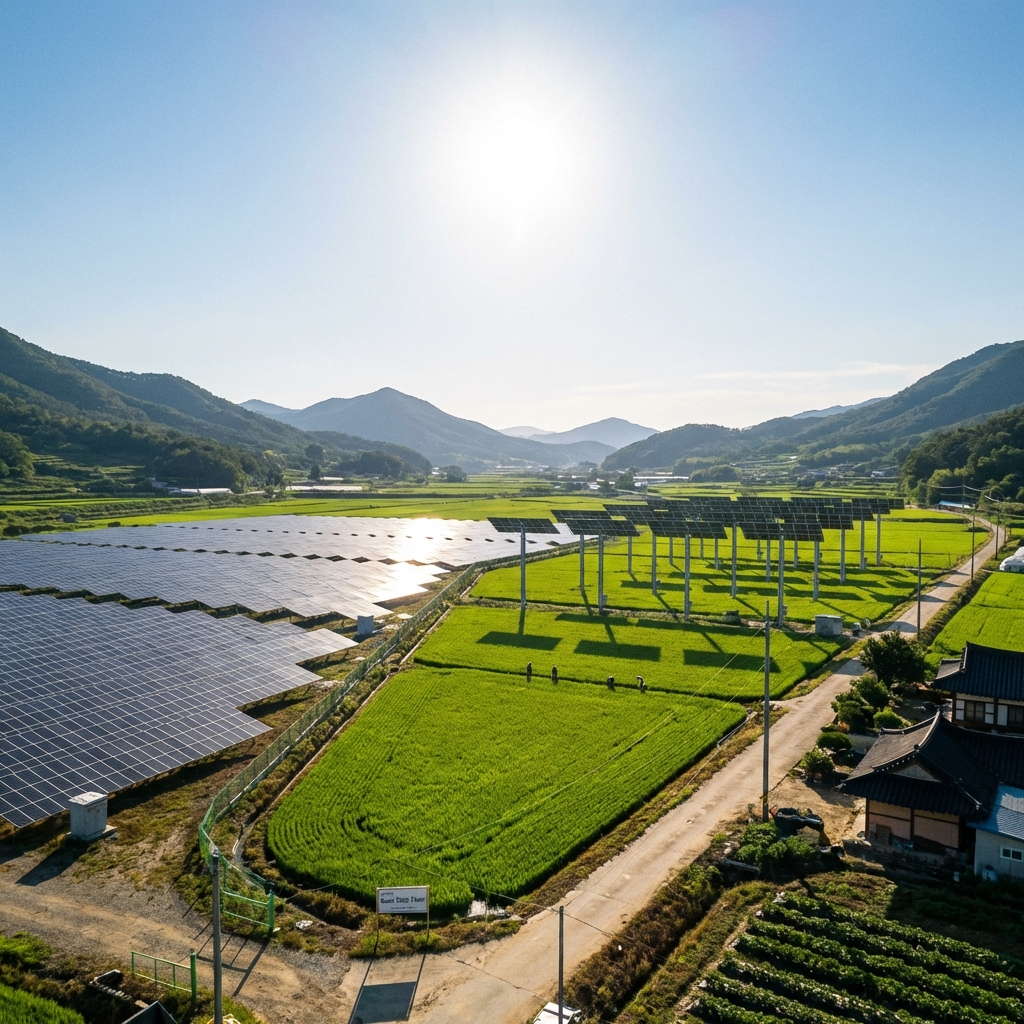
We ran the numbers assuming we’d install a solar power plant on our own farmland.
Last summer, while harvesting rice on my brother’s paddy, a thought hit me. How much do you actually pocket from rice farming on 1,400 pyeong? After fertilizer, pesticides, and equipment rental, a few thousand won per pyeong. Honestly, it doesn’t even cover the labor.
But lately, solar farm talk keeps popping up around me. Some say “put up steel frames over the paddies, mount panels on top, farm underneath and sell electricity.” Others say “just lay down panels and lease it out.” Both sounded plausible, but I wanted to see the actual numbers.
So I ran the calculations myself. Our land in Seonsan-eup, Gumi-si, Gyeongsangbuk-do — 1,400 pyeong of flat terrain. If we installed solar here, which approach would be better? A dedicated solar farm (no more farming), or agrivoltaics (keep farming, sell electricity on the side)?
Two Paths: Generation Only vs. Farming + Generation
Case 1 — Dedicated Solar Farm (Give Up Farming)
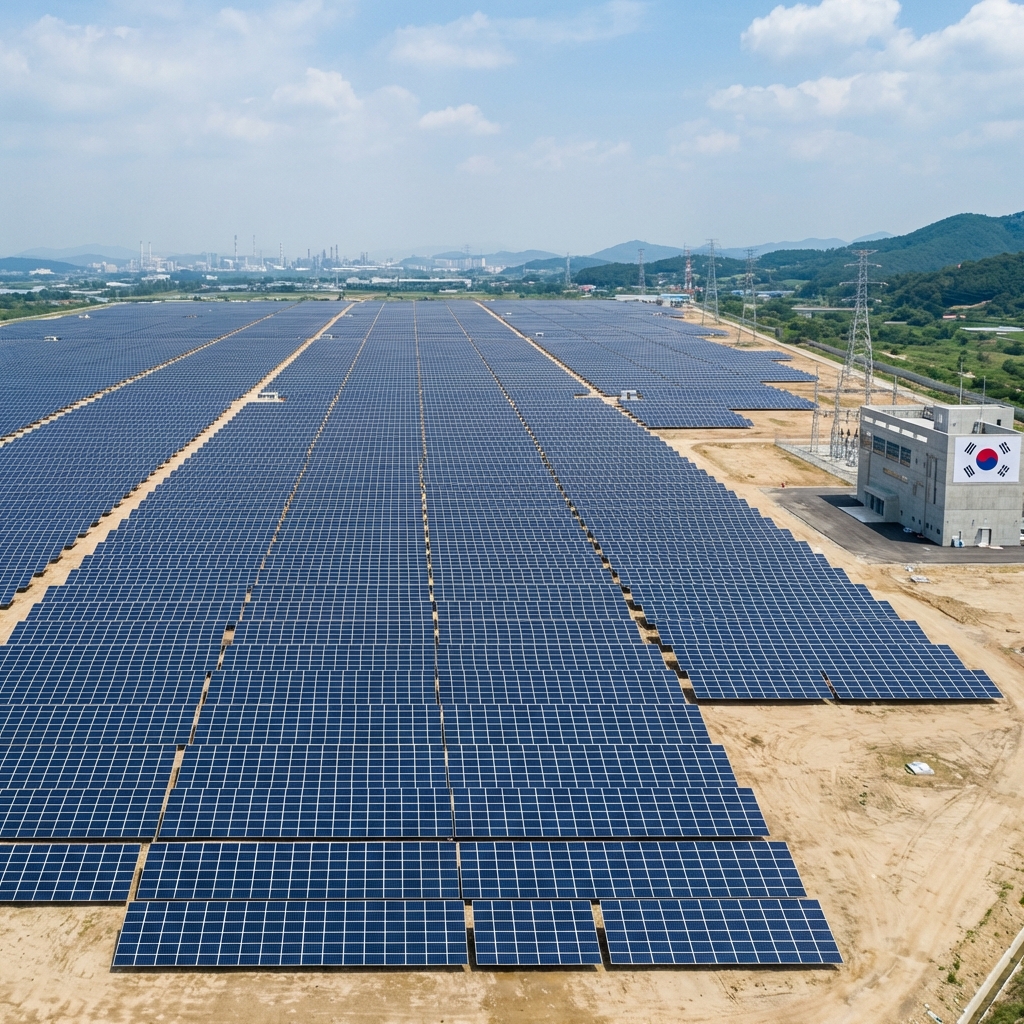
On 1,400 pyeong of flat land, you can install roughly 350kW. Ground-mounted solar typically needs about 4 pyeong per kW, accounting for panel spacing, maintenance roads, and shading.
Upfront Costs
- Solar equipment: 455 million KRW (1.3 million KRW/kW)
- KEPCO grid connection: 12 million KRW
- Permits and approvals: 10 million KRW
- Farmland conversion levy: 14 million KRW (10,000 KRW/pyeong)
- Miscellaneous: 8 million KRW
Total: 500 million KRW. Not small.
But annual generation is 459,900 kWh. Gumi, Gyeongbuk gets about 3.6 hours of peak sunlight per day, so generation is solid. Electricity sales get SMP (System Marginal Price) of 103 KRW, REC (Renewable Energy Certificate) of 71 KRW, and the first 100kW gets an REC weight of 1.2. So in practice, you average about 178 KRW per kWh.
Annual Generation Revenue: Approximately 81.89 million KRW
Subtract operating costs — maintenance, electrical safety manager, insurance — about 10.51 million KRW…
Annual Net Profit (pre-tax): 71.38 million KRW Monthly Average: 5.95 million KRW
Payback on the 500 million KRW investment takes about 7 years. Annual ROI is 14.3%. Way better than a bank deposit. Over 20 years, net profit exceeds 900 million KRW.
But there’s one problem. You can’t farm this land anymore. Panels cover everything — no room for rice or anything else.
Case 2 — Agrivoltaics (Keep Farming, Generation Is a Bonus)
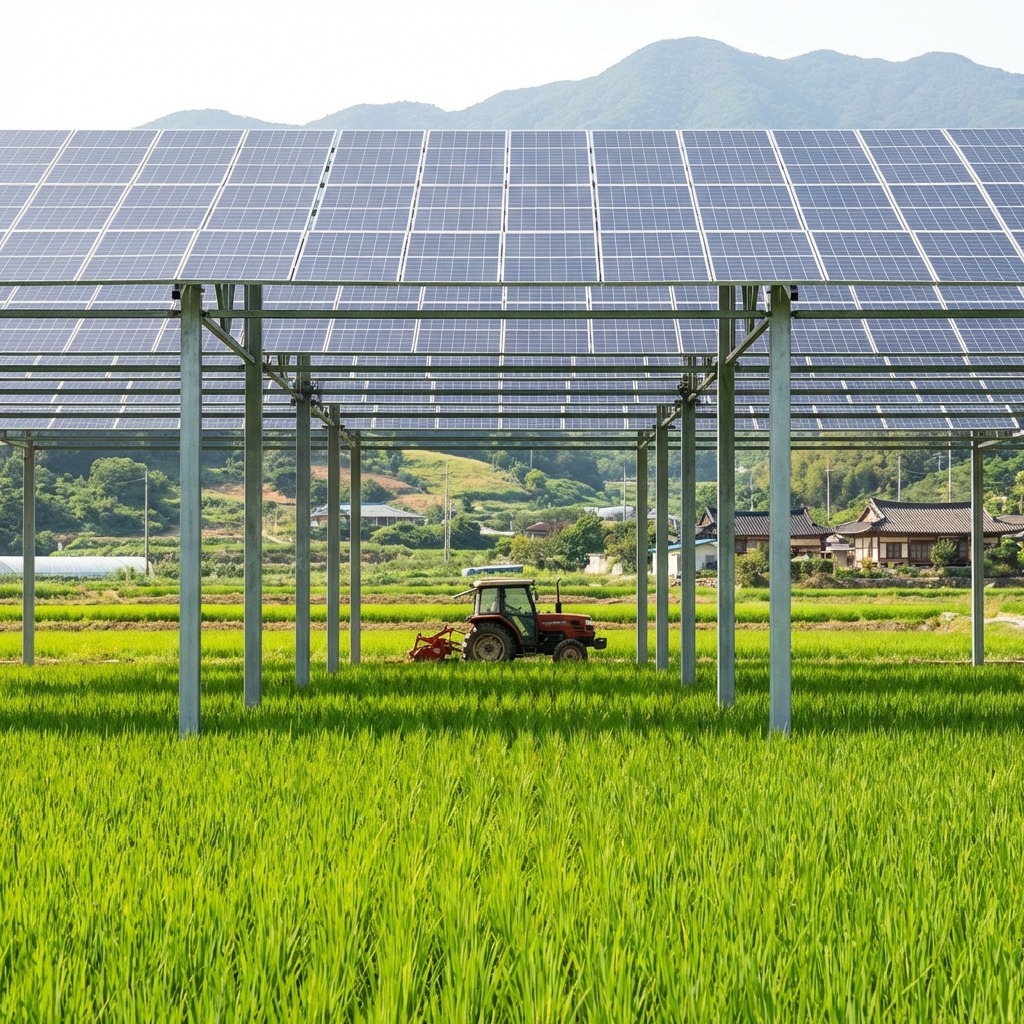
Steel pillars 3–4.5 meters tall go up over the paddies, with solar panels mounted on top. Pillars spaced 5–6 meters apart. Tractors go through, rice planters turn, combines pass underneath. Farming continues. But some sunlight is blocked, so yields take a dip. Expect about a 20% yield reduction.
On 1,400 pyeong, agrivoltaics allows roughly 200kW of installed capacity. The shading rate (panel horizontal projection vs. total area) must stay below 30%. The benchmark is 100kW per 700 pyeong.
Upfront Costs
- Solar equipment: 390 million KRW (structures cost 1.5× more due to height)
- KEPCO grid connection: 12 million KRW
- Permits and approvals: 10 million KRW
- Farmland conversion levy: 0 KRW (agrivoltaics is exempt)
- Miscellaneous: 8 million KRW
Total: 420 million KRW. 80 million KRW cheaper than dedicated solar. Because there’s no farmland conversion levy.
Annual generation is 262,800 kWh. Naturally less than dedicated solar — it’s only 200kW.
Annual Generation Revenue: Approximately 47.59 million KRW
Then farming income adds on. Rice farming on 1,400 pyeong typically nets about 2,000 KRW per pyeong. Apply the 20% yield reduction and it’s 1,600 KRW per pyeong.
Annual Farming Income: 2.24 million KRW
Combined: Annual Total Revenue: 49.83 million KRW
Subtract operating costs (generation management + farming): 10.49 million KRW…
Annual Net Profit (pre-tax): 39.35 million KRW Monthly Average: 3.28 million KRW
Payback takes about 10.7 years. Annual ROI is 9.4%.
Lower profit than dedicated solar, but the land stays a paddy, rice keeps growing. And not paying the 14 million KRW farmland conversion levy is bigger than you’d think.
Head-to-Head Comparison
| Category | Dedicated Solar Farm | Agrivoltaics |
|---|---|---|
| Installed Capacity | 350kW | 200kW |
| Initial Investment | 500 million KRW | 420 million KRW |
| Farmland Conversion Levy | 14 million KRW | Exempt |
| Annual Generation Revenue | 81.89 million KRW | 47.59 million KRW |
| Annual Farming Revenue | 0 KRW (can’t farm) | 2.24 million KRW |
| Annual Net Profit | 71.38 million KRW | 39.35 million KRW |
| Monthly Net Profit | 5.95 million KRW | 3.28 million KRW |
| Payback Period | 7.0 years | 10.7 years |
| Annual ROI | 14.3% | 9.4% |
Which Is Better?
On pure profit alone, dedicated solar wins decisively. 5.95 million KRW/month vs. 3.28 million KRW. Nearly double.
But here’s where it gets complicated:
-
Are you ready to give up the farmland entirely? With dedicated solar, this land is no longer a paddy. After 20 years when the panels reach end of life? Restoring it to farmland costs money. And emotionally… this is land where grandpa grew rice.
-
Agrivoltaics is heavily policy-dependent. In early 2026, news broke that the government plans to extend agrivoltaics permit periods from 8 to 23 years (three 5-year extensions). There’s talk of raising the REC weight to 1.8–2.0. If that happens, agrivoltaics profitability improves significantly. But it’s still uncertain.
-
Actual yield reduction varies by region. In Yeongam, Jeonnam, rice yields dropped 21% under agrivoltaics, but including generation revenue, total income was 8.4 times higher than conventional paddies. Conversely, in Geochang, yield reduction hit 71% in some cases. It varies wildly depending on panel angle, spacing, and rice variety.
-
Do you have the upfront capital? 500 million for dedicated, 420 million for agrivoltaics. Neither is pocket change. Policy loans can bring your contribution down to around 20%, but you still need close to 100 million KRW on hand.
My Tentative Conclusion (Not Final Yet)
Our land is land our grandfather irrigated and planted rice on. Just covering it with panels and calling it done feels wrong. So for now, I’m leaning toward agrivoltaics.
3.28 million KRW per month is decent enough. The 2.24 million KRW in farming income is honestly minimal, but at least the “paddy” identity is preserved. And if government policy shifts favorably, the ROI could improve.
Dedicated solar definitely makes more money. But thinking 20 years ahead… hmm. More deliberation needed.
Reference: What Do You Actually Need to Do?
Everything above is just number-crunching. To actually install:
- Electricity business license (Korea Energy Agency)
- Development activity permit (Gumi city hall)
- Farmland temporary use permit (for agrivoltaics, 8-year terms)
- KEPCO grid connection application
- Contractor selection and contract
- Business registration and tax filing
All of this is required. Procedures are complex, and municipal ordinances vary.
Detailed execution steps will be covered in the next post.
For now, this was just the “money math.” Dedicated solar vs. agrivoltaics — which would you choose?
※ All figures in this post are calculated based on January 2026 market data. SMP and REC prices fluctuate monthly; actual installation requires a precise quote consultation with a contractor.
#GumSolar #FarmlandSolar #Agrivoltaics #SolarProfitability #SolarCalculator #1400PyeongSolar #RenewableEnergy #FarmIncome #Investment