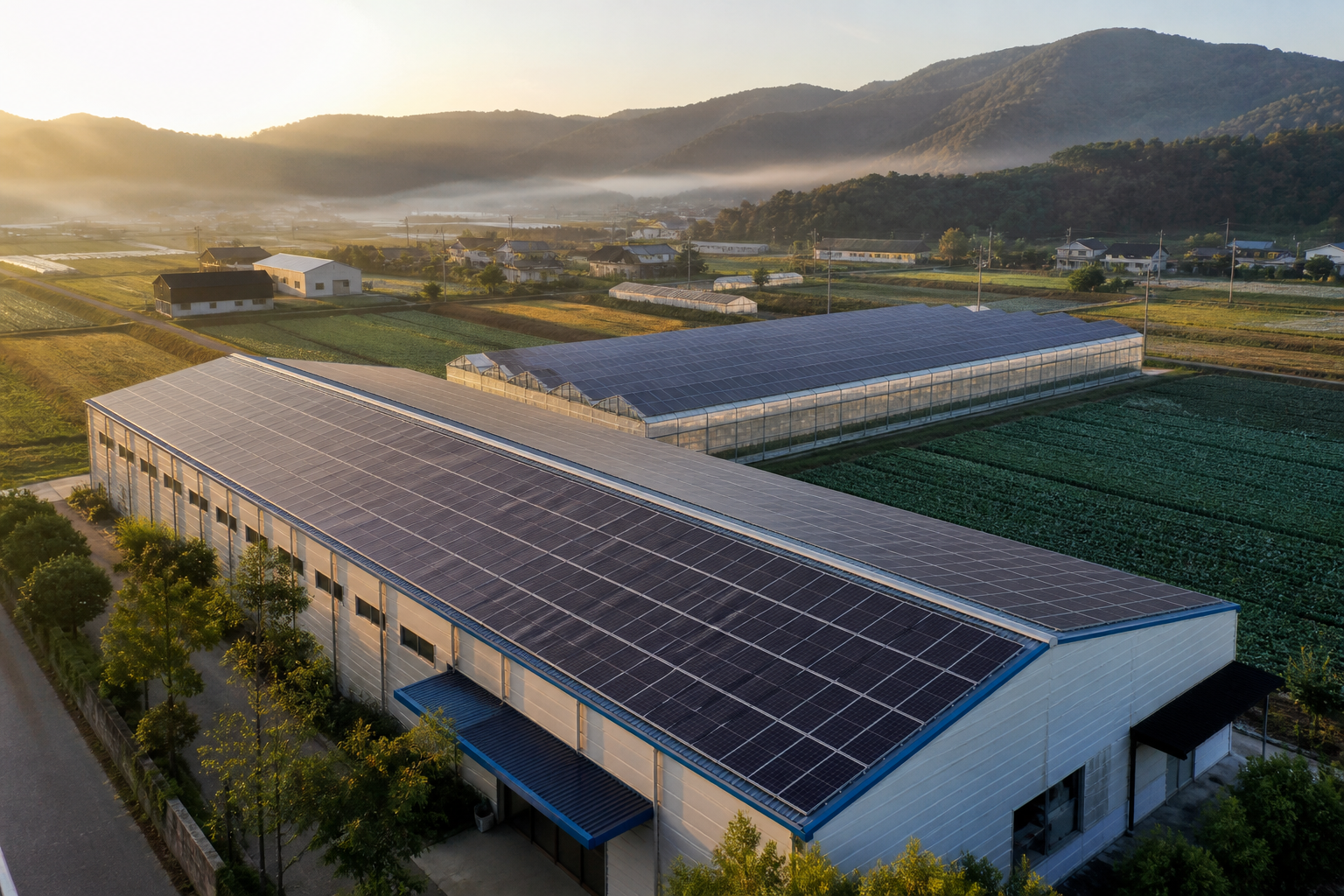
A practical guide to farm roof solar rental programs: how the structure works, how roof rent is calculated, and what farmers should check before signing a long-term lease.
Rent Out Your Farm Roof for Solar Income? How It Works
A farm warehouse roof sits in the sun all day. So does a barn roof, a sorting facility roof, or the roof of a cold storage building. Then someone visits and says, “Let us use the roof and we will pay you rent every year.”
It sounds attractive. The farmer does not sell land. The farm does not stop operating. If the farmer does not have to pay for the solar system, it sounds even better. An empty roof becoming income is a tempting idea.
This model is usually called roof-leased solar, building-roof solar rental, third-party-owned solar, or a roof solar project linked to RE100 or PPA demand. It is not one single government subsidy program offered equally to every farmer. It is closer to a private or project-based structure where a solar developer installs and operates a system on a usable roof, while the building owner receives rent. That is why the contract matters more than the name of the program.
1. The basic structure
The structure is simple. The farmer provides the roof. The solar developer installs and operates the solar power system. The developer earns revenue by selling electricity, securing renewable energy certificates, or connecting the project to a power purchase or RE100-related demand. The farmer receives roof rent in return.
This is different from a farmer directly installing solar. If the farmer owns the project, the farmer also carries the installation cost, loan, permitting, grid connection, maintenance, insurance, repair, and decommissioning responsibility. In a roof-rental model, the developer takes more of that burden, while the farmer receives a fixed or agreed lease payment instead of the full power revenue.
In simple terms, direct ownership is like running the business yourself. Roof rental is more like leasing the storefront. The upside may be lower. The risk and management burden may also be lower. That difference must be understood first.
2. Why developers want roofs
Solar developers sometimes prefer roofs over land. A roof uses an existing structure and causes less land disturbance. It may face fewer farmland conversion issues than ground-mounted solar. Large, flat roofs on warehouses, barns, sorting buildings, and livestock facilities can be suitable for solar panels.
There is also the RE100 trend. Companies want renewable electricity for their operations. Korea has several renewable electricity procurement routes, including green premium programs, third-party PPAs, and direct PPAs. Not every roof solar project automatically becomes an RE100 project, but this demand is one reason developers look for distributed rooftops.
Farm roofs can fit into that flow. Buildings with road access, existing electrical connection, and large roof areas are easier to review. Still, a roof alone is not enough. Sunlight, structural safety, grid access, permits, and building documentation all matter.
3. How much rent can a farmer receive
There is no fixed formula for roof rent. It varies by region, roof condition, installable capacity, grid connection, construction difficulty, lease period, and the developer’s financing conditions. A useful way to estimate it is by solar capacity.
The table below uses three illustrative rent levels: 15,000 KRW, 25,000 KRW, and 40,000 KRW per kW per year. These are not guaranteed market prices. They are simple scenarios for negotiation sense.
| Installable capacity | Low rent | Mid rent | High rent |
|---|---|---|---|
| 50kW | 750,000 KRW/year, about 62,000 KRW/month | 1,250,000 KRW/year, about 104,000 KRW/month | 2,000,000 KRW/year, about 166,000 KRW/month |
| 100kW | 1,500,000 KRW/year, about 125,000 KRW/month | 2,500,000 KRW/year, about 208,000 KRW/month | 4,000,000 KRW/year, about 333,000 KRW/month |
| 200kW | 3,000,000 KRW/year, about 250,000 KRW/month | 5,000,000 KRW/year, about 416,000 KRW/month | 8,000,000 KRW/year, about 666,000 KRW/month |
| 500kW | 7,500,000 KRW/year, about 625,000 KRW/month | 12,500,000 KRW/year, about 1,041,000 KRW/month | 20,000,000 KRW/year, about 1,666,000 KRW/month |
Roof area and installable capacity are not the same. Shade, roof direction, roof slope, maintenance paths, fire access, structural spacing, and equipment layout reduce usable area. A 100kW system may require several hundred square meters or more depending on design.
Farmers should not judge only by the monthly amount. These contracts can last close to 20 years. A small monthly rent becomes meaningful over a long period. But the roof may also be tied up for that same long period.
4. When the model can work well
The model works best when the roof is large and structurally sound. There should be little shading from mountains, buildings, or trees. Building permits, registry records, and occupancy documentation should be clean. The farm should have no plan to demolish, sell, or expand the building soon. Grid connection should be realistic.
In that case, roof-leased solar can become side income. It may be easier than building a new ground-mounted solar facility on farmland. It also uses a surface that already exists. Barns, warehouses, sorting facilities, and cold storage buildings are typical candidates.
It can be a bad fit when the roof is old, leaking, or made of materials that require replacement. It can also be risky if the building record does not match the actual structure, if there is a planned expansion, or if grid connection is blocked. In those cases, the headache may be bigger than the rent.
A roof is not like empty land that can be taken back easily. Once panels and mounting systems are installed, roof repair, leakage, insurance, and removal all become contract issues.
5. Ten contract items to check
In roof-leased solar, “who is responsible” matters more than “how much per month.” The contract should clearly answer these points.
- How long is the lease period.
- Is the rent fixed or adjusted for inflation.
- When is rent paid and what happens if it is unpaid.
- Who is responsible for roof leakage and construction defects.
- Who pays for structural safety inspection before installation.
- Who carries insurance for typhoon, snow, fire, and electrical accidents.
- Who pays for removal and reinstallation if roof repair or building expansion is needed.
- Who removes the system at the end of the contract.
- What happens if the building is sold, inherited, or used as loan collateral.
- Does the developer require any registered use right, easement, or security interest.
The removal clause is especially important. Solar projects often create disputes at the end, not only at the beginning. Panels, mounting structures, wiring, inverters, junction boxes, roof penetrations, and waterproofing must all be covered.
Leakage responsibility should also be documented. The developer may say the roof already leaked. The farmer may say the leak started after installation. Pre-construction photos, drone records, roof condition reports, and waterproofing warranties can prevent future arguments.
6. Permits and grid connection
In many projects, the developer handles power business permits, local permitting, electrical work, and grid connection applications. But the farmer still needs to provide building-owner consent and relevant documents. Building registry, land and building ownership records, lease agreement, seal documents, and consent forms may be required.
Roof solar can look easier than farmland solar. Still, the legal status of the building, structural safety, roof load, electrical safety, fire access, local ordinances, and complaints must be checked. In agricultural promotion zones, roof solar on legally recognized buildings may be reviewable, but temporary, unregistered, or unauthorized structures can cause problems.
Grid connection is another bottleneck. Good sunlight does not help if the local distribution line lacks capacity or requires costly upgrades. A developer’s verbal promise is not enough. The grid connection review should be checked. Stable rent depends on the project actually operating.
7. Direct ownership versus roof rental
Direct ownership can produce higher revenue because the farmer owns the power sales income. But the farmer also takes the investment risk. Installation cost, loan interest, SMP and REC price changes, maintenance, inverter replacement, insurance, generation loss, and tax work all become the farmer’s job.
Roof rental is different. The income may be smaller, but it can be more predictable. For farmers who do not want to operate a solar business, it may be a simpler way to use an empty roof.
The decision rule is simple. If the farmer wants to manage a power business for 20 years and can handle capital and maintenance, direct ownership can be reviewed. If the farmer wants side income from unused roof space without deep involvement, rental can be reviewed. If neither feels right, doing nothing is also a valid choice. Sunlight alone does not guarantee profit.
8. What farmers should prepare first
A farmer with organized documents has better negotiating power. Before talking to developers, prepare and check the following.
- Building registry and ownership records.
- Approximate roof area, direction, slope, and shading.
- Roof repair and leakage history.
- Any plan to demolish, expand, sell, or mortgage the building.
- Electric meter location and existing connection condition.
- Whether the roof uses old or problematic materials.
- Possible complaints from neighbors.
- Whether rent is calculated by kW or by area.
- The basis for the developer’s installable capacity estimate.
- Removal and restoration terms at the end of the contract.
One more question is useful. “How does the developer make money from this roof.” Is it power sales, REC revenue, PPA, RE100 demand, or self-consumption. If the developer cannot explain the revenue structure, caution is needed.
9. How to avoid risky offers
Roof-leased solar is not a bad model by itself. The problem is a proposal that sounds too easy. Phrases such as “free installation,” “guaranteed rent,” “government-backed,” or “just sign and everything is done” should be checked carefully.
Stop if a company asks for upfront deposits, consulting fees, guarantee fees, or document processing fees before showing a proper structure. Check the developer’s business registration, project history, contractor licenses, insurance, financing plan, grid review, and draft contract. Do not give roof-use consent verbally before reviewing documents.
Family review also matters. A roof lease is usually not a one-year agreement. It can affect inheritance, building sale, collateral, and roof repair. A signature is quick, but a contract can last for decades.
10. Bottom line
Roof-leased solar can be a realistic side-income model for farms. It can work well when a farm has a large, strong, legally documented warehouse, barn, sorting facility, or cold storage roof with no short-term redevelopment plan. Using an empty roof while keeping the farmland unchanged is clearly attractive.
But it is not free money. It is a long-term roof-use contract. Leakage, structural safety, insurance, removal, grid connection, permitting, and contract succession all matter. The responsibility clauses are more important than the monthly rent number.
The key sentence is this. Roof-leased solar is less like “starting a solar business” and more like “signing a long-term real estate lease for your roof.” Sunlight may be free, but contracts are not. Read the documents, check the structure, and define responsibility before entering. That is how an unused roof can become real farm income.
References
- Korea Energy Agency renewable energy and RPS/REC program information was used as a policy background reference.
- Korean RE100 procurement routes, including green premium, third-party PPA, and direct PPA, were used to frame why distributed roof solar demand exists.
- General Korean power business permitting, electricity trading, and grid connection procedures were considered for the project structure.
- Existing permitting issues around building-roof solar, building registry status, occupancy approval, and structural safety review were reflected.
- The rent table is an illustrative scenario for negotiation sense. It is not a guaranteed market rate or income promise.