Conditions for Agrivoltaics in Agricultural Promotion Zones
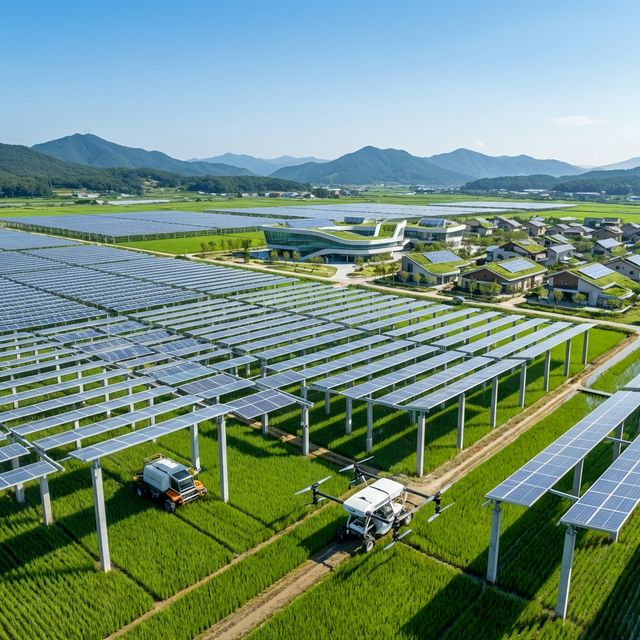
When you mention agrivoltaics on absolute farmland, people around you say it flat out: “Don’t even dream about it.” But since the second half of 2025, the landscape has shifted slightly. It’s not wide open yet — more like the door is cracked. The question is when, and under what conditions, you can slip through that crack.
1. Let’s Start with the Basics — Right Now It’s ‘Prohibited in Principle + Exception Preparation Underway’
Under the current Farmland Act, the answer is simple.
- In Agricultural Promotion Areas, farmland conversion for solar generation is prohibited in principle.
- Agrivoltaics also lacks a separate legal basis, so most operations exist only as pilot/demonstration projects.
Then in October 2025, the government laid out a major direction.
- Even in Agricultural Promotion Areas, agrivoltaics would be allowed when ‘Renewable Energy Zones’ are designated.
- Farmland use period extended from 8 → 23 years.
However, on January 29, 2026, the Ministry of Agriculture drove the point home again.
- “The requirements for agrivoltaics businesses have not been finalized.”
- Actual farming obligations, generation scale (area) limits, etc., will be “finalized through consultation with the National Assembly and agriculture sector during the special act legislation process.”
In summary, right now (February 2026) the cases where agrivoltaics is possible in Agricultural Promotion Zones are:
- Participating in government/municipality-designated pilot sites/demonstration projects
- Having your land included in a future Renewable Energy Zone (not yet implemented)
Those are the only two.
2. You Need to Be Inside a ‘Renewable Energy Zone’ — The Big Picture on Site Conditions
The keyword in the government’s roadmap is Renewable Energy Zone.
- Even within Agricultural Promotion Areas, certain areas would be designated as Renewable Energy Zones.
- Agrivoltaics businesses would only be allowed within these zones.
- To prevent sprawl, this follows a planned-location approach at the village/district level.
Two important points here.
- It’s a ‘zone’ designation, not individual lot-level.
Going solo with “just do my rice paddy please” will be difficult. - Zone designation authority is shared between central government and local governments.
Whether zone designation is pursued depends on local politics and public sentiment.
If “my land is in an Agricultural Promotion Zone and I want to aim for agrivoltaics long-term,” then you need to enter village-level discussions. Moving as a group — through the village head, crop groups, or farming cooperatives — carries far more weight than acting alone.
3. Actual Farming Obligation — No Farming, No Permission
In exchange for allowing agrivoltaics in Agricultural Promotion Zones, the government’s strongest principle is one thing.
“Only those who continue to farm can do agrivoltaics.”
When media reports mentioned requirements like “only farmers with 3+ years of actual cultivation, installation area limited to 2,000㎡,” the Ministry of Agriculture immediately clarified.
- The 3-year cultivation requirement, 2,000㎡ limit, etc., have not yet been decided.
- However, the actual farming obligation itself is very likely to be included, as officially acknowledged.
The rough direction of cultivation standards being discussed:
- Minimum 90 days per year engaged in agriculture.
- Annual agricultural product sales of 1.2 million KRW or more, or cultivated area of 1,000㎡ or more.
These standards are already established as farmer qualification criteria in the Farmland Act and related laws. The special act is very likely to adopt these criteria directly for agrivoltaics eligibility.
4. Generation Scale and Shading Rate — The Signal Is ‘Don’t Get Too Greedy’
Agrivoltaics allowed in Agricultural Promotion Zones is designed under the principle that “farming is the host, solar is the guest.”
The direction of conditions currently under discussion (not yet finalized):
- Setting an installation area cap per lot (or per farm) (e.g., around 2,000㎡).
- A structure where only a portion of the area is used for generation equipment, not the entire farmland.
- Setting shading rate standards targeting 80%+ crop yield maintenance.
Reports from the National Assembly Research Service and Korea Rural Economic Institute present multiple scenarios limiting generation equipment area to 40% or less of the farmland. The remaining 60% isn’t left empty — farming continues under and between the panels.
The three principles the government has repeatedly emphasized say the same thing.
- Prevention of sprawl
- Food security maintenance
- Community benefit sharing
Ultimately, a scenario of “all solar, farming is just for show” is impossible in Agricultural Promotion Zones.
5. Village-Level & Cooperative Models — Solo Businesses Are Getting Harder
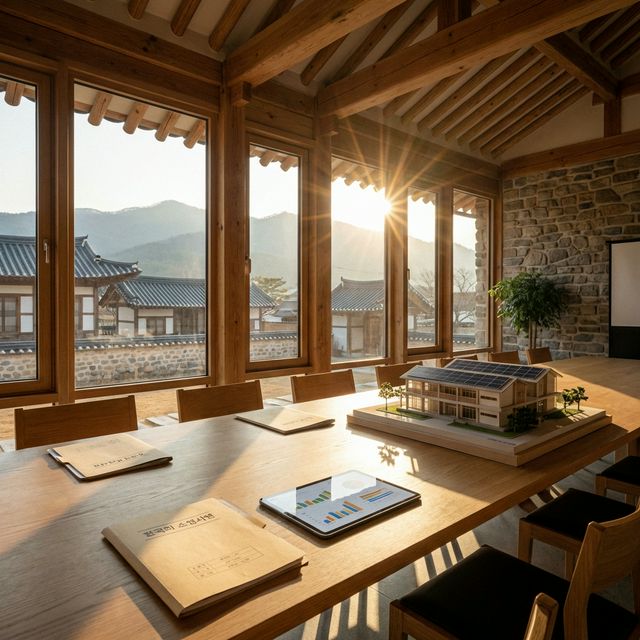
The model that the government and National Assembly are pushing is village/cooperative-centered.
- Allowing village cooperative corporations as agrivoltaics business entities.
- A structure where the entire village participates and shares revenue, not individual farms.
Why this direction?
- A structure where only specific farms benefit fuels village conflicts.
- Agricultural Promotion Zones are literally the village’s collective ‘rice bowl,’ demanding high public interest.
In practice, some pilot sites in Jeonnam and Chungbuk are recruiting participating farms at the village level and distributing generation revenue proportionally by number of farms.
6. Summarizing the ‘Possible Conditions’ in Agricultural Promotion Zones
The law isn’t finalized yet, but based on materials from the government, National Assembly, and research institutions, the outline of conditions for agrivoltaics in Agricultural Promotion Zones looks like this.
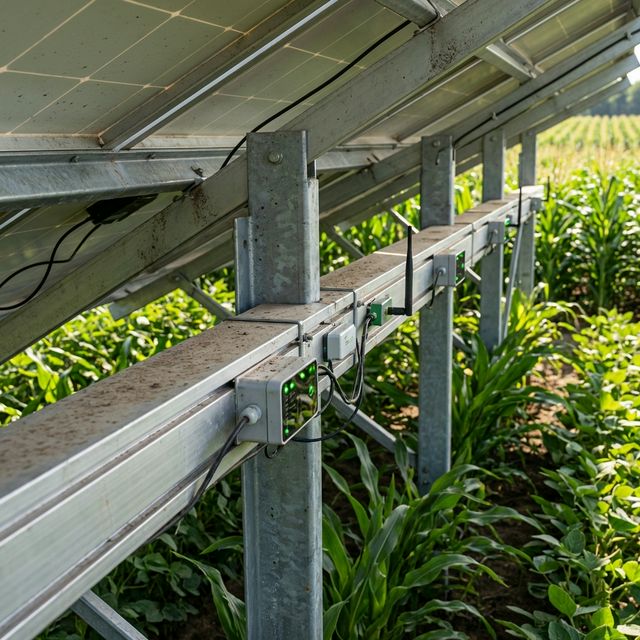
- Site Conditions
- Within an Agricultural Promotion Zone, the area must be designated as a Renewable Energy Zone.
- Must not overlap with prohibited zones under other laws: Ecological Grade 1, Water Source Protection Zones, Cultural Heritage Protection Zones, etc.
- Must meet municipal setback distance ordinances (to be adjusted to nationally unified standards later).
- Entity Conditions
- Business entity must be an actual farming farmer (or agricultural corporation).
- Priority given to community benefit-sharing structures like village cooperatives and farming cooperative corporations.
- Farming Conditions
- The primary use of the farmland must still be agriculture.
- Design must ensure 80%+ yield maintenance after panel installation.
- Crops, varieties, and cultivation methods must be adjusted accordingly.
7. If Your Land Is in an Agricultural Promotion Zone — What You Can Prepare Now
”The law isn’t even passed yet, what’s there to prepare?” you might think. But when the law passes and applications open, the gap between prepared villages and unprepared villages widens dramatically.
Here’s what you can do now.
- Organize your land status
- Mark where your land sits within the Agricultural Promotion Zone on a single map.
- Also check locations of nearby utility poles, substations, and KEPCO lines.
- Organize your farming records
- Compile crop-by-crop cultivation areas, yields, and sales amounts for the last 3 years in a spreadsheet.
- Update your Farm Business Entity registration information.
- Build consensus within the village
- Share basic information about agrivoltaics with your village head and neighboring farmers.
- Start rough discussions about “who will participate, how, and how revenue will be divided.”
8. The One-Line Summary
The conditions for agrivoltaics in Agricultural Promotion Zones mean “it’s not a business anyone can do once the law opens up.”
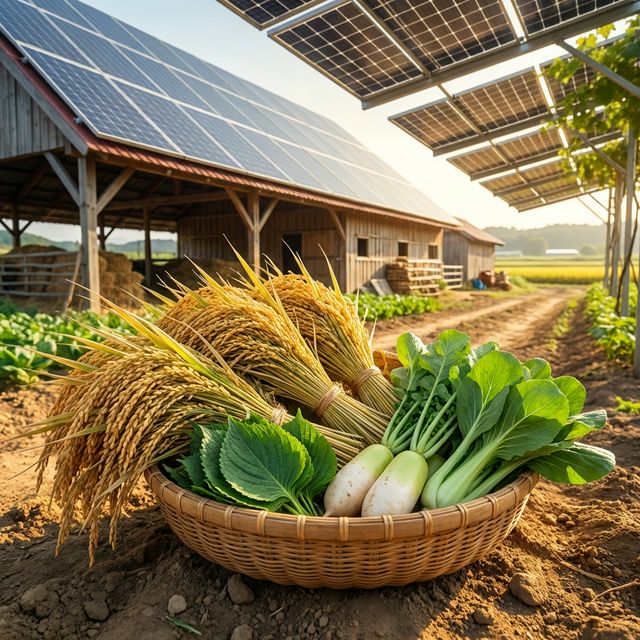
- Your Agricultural Promotion Zone must be included in a designated Renewable Energy Zone.
- The entity must be a farmer who actually farms (or a village/cooperative).
- The design must be able to meet the principle of 80%+ yield, farming continues.
On top of these three, you must also clear peripheral conditions like setback distances, environmental regulations, cultural heritage, water source protection, and grid access. So rather than harboring vague expectations, the realistic strategy is to calmly watch “when and under what rules the door will open” while preparing your numbers and people for that day.
#Agrivoltaics #AgriculturalPromotionZones #FarmlandAct #RenewableEnergyZones #AbsoluteFarmland #SmartFarm
This article is based on government press releases, Ministry of Agriculture explanatory materials, media reports, and National Assembly/research institution reports as of February 2026. Actual permitting standards may vary depending on the forthcoming Agrivoltaics Special Act, Farmland Act amendments, and local ordinances — always verify the latest regulations before proceeding with any project.