Complete Summary of Agrivoltaics Regulations as of January 2026
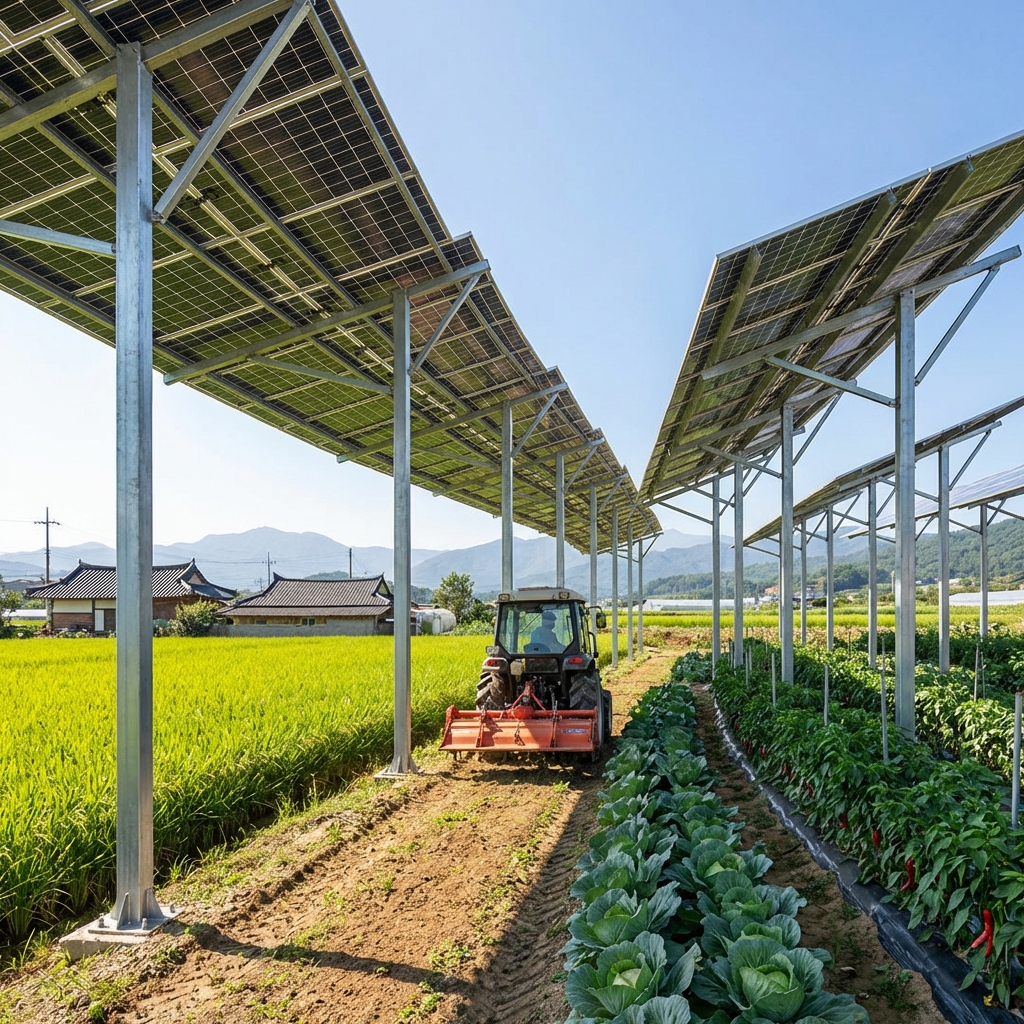
Power Plants on Farmland — The Legal Foundation Is Being Laid
As of January 2026, agrivoltaics is reaching a new turning point for Korean rural areas. Until now, the Farmland Act’s constraints — an 8-year maximum business period and prohibition of installations in Agricultural Promotion Areas — had made widespread adoption difficult. But multiple special bills introduced in the National Assembly in 2025, combined with the government’s aggressive regulatory reform, are ushering in a new phase.
Agrivoltaics is a system that installs solar generation equipment above farmland while farming continues below. It has garnered attention as an innovative agricultural model that can simultaneously achieve food security and energy transition — going far beyond simply increasing farm income.
Special Agrivoltaics Bills Introduced in the National Assembly
1. Act on Support for Agrivoltaics Power Generation Business (Rep. Kim Seong-hwan, 2025.01.21)
Introduced on January 21, 2025, by Rep. Kim Seong-hwan and 27 co-sponsors, this bill contains the most comprehensive and systematic support measures for agrivoltaics.
Key Provisions
| Category | Details |
|---|---|
| Business Period | Up to 30 years (major expansion from current 8 years) |
| Business Entities | Self-cultivating farmers, tenant farmers, agricultural corporations, community cooperatives, etc. |
| Agricultural Promotion Areas | Installation allowed under condition of maintaining certain agricultural output levels |
| Direct Payments | Farmland with agrivoltaics explicitly included in public interest direct payment eligibility |
| Farmland Protection | Prohibition of materials that damage farmland |
| Penalties | Up to 2 years imprisonment or 20 million KRW fine for fraudulent approvals |
The core of this bill is to establish an institutional foundation that enables farmers to achieve genuine income growth while preserving farmland. In particular, allowing a business period of up to 30 years makes realistic investment recovery possible, considering solar modules’ actual lifespan of 20-25 years.
Article 4 (Approval of Business Plans, etc.)
① Any person intending to conduct an agrivoltaics power generation business shall prepare a business plan designating farmland as the solar energy generation facility site and obtain approval from the mayor, county head, or district head, as prescribed by Presidential Decree.
② The approval period under paragraph 1 shall be within 30 years.
2. Special Act for Activation of Agrivoltaics Power Generation Business (2025.08.26)
This bill focuses on improving administrative efficiency by enabling one-stop processing of farmland temporary use permits when business plans are approved.
Key Features- Simplified permitting procedures (one-stop processing) - Government priority purchase of electricity and consulting support - Support for community-centered solar power generation businesses
3. Bill Comparison Summary
| Category | Kim Seong-hwan Bill (January) | Activation Special Act (August) |
|---|---|---|
| Business Period | Up to 30 years | Not specified |
| Permitting | Standard | One-stop processing |
| Agricultural Promotion Areas | Conditionally allowed | Not specified |
| Direct Payments | Explicitly allowed | Not specified |
| Government Support | Loans, electricity purchase, etc. | Priority purchase, consulting |
Government’s Regulatory Reform Direction (2025.10.16)
On October 16, 2025, at the ‘2nd Core Regulation Rationalization Strategy Meeting’ chaired directly by the President, agrivoltaics activation was addressed as a key agenda item. The government announced three major improvement measures to promote agrivoltaics expansion.
Three Core Improvements
1. Installation Allowed Even in Agricultural Promotion Areas
Under the current Farmland Act, Agricultural Promotion Areas are core zones of Korea’s prime farmland where solar generation equipment installation is prohibited in principle. However, under the amendment, agrivoltaics installation would become possible in Agricultural Promotion Areas when ‘Renewable Energy Zones’ are designated.
This is a compromise to simultaneously achieve two goals — farmland preservation and renewable energy expansion — allowing agrivoltaics in appropriate locations while preventing sprawl development.
2. Major Extension of Business Period (8 → 23 years)
According to the Korea Rural Economic Institute’s economic analysis, a minimum of 20 years is needed to secure profitability for agrivoltaics businesses. However, current Farmland Act enforcement regulations limit the temporary use period to a maximum of 8 years, serving as the biggest obstacle to economic viability given the high initial installation costs.
The amendment dramatically extends this to 23 years, creating an environment where businesses can stably recover their investments.
3. Nationwide Unification of Setback Distance Standards
Currently, setback distances between solar generation facilities and residential areas are set by local ordinances, with wildly varying standards across municipalities. Some require 100m while others require 500m or more, creating regulatory disparities that reduce business predictability and cause conflicts.
The government has announced plans to unify setback distance standards nationally through amendments to the Renewable Energy Act, creating a predictable business environment.
Implementation Timeline
The government’s legislative roadmap is as follows:
| Timeline | Action |
|---|---|
| End of 2025 | Enactment of Agrivoltaics Special Act |
| End of 2025 | Renewable Energy Act amendment (unified setback distances) |
| First half of 2026 | Farmland Act amendment completed |
| Second half of 2026 | Law implementation and full-scale rollout |
Agrivoltaics Technical Standards and Field Trial Results
Just as important as the regulatory framework is the question: ‘Can you really farm and generate profit at the same time?’ Authoritative institutions including the Ministry of Agriculture, the Rural Development Administration, and the Jeonnam Green Energy Research Institute have conducted years of field research.
Core Technical Standards
Shading Rate Below 30% Mandatory
The shading rate refers to the ratio of the solar panels’ horizontal projection area to the total farmland area. The government has set a standard of below 30% shading to secure the minimum sunlight needed for crop growth.
Target: Yield Reduction Within 20%
The government’s basic policy is that crops cultivated under agrivoltaics panels must maintain at least 80% of normal open-field yields.
Field Trial Results
National Institute of Crop Science, RDA Research (2019-2020)
The National Institute of Crop Science conducted Korea’s first comparative study of tracking and fixed agrivoltaics systems.
Research Results:
| Category | Tracking | Fixed |
|---|---|---|
| Installed Capacity | 43.2kW | 43.2kW |
| Facility Area | 217 pyeong | 267 pyeong |
| Number of Pillars | 3 | 44 |
| Shading Rate | 36.2% | 25.4% |
| Rice Yield (vs. open field) | 81% | 82% |
Interestingly, there was virtually no difference in yield between tracking and fixed systems. This suggests that structure type matters less than shading rate and crop management practices.
Soil Environment Improvement Effects
Agrivoltaics doesn’t simply reduce yields — it also showed some environmental improvement effects.
- Soil Moisture: Under panels 20.7% vs. open field 11.6% → advantageous in droughts
- Soil Temperature: 2.5°C lower under panels → reduces summer heat stress
Jeonnam Green Energy Research Institute’s Multi-Crop Studies
The Jeonnam Provincial Green Energy Research Institute conducted field trials across various crops including rice, field crops, fruit trees, and medicinal plants.
- Rice, cabbage, potato, grape, pear, green tea, blueberry, fig, etc.
- Development of optimal shading rates and cultivation methods for each crop
- Yield reduction levels of 7-20%, meeting standards
Bonghwa Medicinal Crop Research Institute Studies
Field trials with medicinal crops like cnidium and rehmannia yielded the following results:
- Power generation: 38.8MWh (January-June)
- Solar irradiance: 54% of open-field levels
- Confirmed improvements in soil moisture and temperature
These field trial results demonstrate that agrivoltaics is not merely theoretical but a practically functional agricultural model.
Economic Analysis — How Much Does Farm Income Increase?
Korea Rural Economic Institute Analysis
The Korea Rural Economic Institute published a detailed economic analysis of agrivoltaics in their 2023 report “Economic Analysis and Policy Implications for Agrivoltaics Introduction.”
Analysis Summary
- Benefit/Cost Ratio: 1.08 – 1.93 (varies by crop)
- Rice: 1.34
- Grape: 1.93
- Cabbage: 1.47
- Annual Net Income: Approximately 5.55 million KRW (average)
- Small-scale Farms (under 0.5ha): Non-farm income increase of 1.36 million KRW (5.85% growth rate)
Actual Revenue Structure
For a 100kW agrivoltaics system installed on 1,000 pyeong (approx. 3,305㎡) of farmland:
| Item | Amount |
|---|---|
| Monthly electricity sales revenue | Up to 1 million KRW |
| Annual electricity sales revenue | Approximately 12 million KRW |
| Agricultural income reduction (assuming 20% decrease) | -2.4 million KRW |
| Net Income Increase | Approximately 9.6 million KRW |
Note that these figures are before accounting for initial investment costs (installation), loan interest, and operating/maintenance expenses, so actual net income may be lower. The Korea Rural Economic Institute analyzed that economic viability is secured when the business operates for 20+ years.
REC Weighting and Power Sales
Agrivoltaics revenue consists of SMP (System Marginal Price) + REC (Renewable Energy Certificate) sales.
REC Weightings (2026 Standards):
| Site Type | Capacity | REC Weighting |
|---|---|---|
| General land | Under 100kW | 1.2 |
| General land | 100kW and above | 1.0 |
| Buildings | 3,000kW or less | 1.5 |
| Forested land | All capacities | 0.5 |
RPS Obligation Ratio Outlook- 2026: 15% - 2030: 25%
As the RPS (Renewable Portfolio Standard) ratio increases, REC demand will grow, with price stabilization and increases expected.
Ministry of Agriculture’s Concerns and Management Measures
The Ministry of Agriculture has clearly stated its position regarding potential problems from unchecked agrivoltaics expansion.
Government’s Three Principles
”The government will introduce agrivoltaics in an orderly manner centered on Renewable Energy Zones according to rural spatial plans, based on the principles of ①preventing sprawl, ②food security, and ③returning benefits to residents, communities, and farmers, preventing indiscriminate development to address rural landscape concerns.”
Concerns and Responses
1. Rural Landscape Damage Concerns
Response:- Concentration around Renewable Energy Zones - Only allowing locations consistent with rural spatial plans - Preventing indiscriminate sprawl development
2. Increased Burden on Tenant Farmers (Rising Rents)
Response:- Providing tenant farmers with opportunities to participate in generation business - Establishing revenue-sharing mechanisms - Explicitly stipulating tenant farmer protections
3. Weakening of Agricultural Production Base (Fake Farming)
Response:- Setting agricultural production standards (maintaining 80%+ of neighboring farmland yields) - Mandatory submission of farmer qualification documentation every 3 years - Approval revocation if production standards are missed for 3 consecutive years - Imposing surcharges (fines larger than power generation revenue when farming is not maintained)
Thorough Post-Management System
”We will prepare thorough post-management measures, including economic sanctions, to ensure agrivoltaics generation businesses fulfill their sincere farming obligations, preserving farmland and the agricultural production base.”
Current Regulations vs. Amendment at a Glance
| Category | Current (2025) | Amendment (Planned 2026) |
|---|---|---|
| Business Period | Maximum 8 years | 23 or 30 years |
| Agricultural Promotion Area Installation | Not allowed | Allowed when designated as Renewable Energy Zone |
| Business Entities | Farmers (limited) | Farmers, agricultural corporations, community cooperatives |
| Direct Payments | Limited | Agrivoltaics farmland included |
| Setback Distance Standards | Varies by municipality | Nationally unified (Renewable Energy Act) |
| Legal Basis | Farmland Act temporary use | Agrivoltaics Special Act |
What Farmers Need to Prepare
1. Verify Business Entity Qualifications
You must meet one of the following criteria:- A farmer who has resided in the area for a certain period or longer - A farmer who has leased farmland for agricultural purposes - An agricultural corporation with offices in the area - A community cooperative (jointly established with local government)
2. Essential Documents and Procedures
| Step | Description |
|---|---|
| Step 1 | Prepare farming plan (crops to cultivate, cultivation methods, etc.) |
| Step 2 | Prepare business plan and apply for mayor/county head approval |
| Step 3 | Related permits processed simultaneously (one-stop) |
| Step 4 | Generation business license (Electricity Business Act) |
| Step 5 | Equipment installation and completion |
| Step 6 | Farmer qualification maintenance proof every 3 years |
3. Investment and Loan Support
The government plans to provide policy fund loans to support agrivoltaics businesses.
- Low-interest loans (1.5% fixed rate, etc.)
- Sunshine Income Village financial support (extended to secondary financial institutions)
- Primary financial institutions, NongHyup/ChukHyup support
4. Insurance Enrollment
The Ministry of Agriculture, in cooperation with the Ministry of Trade, plans to develop agrivoltaics-specific insurance products to support stable farm management.
Outlook and Recommendations
2026: The Inaugural Year of Agrivoltaics Expansion
2026 is expected to be the inaugural year when agrivoltaics transitions from the pilot stage to the expansion stage. With institutional foundations being laid through special act enactment, Farmland Act amendment, and setback distance unification, the floodgates that had been closed are opening.
Recommendations for Successful Establishment
1. Farmer-Centered Business Approach
Agrivoltaics must be ‘gaining additional income while farming,’ not ‘squeezing farming into a solar business.’ This is precisely why the government has emphasized “imposing surcharges when farming is not maintained.”
2. Community-Led Models
Models where local residents participate together and share revenue through village cooperatives and community participation cooperatives are desirable. This can increase community acceptance and contribute to regional economic revitalization.
3. Crop Selection and Cultivation Technology Development
Not all crops are suitable for agrivoltaics. It’s important to select crops appropriate for the region and soil type based on field trial results from the Rural Development Administration and Green Energy Research Institute, and to receive expert consulting.
4. Long-term Investment Planning
Agrivoltaics requires significant initial investment and an investment recovery period of 20+ years. Therefore, it should be approached as part of a long-term farm management strategy rather than expecting short-term returns.
Summary and Core Checklist
2026 Agrivoltaics Legislation Key Summary
- Business Period: Extended from 8 → 23 or 30 years
- Agricultural Promotion Areas: Installation possible when designated as Renewable Energy Zones
- Setback Distances: Municipality-specific → nationally unified standards
- Business Entities: Expanded to farmers, agricultural corporations, community cooperatives, etc.
- Direct Payments: Agrivoltaics farmland included in eligibility
- Thorough Management: Approval revocation and surcharges for failing production standards
Farmer’s Checklist
- Am I qualified as a farmer?
- Is my area likely to be designated as a Renewable Energy Zone?
- Is my intended crop suitable for agrivoltaics?
- Have I established an initial investment and financing plan?
- Do I have a long-term operation plan of 20+ years?
- Have I consulted with and obtained consent from local residents?
- Am I prepared to receive relevant training and consulting?
In Closing
2026 will be a turning point when agrivoltaics truly takes root in Korean rural areas. But just because the system is being created doesn’t mean success will follow automatically. Only farmers who are genuinely prepared to combine sincere agricultural management with energy production will be the true beneficiaries of agrivoltaics.
Farmland is both the foundation of our food supply and a precious asset to pass on to future generations. We hope that agrivoltaics will establish itself as an innovative agricultural model that enriches farmers’ lives while preserving farmland.
This post is based on legislation and government policy materials as of January 2026. Local ordinances and specific details may vary by municipality. Please consult local government authorities and relevant experts when pursuing actual projects.