Agrivoltaics: 5 Cases Where You Should Absolutely NOT Install It
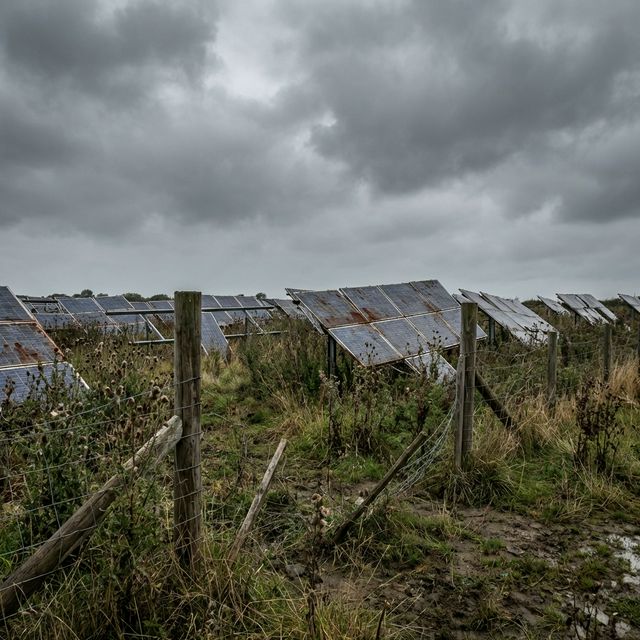
Agrivoltaics is not the answer for every farm. There are exactly 5 cases where it is “better off not doing it at all.”
1. Farmland with a strict 8-year permit limit
Panels can easily last over 25 years, but there are sections of farmland where the Farmland Act only permits use for 8 years. This combination is the most dangerous.
- Current Farmland Act Structure
- Agrivoltaics are installed on farmland under a “temporary permission for other uses,” which often ties the basic permit period to a maximum of 8 years.
- Research explicitly states, “Based on an 8-year operation, the B/C (Benefit-Cost ratio) of agrivoltaics is 0.74, meaning there is no economic feasibility.”
- Using a 25-year facility for only 8 years
- In a case in Hamyang, Gyeongnam, it was reported that a cooperative spent 160 million KRW on a facility that was barely reaching the break-even point in its 5th year, but now faced the prospect of having to demolish it after 8 years.
- The cooperative head expressed frustration, saying, “It’s infuriating to be told to demolish a facility that could generate 600 million KRW in profits over the next 20 years.”
Under these conditions,
- You might barely recover your installation costs before it’s over, or
- You might even end up with a net loss if you have to bear the demolition costs.
If dealing with farmland where the permit period cannot be extended beyond 8 years, agrivoltaics is almost a “losing game.”
2. Farms with a mismatch in electricity sales price, interest rates, and installation costs
Looking at a KREI report analyzing the economic feasibility of agrivoltaics, three key variables are electricity sales price, loan interest rates, and installation costs.
- Report Results
- Under the current Farmland Act (8-year operation) conditions, it is shown that there is no economic feasibility in all scenarios.
- Even assuming the temporary use permit is allowed for 20 years or more, the B/C ratio fluctuates from 0.98 to 1.48 depending on the combination of sales prices, installation costs, and interest rates.
- In other words, if the sales price is low, the interest rate is high, and the installation is expensive, securing economic feasibility is difficult even scanning across 20 years.
So, these cases are particularly dangerous:
- Regions experiencing a downtrend in the System Marginal Price (SMP) after the end of FIT (small-scale fixed-price contracts).
- Cases where existing loans with fixed interest rates above 5-7% are being utilized.
- Cases where installation costs were contracted at a higher rate than the surrounding market (e.g., rural fraud, over-priced lot sales).
What happens with this combination?
- Annual net income falls far below expectations,
- Principal and interest repayment becomes burdensome, creating a structure where “electricity profits barely cover loan interest.”
If the calculations show an unviable ROI even when making conservative estimates for electricity unit prices and interest rates, it is right for that farm to postpone installation.
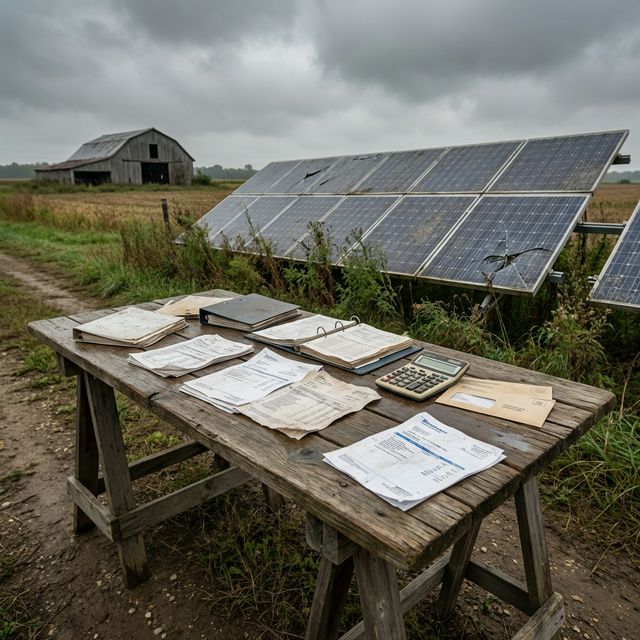
3. Farms with no real intention of continuing to farm
Agrivoltaics is a model institutionalized on the premise of “Farming + Electricity.” However, in reality, there are cases where people jump in “farming half-heartedly, looking only at the panels.” These cases lose out twice.
- Farmland Value & Food Security Issues
- During the dissemination of rural solar power, speculative and nature-destroying acts of abandoning farming and only seeking solar profits have been pointed out.
- One study estimates that if agrivoltaics were expanded to farmland nationwide, the reduction in rural landscape value would amount to 1.9 trillion KRW.
- Farmer Acceptance Issues
- A research report analyzes that the acceptance of agrivoltaics is not simply a matter of profit but a tangled issue involving rural communities, landscapes, and rising land rents (a kind of gentrification).
If there is no actual intention to continue farming, and
- Weeds are just left to grow rampant, or
- Entrusted farming is not being managed properly,
that farm assumes all the risks of surrounding civil complaints, legal revision risks, and the possibility of future permit revocation. For such a farm, agrivoltaics might bring “short-term profit,” but in the long run, the risks of regulation, conflict, and demolition are far greater.
4. Farmland where structure & design completely clash with the crops
This is a loss closer to “the farming is ruined” rather than just profit issues. The keywords that repeatedly appear in research and articles are shading rate, panel height, and crop selection mistakes.
- Case of up to 71% rice harvest decrease
- In the Ministry of Agriculture’s data analysis, the average rice yield reduction is 15.7%, but in a specific verification, a case where it dropped to 71% was revealed.
- At this level, it is reasonable to view it as a case where something went terribly wrong regarding structure, design, or management.
- Safety range commonly suggested by research
- They summarize that if a shading rate of 30% or less, panel height of 3m or higher, and proper spacing are maintained, the yield reduction for major crops can be managed to under 20%.
- While partial shading affects photosynthesis and electron transport efficiency, adjusting the shading ratio can mitigate growth degradation.
Farmlands that lose out upon installation match this pattern:
- Low-lying paddies where humidity and ventilation aren’t controlled because panel height is too low.
- A structure with an excessive shading rate while cultivating light-loving crops like beans or fruit trees.
- A layout so densely packed with pillars and beams that agricultural machinery struggles to navigate.
This combination can lead to:
- Sudden drop in harvest yield (surpassing 20% to reach 50-70%)
- Increase in disease and lodging
- Ultimately falling into the worst-case route of “giving up on farming and leaving only the power plant.”
5. Farms unable to control contract & company risks
This final point is a very practical problem. Issues with sales, construction, and fraud. If you take a loss here, no matter how well structured the system or profit model is, it is useless.
- Types of rural solar fraud
- Installing cheap Chinese panels while deceiving customers into believing they are “domestic, large-corporation products.”
- There was an actual case where a 3kW residential system was installed, yet the electricity bill barely decreased for over 2 years.
- Inducing contracts with fake profit simulations, exaggerated power generation amounts, and underestimated operating costs.
- Sales, Licensing, and Grid Connection Issues
- Fake licensing (contracting by claiming a permit is possible when it isn’t)
- Cases where power cannot be generated for years due to a lack of grid connection capacity
- Demands for additional costs, identity theft, sales fraud, etc.
Agrivoltaics is no exception. Even if the facility is called agrivoltaic, the business landscape contains intermingled companies whose sales methods do not differ much from “rural solar fraud.”
In this environment, if a farm cannot fully understand the contents of the contract to the end and independently verify the company through the Energy Agency, local governments, or public institutions, then frankly speaking, agrivoltaics is dangerous. If caught in a bad deal, you can end up saddled with “installation costs + demolition costs + legal dispute fees” rather than electricity profits.
6. Conclusion: 5 types of farms that should NOT install, summarized
Summarizing the above from the farmer’s perspective, line by line, it looks like this:
- Farmland where the 8-year permit period has no room for extension: A structure where the B/C drops below 1 because a 25-year facility must be demolished after just 8 years of use.
- Farms where economic feasibility fails due to combination of sales price, interest, and cost
: Cases where the ROI comes out to 0.x right from initial calculations due to the end of FIT, high interest rates, and expensive installation costs.
- Farms with practically no intention to continue actual farming: A structure that assumes all risks: farmland damage, landscape/community conflict + future regulatory risks.
- Farmland where shading rate, height, and crop selection are a bad match: The worst possible design where harvests might fly off up to 70% instead of hitting the 10-20% benchmark for rice.
- Farms finding it difficult to independently verify contracts and companies: Highly vulnerable to cheap panels, fake profits, sales fraud, and additional cost demands, presenting a massive risk that the entire project will end in the negative.
For the farms falling into these five categories, they might be able to do agrivoltaics “someday,” but they are not in a situation to do it “right now.” Running the calculator two or three more times and jumping in after system, permit, and company verifications are entirely organized is a substantially cheaper path across a long life.
References
- KREI (Korea Rural Economic Institute), “What is the future of the agrivoltaics business?” (Economic feasibility analysis under current farmland act, B/C 0.74, etc.)
- Edaily, “Agrivoltaics in crisis… ‘A panel meant for 25 years, told to remove from paddy after 3 years’” (Hamyang agrivoltaics 8-year permit/demolition issue)
- Research on problems and improvement measures for rural solar distribution (100kW installation area, economic feasibility, farmland damage issues)
- Farm income impact analysis paper, “Analysis of impact on farm income following agrivoltaics installation” (Rural income change, acceptance issues)
- Renewable Energy & Policy Issue Article, “All issues surrounding agrivoltaics: Farmer profit generation vs. Gentrification” (Landscape value, farmland damage, gentrification analysis)
- Ministry of Agriculture, Food and Rural Affairs, press releases and contest materials related to agrivoltaics systems and guidelines
- Blogs and videos summarizing rural solar damage cases and types of fraud (cheap panels, fake profits, sales fraud, etc.)