How Much Does Crop Yield Decrease? (Agrivoltaics Research & Cases)
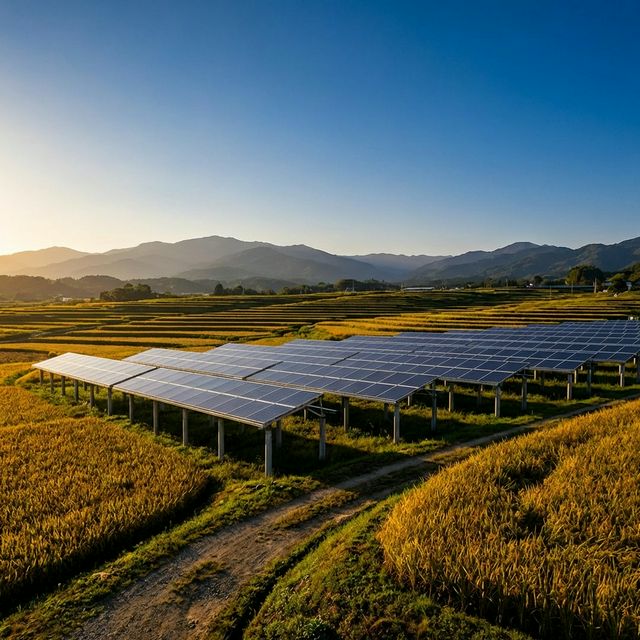
“I heard rice harvest dropped by 70% after installing agrivoltaics.”
You might have heard this at least once. It’s a number that sends chills down your spine just hearing it. But when you look closely at research and verification results, the story flows quite differently. If you break it down by averages, conditions, and design flaws, a much more realistic picture emerges.
1. “Average” Yield Reduction by the Numbers
First, let’s look at the average yield reduction stated by research institutions and government data. Don’t fight with intuition, fight with numbers.
- Jeonbuk Agricultural Research & Extension Services
- In cultivation under agrivoltaics:
- Rice yield: 10-20% decrease compared to normal paddies
- Potato yield: 13.7% decrease
- Based on the <Samgwang> rice variety, it went from 717kg per 10a (normal) → 585kg (agrivoltaics), an approximate 18.4% decrease.
- Domestic Verification & Modeling Research (Jeonnam Case)
- At a 20% reduction in solar radiation:
- Rice: Approx. 18.1% decrease
- Barley: Approx. 14.1% decrease
- Soybeans: Approx. 20.8% decrease
- Even with a 40% reduction in radiation, rice and barley show a gentle decline curve, whereas soybeans drop much more sensitively.
- “Appropriate Reduction Rate” organized by MAFRA and Research Data
- An average yield reduction of 15-20% for rice is mentioned as the appropriate range.
To sum it up in one line: “Under properly designed agrivoltaics, major crops like rice, potatoes, and soybeans experience an approximate 10-20% decrease in yield compared to normal cultivation.”
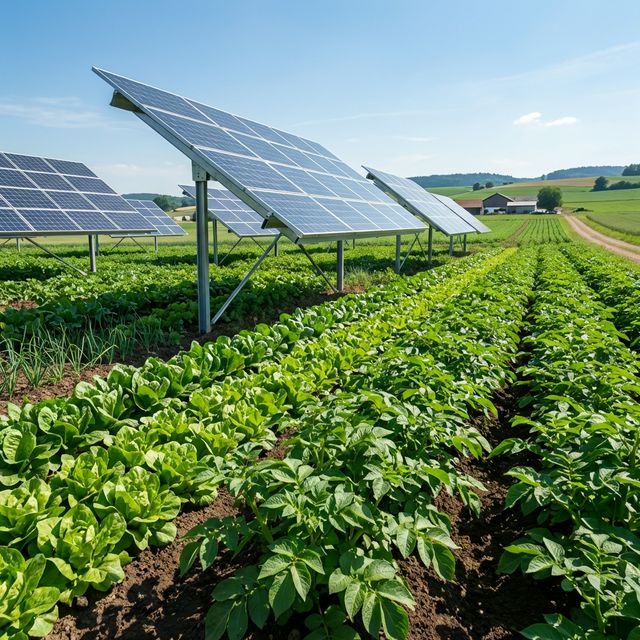
2. What about extreme numbers like “71% decrease”?
Headlines like “Rice harvest drops 70%” that occasionally appear in the news are shocking. But looking at the context, this is closer to a problematic case rather than an industry average.
- National Assembly Data Citation Reports
- MAFRA data analysis shows an average rice yield reduction of 15.7%.
- However, in one agrivoltaics verification project installed by Korea South-East Power Co. in Geochang, Gyeongnam, a case where the yield plummeted to 71% was identified.
- On-site Rebuttal Cases
- A farmer operating an agrivoltaic farm in Boseong, Jeonnam, calls the “70% yield reduction” claim exaggerated.
- He testified that comparing the rice conditions under the panels and outside the panels in his own paddy showed no significant difference, and the overall harvest that year dropped slightly due to weather impacts compared to the previous year.
Ultimately, this 70% figure should be viewed as an “outlier case mixed with design and operational flaws.”
- The panel height and arrangement might not have met crop standards, or
- The shading ratio was excessive, or
- The crop variety and cultivation method were highly vulnerable to shading.
When talking about the average, a 10-20% decrease is the more accurate number. The 70% figure is more of a warning case of “how to ruin it.”
3. How much does it decrease by crop type?
Even under the same agrivoltaic system, the reaction varies significantly by crop. Compiling various studies shows this general pattern:
- Rice
- A 10-20% decrease compared to normal cultivation is most frequently mentioned.
- Approximately 18% decrease under a 20% solar radiation reduction environment.
- In complexes with well-designed panel spacing and height, the reduction can stay in the low 10% range.
- Potatoes
- Based on harvest per 10a: Normal 2,475kg → Agrivoltaics 2,368kg, a 13.7% decrease.
- Soybeans
- Sensitively react to reduced radiation, an approximate 20% harvest reduction under a 20% radiation decrease.
- Barley
- Decreases slightly less than rice, around a 14% reduction case.
- Vegetables & Special Crops
- Cabbage, onions, garlic, and fruit trees show much larger variances depending on structure, variety, and cultivation methods.
There is one important point here. “The adjustable range is surprisingly large, between 5% and 20%, depending on the shading rate (how much is blocked), panel height, spacing, and crop selection.”
4. There are cases where harvest actually increased
It’s somewhat surprising, but there are cases where “the harvest increased.” Especially in crops like green tea.
- Jeonbuk Agricultural Research Summary
- In January 2021, the lowest temperature dropped to -18℃, causing massive freezing damage to green tea fields.
- Freezing damage rate in normal green tea fields: 22.2%
- Freezing damage rate in green tea fields with agrivoltaics: 9%
- As a result, the under-panel production was 102.3kg per 10a, while the normal field was 53kg → Almost a twofold increase.
The reason is simple.
- The panels doubled as shade screens + thermal screens, blocking direct sunlight and winter cold.
- For crops not sensitive to shading, instances occur where growth stabilizes as stress is reduced.
Therefore, recent research trends are leaning toward classifying “which crops are okay up to what level of shading, and which crops should not be put under panels.”
5. What Korean studies have in common
When you string together recent domestic papers and verification studies, a few common messages emerge.
- Shading rate under 30%, panel height above 3m, proper spacing →
- Results show that achieving a “target crop reduction under 20%” is entirely possible.
- In mid-term (3+ years) growth monitoring studies targeting various crops like rice, potatoes, cabbage, and onions:
- Some crops show no significant change in quality or marketability.
- Only the quantity tends to decrease by 10-20%.
- It is inevitable that reduced light quantity affects physiological indicators like photosynthesis, electron transport efficiency, and non-photochemical quenching.
- However, they conclude that by adjusting panel layout, angle, and height, a “design that doesn’t block too much” is possible.
In summary: “If shaded moderately, it drops by 10-20%. If designed terribly, it can drop up to 70%. Conversely, certain crops might even see an increase.”
6. How does the yield reduction actually feel?
For realistic context, let’s create a scenario with numbers. Based on rice.
- Let’s say you have a normal paddy yielding 700kg of rice per 10a.
- If it’s a 15% reduction under agrivoltaics:
- 700kg × 0.85 = 595kg
- This means a reduction of 105kg per 10a.
- If we assume 2,500 KRW per kg, the annual revenue per 10a drops by about 260,000 KRW.
If we assume putting 100kW of agrivoltaics on that same area brings in a net annual profit of around 10 million KRW (a range frequently appearing in research/articles):
- 260,000 KRW rice revenue drop vs. 10 million KRW electricity profit.
- Most farmers can’t help but place more significance on the “3 to 4 times multiple increase in total income” rather than the “15% reduction in harvest yield.”
Of course, from the perspective of pure affection for the crop or agricultural philosophy, a different judgment could be made. This is purely from an “income perspective.”
7. When does the yield reduction become severe?
Summarizing the “ruin patterns” commonly pointed out in research and field cases:
- When the shading rate is excessively high
- Structures where panel spacing is too tight and module width is wide, blocking too much light.
- When the panel height is too low
- Hinders agricultural machinery movement and extremely degrades the air/light environment above the crop.
- When crop selection is wrong
- A combination of putting light-loving crops (e.g., some field crops/fruit trees) under a high-shade structure.
- When drainage and soil management are poor
- Patterns where drainage paths are twisted due to structural foundations, leading to increased excessive moisture and disease.
Conversely, methods to minimize yield reduction generally point in this direction:
- Shading rate under 30%
- Panel height 3m or higher, structures allowing machinery work
- Focusing on “crops that tolerate moderate shading” like rice, barley, and potatoes
- Custom designs tailored to local climate and varieties
In other words, it is closer to “terribly designed agrivoltaics are the problem” rather than “agrivoltaics themselves are the problem.”
8. Summary: Crop Yield, One truly intuitive sentence summary
If you mix all the research, articles, and verification results and compress them into one sentence, it looks like this:
- “If agrivoltaics are designed properly:
- Crops like rice, potatoes, and soybeans see a reduction level around 10-20%.
- For certain crops like some green teas, there are actually cases where the harvest increases.
- Conversely, if the design is a mess, worst-case scenarios like a 70% decrease actually exist.”
Therefore, the key issue is not “agrivoltaics or not,” but: “With what design, for what crop, and at what shading rate will you build it?”
References
- Jeonbuk State Agricultural Research & Extension Services, “Rice Yield Drops 10-20% When Installing Agrivoltaics” (Rice/Potato Verification Results)
- Domestic Agrivoltaics Mid-Term Growth Research, “Mid-Term (3-Year) Growth Study of Agricultural Crops Under Agrivoltaic Systems” (Rice, Potatoes, Cabbage, etc.)
- Domestic APV Simulation Paper, “Simulation of Crop Yields Grown under Agro-Photovoltaic Panels: A Case Study in Chonnam Province, South Korea” (Analysis of yield changes in rice, barley, soybeans at 20-40% radiation decrease)
- Domestic Development & Verification Comprehensive Research, “Development of Domestic Agrivoltaic Systems and Analysis/Consideration of Under-Crop Growth Characteristics” (Targeting shading rate <30%, reduction rate <20%)
- Agrivoltaic Shading Environment & Crop Physiological Reaction Research, “The Effect of Partial Shading Growth Environment of Agrivoltaic Panels on Crop Electron Transport Efficiency and Non-Photochemical Quenching”
- Articles citing MAFRA/National Assembly submitted data, mentioning average 15.7% rice yield drop, max 71% drop cases
- Hankyoreh/Local articles, Boseong Agrivoltaics Farmer Field Interview (Rebutting the “70% decrease” claim)
- Agrivoltaics/Farm Income Articles, “Cases of increased rice/farm income and RE100 connection”
- Agrivoltaics Comprehensive Report, “Agrivoltaics: The Convergence of Agriculture and Energy” (Summary of domestic cases, policies, crop impacts)