Agrivoltaics: The Battle Is Won on the Ground, Not at the Panel
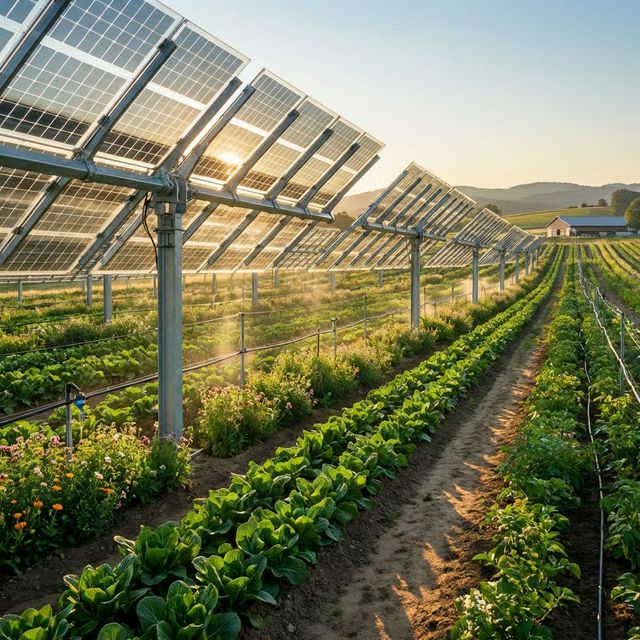
Albedo design separates the winners from the losers. Even with identical modules, generation output differs.
The reason is the reflectance of the surface beneath the panels — albedo.
The Bifacial Module Era: Ground Reflectance Isn’t a Variable — It’s Leverage
With monofacial PV, ground-reflected irradiance accounted for just 1-2% of total irradiance, so rough estimates were fine.
Bifacial modules are designed to “capture” that additional 1-2%, which changes everything.
Depending on whether the ground is wet, has grass cover, or has rough texture, albedo fluctuates with time of day, season, and angle of incidence.
In agrivoltaics, albedo is where land-use details directly translate to kWh — if it’s missing from design drawings, it shows up in the profit and loss statement.
Why “Just Use White Ground Cover” Isn’t Enough: What the Data Shows
The intuitive albedo improvement is white ground cover material. Data confirms the effect.
According to AgriVoltaics Conference Proceedings, in a Horizontal Single-Axis Tracker configuration, white ground cover increased rear-side cumulative irradiance by an average of 25%.
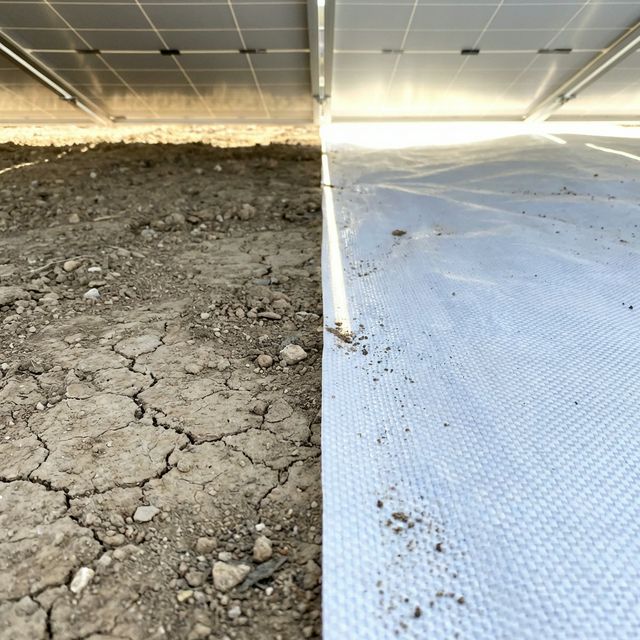
However, the same paper reports that for vertically installed fixed bifacial systems, 5.5 months of field measurements showed “no measurable difference” between ground cover types.
Simulations predicted 8.2% irradiance increase in March and 7.3% in June, yet these gains vanished in actual measurements — that’s the key finding.
This means even with albedo-enhancing materials, “field variables” like structure geometry, height, shadow patterns, sensor placement, and soil moisture can offset the effect.
Tracking Systems Boost Generation — but Crops Send the Bill
From a generation-only perspective, tracking systems are superior.
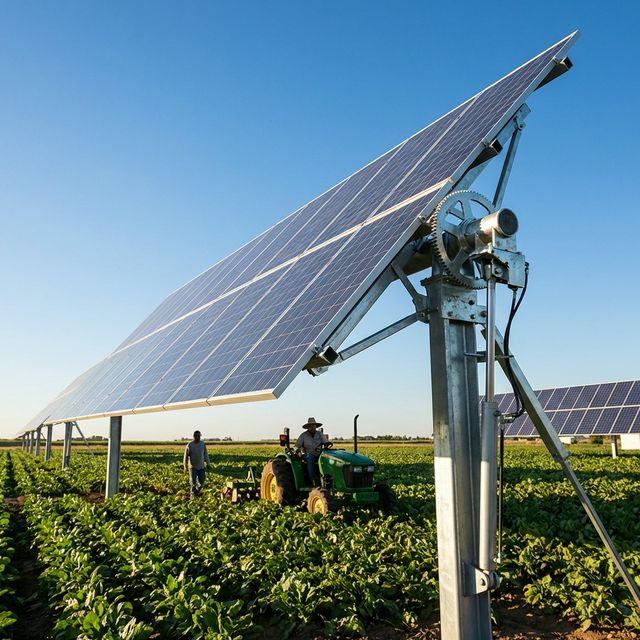
In agrivoltaics configurations, “tracked bifacial” systems produced an average of 24.6% more energy compared to “fixed bifacial” systems.
But here’s the catch.
The same study found that tracked bifacial systems incurred crop yield reduction costs, while fixed bifacial systems showed better balance in Land Equivalent Ratio (LER), reporting values up to 1.39.
The practical conclusion is straightforward.
Applying the same tracking standard to sites where “maximum generation” is the goal and sites where “maintaining agricultural production” is the goal leads to losses.
Agrivoltaics KPIs can’t end at PR alone — they must bundle crop yield, quality, work logistics, and operational risk together.
Viability Depends on ‘Added Complexity,’ Not ‘Generation Cost’
Agrivoltaics has already entered the cost-competitiveness discussion.
The Fraunhofer ISE Guideline places agrivoltaics LCOE in the 7-12 eurocents/kWh range and acknowledges competitiveness.
However, agrivoltaics tends to amplify “complexity costs” more than equipment costs.
When panel height, row spacing, shadow movement, ground management (weeds, moisture, dust), machinery clearance, and complaints (reflected light) all enter the design requirements, “small optimizations” like albedo improvement simultaneously affect CAPEX and OPEX.
Actionable Checklist: Albedo Is ‘Operational Design,’ Not ‘Material Selection’
First, measure your site’s baseline albedo across seasons and before/after rainfall to establish the range of variation.
Second, set your albedo improvement target as “rear-side irradiance increase rate” and calculate whether that value exceeds “cleaning, soiling, and crop management costs.”
Third, the choice between fixed and tracking systems must be evaluated using composite metrics like LER, not just generation output.
Fourth, white ground cover brings reflected-light complaints and workplace safety issues — conduct a reflection assessment covering nearby roads and residences during the design phase.
Fifth, never assume that “laying down ground cover is enough.” Depending on configuration, measured effects can disappear entirely — design pilot sections with this reality as a premise.
References
- Fraunhofer ISE, “Agrivoltaics: Opportunities for Agriculture and the Energy Transition – A Guideline for Germany (Third edition)” (2024.02) https://www.ise.fraunhofer.de/content/dam/ise/en/documents/publications/studies/APV-Guideline.pdf
- AgriVoltaics Conference Proceedings (TIB Open Publishing), “Influence of the Albedo on Agrivoltaics Electricity Production” (2024.05.23) https://www.tib-op.org/ojs/index.php/agripv/article/view/993
- Solar Energy (ScienceDirect), “Evaluating tracking bifacial solar PV based agrivoltaics system across the UK” (2024.12) https://www.sciencedirect.com/science/article/pii/S0038092X24007977
- NREL, “Albedo Data Sets for Bifacial PV Systems: Preprint” (2020.11) https://docs.nrel.gov/docs/fy21osti/75924.pdf
- NREL, “Illuminating Agrivoltaics at NREL” (2024.06) https://docs.nrel.gov/docs/fy24osti/91195.pdf