Agricultural Carbon Credits: 'Verification' Is What Makes Money
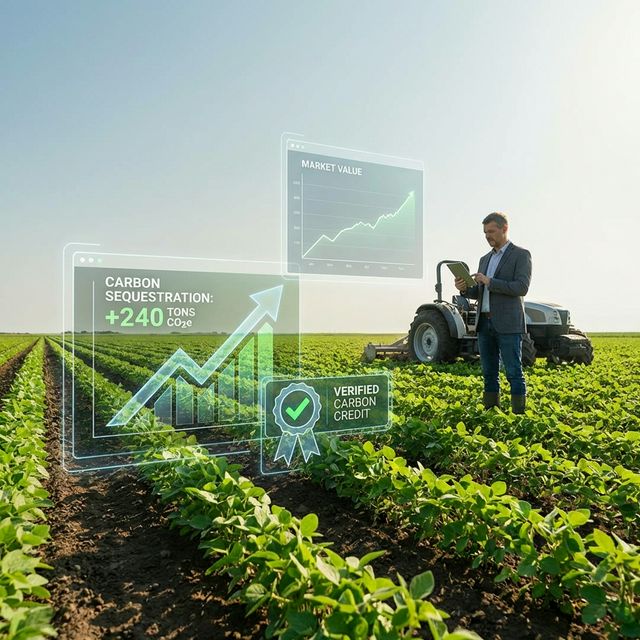
Agricultural carbon credits are growing fast — and getting scrutinized fast. What survives in this market isn’t farming. It’s evidence. Korea has already hit the ‘trade’ button. Now the question boils down to one thing. Who controls MRV.
In Korea, What Changed First Wasn’t Subsidies — It Was Trading Infrastructure
On September 26, 2025, the Ministry of Agriculture, Food and Rural Affairs announced that it had signed a business cooperation agreement with the Korea Chamber of Commerce and Industry and NH NongHyup Financial Group to connect agricultural carbon reduction results to “market trading.” The significance of this single line is enormous. The sentence changed from “you reduced, so here’s money” to “you proved your reduction, so let’s trade.”
The Ministry has been building reductions through policies like voluntary greenhouse gas reduction projects, low-carbon agricultural product certification, and low-carbon agriculture programs. Results were presented in numbers: by 2024, approximately 853,000 tons of CO₂ reduction had been achieved across 25,513 hectares. This figure sends the message “agriculture can reduce emissions.” Now it moves to the stage of “making the market buy those reductions.”
The key here is ‘measurement and verification systems.’ The Ministry diagnosed that the agricultural sector lacked scientific measurement and verification systems, as well as market trading foundations. The solution presented was also MRV. Using IPCC-registered methodologies for paddy water management, they piloted scientific compliance monitoring using GPS-based photo registration, satellites, and instruments, and after gaining reliability recognition through the ‘Carbon Reduction Certification Standard’ operated by the Korea Chamber of Commerce, market trading would commence. Policy ultimately creates “evidence channels.” It transforms the essence of credits from administrative processes into data pipelines.
MRV Is Not an Agricultural Problem — It’s an Accounting Problem
MRV stands for Measurement, Reporting, Verification. In the field, it means “measure it, record it, and have a third party verify it.” The market goes one step further. MRV is ultimately the interface into the world of corporate accounting and disclosure.
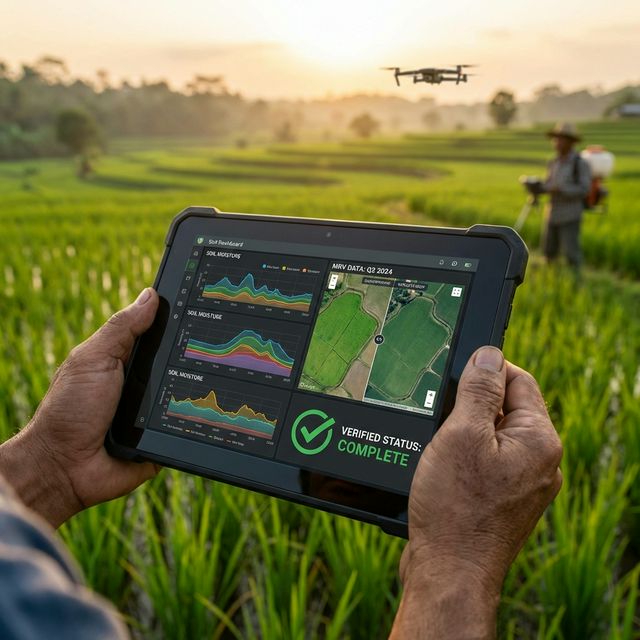
The clearest illustration of this trend is the GHG Protocol’s Land Sector and Removals (LSR) Standard. This standard was officially released on January 30, 2026, with an effective date of January 1, 2027. This standard attempts to create a “global benchmark” for how companies should incorporate emissions and CO₂ removals from agricultural land use into their GHG inventories. The emphasis is on rigor. The press release mentions data quality improvement, lifecycle accounting perspectives, and transparency of storage over time, stating that “safeguards” — worn like rubber gloves — are needed when including removals in inventories.
On the demand side, the grammar is changing too. VCMI released additional Claims Code guidance on November 28, 2023, publishing tools including a Monitoring, Reporting and Assurance (MRA) Framework enabling companies to make claims about high-quality credit usage. They even introduced tiered claims like Silver, Gold, and Platinum, steering the direction not toward “we used carbon credits” but toward “at what level of integrity did we use them.” The moment agricultural credits are sold to corporations, the buyer becomes the audit and risk team, not the marketing team. What matters then isn’t emotional appeal — it’s documentation and logs.
Soil and Paddy Carbon Is Not a Measurement Problem — It’s an Error Management Problem
There isn’t just one reason agricultural carbon credits get criticized. But the most frequently occurring issue in practice is simple. Proving that it “actually increased” is difficult. That difficulty stems not from technical shortcomings but from the structural nature of soil data.
A study published in the journal SOIL on January 8, 2025, confronts this problem head-on. The study states that precise quantification of SOC (soil organic carbon) is crucial for the credibility of soil carbon credit programs, and that detecting ‘real changes’ in SOC after management practice changes is inherently difficult. The core reason is clearly stated: soils are heterogeneous, and SOC changes are small relative to existing stocks, requiring robust sampling, processing, and quantification procedures for accurate measurement.
What makes this study practically alarming is its experimental design. The researchers conducted blind comparisons across 8 external laboratories, directly measuring “inter-laboratory variability.” The conclusion is simply summarized: variability is large, and deviations due to sample processing, bulk density estimation, and laboratory procedures can be larger than the average carbon accumulation rate from any agricultural management practice. In market terms, this translates to: no matter how impressive the model, if the sampling and labs are shaky, the credit can’t get a ‘quality rating.‘
The CCP Approval Flow Is Making Agricultural Credits Even More Demanding
Suppliers aren’t the only ones getting serious. The referees have changed too. When rules change, the game changes. Agricultural carbon credits are now in that zone.
ICVCM launched a global benchmark for ‘high-integrity carbon credits’ on March 29, 2023, announcing that the CCP and assessment framework would establish standards for high-quality, verifiable, and traceable credits. What matters here is the “label.” Labels are price signals. And the prerequisites for labels are disciplines like measurement/estimation methods, additionality, permanence, and disclosure levels.
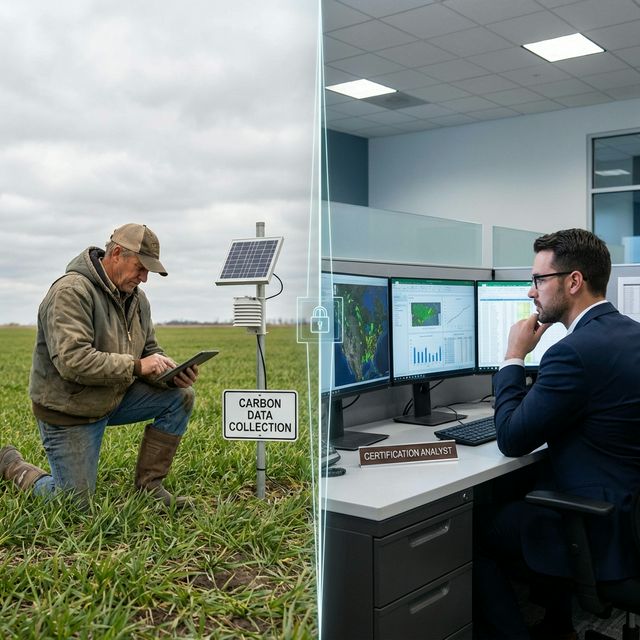
This trend entered agriculture on October 30, 2025. ICVCM announced CAR’s U.S. Soil Enrichment Protocol v1.1 and Verra’s VM0042 v2.2 as CCP-Approved methodologies under the ‘Sustainable Agriculture’ category. Conditions were attached. CAR’s side specified that a PIA including a minimum 40-year permanence commitment is required. Verra’s side was even more symbolic. It indicated that Digital Soil Mapping (DSM) for SOC measurement was not assessed in this decision, meaning only non-DSM methods are recognized. This signals that remote sensing and mapping are treated as “supplementary/optimization tools,” not “complete substitutes.”
So what does Verra’s VM0042 v2.2 require? This methodology has been Active since October 21, 2025, and calculates emission reductions and SOC-based removals through improved Agricultural Land Management (ALM). For the CCP label, the additional criteria specify that SOC must be measured using specific techniques: Dumas dry combustion, infrared spectroscopy (NIR/Vis-NIR/MIR), LIBS, INS, Walkley-Black/LOI. In market language, this means: “issuance based on satellite + model alone” is likely to be pushed out of the premium track, and “direct measurement + verification systems” become the new default.
Who Benefits?
When Korea’s pilot program transitions to market trading, benefits don’t automatically accrue from reduction itself. Benefits come from ‘verifiability.’ Conversely, losses come from ‘verification costs.’ So the game splits by stakeholder.
Farms gain opportunity. The direction of shifting from government-led incentives to private market-centered trading has been written into official documents, with plans to expand from paddy water management trading to more programs and participating companies. Simultaneously, burdens grow. Compliance monitoring bundled with GPS photos, satellites, and instruments — like paddy water management — must be passed for the output to become a “product.” Companies face higher bars. Accounting standards like the LSR Standard openly reveal their intent to raise agricultural impact measurement to “energy-use levels of rigor.” Intermediaries and platforms find the field opening. When role divisions emerge — certification standard operators, electronic carbon registries, credit issuance/trading support — data standardization and audit readiness in between become “products.”
Next actions also differ. Farms must design “what evidence to leave” before “what activities to do.” Companies must define “credits that won’t cause problems later” as their internal standard, not “cheap and plentiful credits.” Service providers must build pipelines where sampling, laboratories, logs, and satellite data connect into an audit-ready format — with pipeline integrity mattering more than model performance.
References
- Ministry of Agriculture, Food and Rural Affairs, “Pilot Operation of Market Trading for Agricultural Carbon Reduction Results — Expected to Increase Farm Income and Expand Corporate Carbon Reduction Contributions” (2025.09.26) https://www.mafra.go.kr/bbs/home/792/575213/artclView.do
- ICVCM, “Integrity Council approves first sustainable agriculture methodologies from CAR and Verra” (2025.10.30) https://icvcm.org/integrity-council-approves-first-sustainable-agriculture-methodologies-from-car-and-verra/
- ICVCM, “Integrity Council launches global benchmark for high-integrity carbon credits” (2023.03.29) https://icvcm.org/integrity-council-launches-global-benchmark-for-high-integrity-carbon-credits/
- Verra, “VM0042 Improved Agricultural Land Management, v2.2” (2025.10.21) https://verra.org/methodologies/vm0042-improved-agricultural-land-management-v2-2/
- GHG Protocol, “RELEASE: GHG Protocol Launches Its First-Ever Global Standard for Corporate Accounting of Land-Sector Emissions and Removals” (2026.01.30) https://ghgprotocol.org/blog/release-ghg-protocol-launches-its-first-ever-global-standard-corporate-accounting-land-sector
- VCMI, “Release of additional guidance to the VCMI Claims Code: Ambition, Assurance, and Accessibility” (2023.11.28) https://vcmintegrity.org/release-of-additional-guidance-to-the-vcmi-claims-code-ambition-assurance-and-accessibility/
- SOIL, “Large errors in soil carbon measurements attributed to inconsistent sample processing” (2025.01.08) https://soil.copernicus.org/articles/11/17/2025/
- ESA, “Sentinel-2 Facts and figures” (accessed: 2026.02.09) https://www.esa.int/Applications/ObservingtheEarth/Copernicus/Sentinel-2/Factsandfigures